Definitions [18]
A real function \[f\] is said to be a continuous function if it is continuous at every point in its domain.
\[ \boxed{\lim_{x \to c} f(x) = f(c)} \] for every \[c\] in the domain of \[f\].
Continuity at End Points
If \[f\] is defined on a closed interval \[[a, b]\]:
At the left endpoint \[a\], \[ \boxed{\lim_{x \to a^+} f(x) = f(a)} \]
At the right endpoint \[b\], \[ \boxed{\lim_{x \to b^-} f(x) = f(b)} \]
Only the appropriate one-sided limit is considered at an endpoint.
Removable Discontinuity:
If \[\lim_{x\to a^{-}}f\left(x\right)=\lim_{x\to a^{+}}f\left(x\right)\neq f\left(a\right),\] then f(x) is said to be removable discontinuous.
Non Removable Discontinuity:
If \[\lim_{x\to a^{+}}f\left(x\right)\neq\lim_{x\to a^{-}}f\left(x\right),\] then f(x) is said to be non-removable discontinuous.
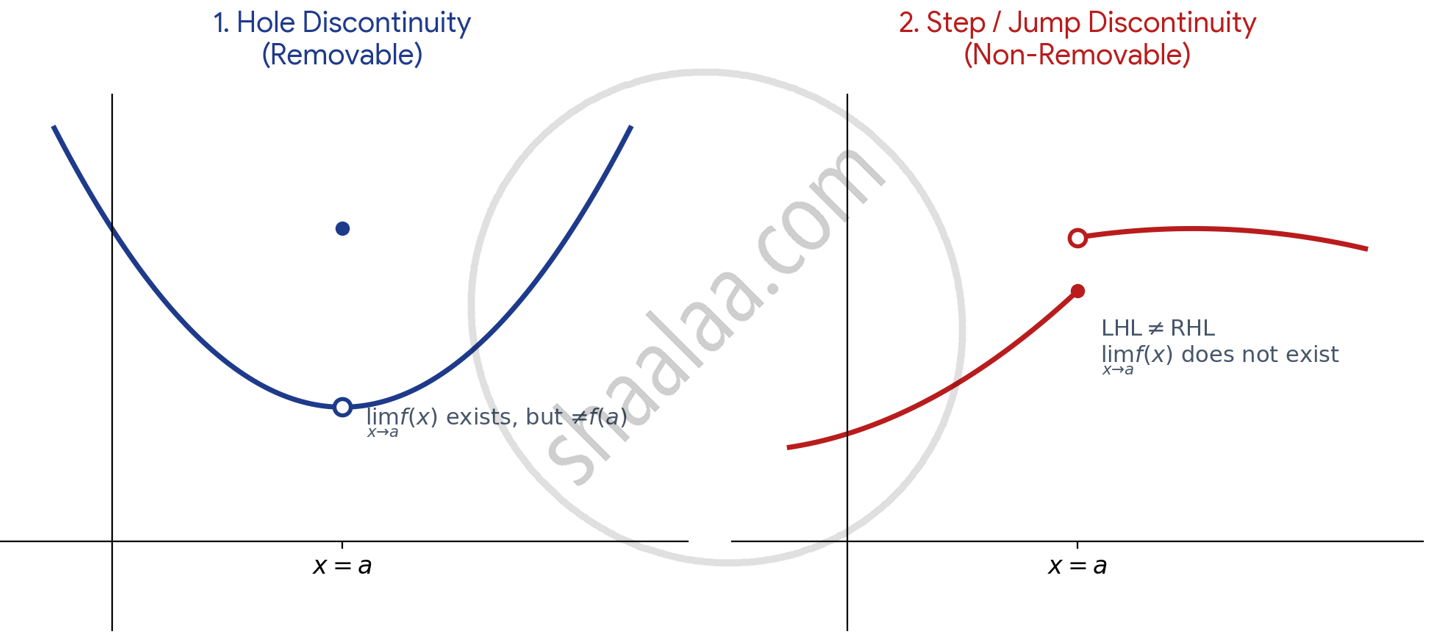
A function f(x) is said to be discontinuous at x = a if it is not continuous at x = a, i.e.
- \[\lim_{x\to a}f\left(a\right)\] does not exist.
- The left-hand limit and the right-hand limit are not equal.
- \[\lim_{x\to a}f\left(x\right)\neq f\left(a\right)\].
A real-valued function \[f\] is said to be continuous at \[x = c\] if
\[ \boxed{\lim_{x \to c} f(x) = f(c)} \]
In terms of one-sided limits,
\[ \boxed{\lim_{x \to c^-} f(x) = \lim_{x \to c^+} f(x) = f(c)} \]
Thus, for continuity at \[x = c\]:
- \[f(c)\] must be defined.
- Left-hand limit must exist.
- Right-hand limit must exist.
- Both limits must be equal to \[f(c)\]
If any of these conditions fails, \[f\] is discontinuous at \[x = c\].
The derivative of a real function f at a point c in its domain is defined as:
\[f'(c) = \lim_{h \to 0} \frac{f(c+h) - f(c)}{h}\]
A function is differentiable on an open interval (a,b) if it is differentiable at every point of (a,b).
For a closed interval [a,b][a,b]:
- at a, the right-hand derivative is considered
- at b, the left-hand derivative is considered
If \(u = g(x)\) and \(y = f(u)\), then \(y = f(g(x))\) is called a composite function. Here, \(g(x)\) is the inner function and \(f(u)\) is the outer function.
Let \[f\] be a real-valued function which is a composite of two functions \[u\] and \[v\]; i.e., \[f = v \circ u\]. Suppose \[t = u(x)\] and if both \[\frac{dt}{dx}\]and \[\frac{dv}{dt}\]exist, we have
\[ \boxed{\dfrac{df}{dx} = \dfrac{dv}{dt} \cdot \dfrac{dt}{dx}} \]
For example, if \[ f = w \circ v \circ u, \]
then the derivative is obtained by multiplying the successive derivatives.
\[ \boxed{\dfrac{df}{dx} = \dfrac{dw}{ds} \cdot \dfrac{ds}{dt} \cdot \dfrac{dt}{dx}} \]
where the intermediate variables represent the nested functions.
Implicit Function
Implicit differentiation means differentiating both sides of an equation with respect to x, while remembering that y depends on x. Therefore, whenever a term containing y is differentiated, the factor \[\frac{dy}{dx}\] appears by the chain rule.
Explicit Function
If a relation between x and y can be easily solved for y and written as \[ y = f(x), \] then y is given as an explicit function of x.
If a function reverses the action of another function, it is called its inverse function. For example, if \[y = \sin^{-1} x\], then \[x = \sin y\], which means the inverse function converts a trigonometric value back into an angle.
A function of the form \[y = b^x\], where b > 0 and \[b \neq 1\], is called an exponential function.
Exponential Growth
For positive values of xx, an exponential function grows much faster than a polynomial function when xx becomes sufficiently large.
For example,
\[ 10^x \] grows faster than \[ x^n \]
for any fixed positive integer n, when x is sufficiently large.
Derivatives of Exponential
\[ \boxed{\dfrac{d}{dx}(e^x) = e^x} \]
If b > 0, \[b \neq 1\], and a > 0, then
This means a logarithm tells the exponent to which the base must be raised to obtain the number.
Derivatives of Logarithmic Functions
\[ \boxed{\dfrac{d}{dx}(\log x) = \dfrac{1}{x}, \qquad x > 0} \]
If differentiation of a function is performed after taking logarithm on both sides, the process is called logarithmic differentiation.
This method is especially useful when:
- both the base and exponent contain variables;
- the function contains complicated products, quotients, or powers.
General Form:
\[ \boxed{\dfrac{dy}{dx} = y\left[\dfrac{v(x)}{u(x)}u'(x) + v'(x)\log[u(x)]\right]} \]
Since \[ y = [u(x)]^{v(x)}, \]
we may also write
\[ \boxed{\dfrac{dy}{dx} = [u(x)]^{v(x)}\left[\dfrac{v(x)}{u(x)}u'(x) + v'(x)\log[u(x)]\right]} \]
When x and y are expressed separately as functions of the same third variable t, i.e. \[ x = f(t), \qquad y = g(t), \] the equations are called parametric equations, and t is called the parameter.
The parameter may also be denoted by \[\theta, u,\] etc.
Important Condition
The formula \[ \frac{dy}{dx} = \frac{dy/dt}{dx/dt} \] is directly applicable when
\[ \boxed{\frac{dx}{dt} \neq 0.} \]
If \[ \frac{dx}{dt} = 0, \] the point must be examined separately. It may correspond to a point where the tangent is vertical.
Let \[ y = f(x) \]
Then the first derivative of y with respect to x is \[ \frac{dy}{dx} = f'(x) \]
If f'(x) is differentiable, we differentiate it again with respect to x. Thus,
\[ \boxed{\frac{d^2y}{dx^2} = \frac{d}{dx}\left(\frac{dy}{dx}\right)} \]
This is called the second order derivative of y with respect to x.
The second derivative of f(x) may also be written as
\[ \boxed{f''(x), \quad y'', \quad y_2, \quad D^2y} \]
Higher order derivatives are obtained by differentiating successively.
The set of all points where a function is continuous is called its domain of continuity.
Let f(x) be a real function and a be a point in its domain.
A function f is continuous at x = a iff all three conditions hold:
- f(a) is defined
- \[\lim_{x\to a}f(x)\] exists
- \[\lim_{x\to a}f(x)\] = f(a)
\[\lim_{x\to a^-}f(x)=\lim_{x\to a^+}f(x)=f(a)\]
For the open interval:
A function f is said to be continuous on an open interval (a, b) if it is continuous at every point in the interval.
For a closed interval:
A function f is said to be continuous on the closed interval [a,b] iff:
-
f is continuous at every point of (a,b)
-
f is right continuous at a
\[\lim_{x\to a^+}f(x)=f(a)\] -
f is left continuous at b
\[\lim_{x\to b^-}f(x)=f(b)\]
Formulae [10]
| Function | Derivative |
|---|---|
| [f(x)]ⁿ | n[f(x)]ⁿ⁻¹ · f′(x) |
| \[\sqrt{\mathrm{f}(x)}\] | \[\frac{1}{2\sqrt{\mathrm{f}(x)}}\cdot\mathrm{f}^{\prime}(x)\] |
| \[\frac{1}{\mathrm{f}(x)}\] | \[-\frac{1}{\left[\mathrm{f}(x)\right]^{2}}\cdot\mathrm{f}^{\prime}(x)\] |
| sin(f(x)) | cos(f(x)) · f′(x) |
| cos(f(x)) | −sin(f(x)) · f′(x) |
| tan(f(x)) | sec²(f(x)) · f′(x) |
| cot(f(x)) | −cosec²(f(x)) · f′(x) |
| sec(f(x)) | sec(f(x)) tan(f(x)) · f′(x) |
| cosec(f(x)) | −cosec(f(x)) cot(f(x)) · f′(x) |
| \[\mathbf{a}^{\mathbf{f}(x)}\] | \[a^{f(x)}\log a\cdot f^{\prime}(x)\] |
| \[\mathrm{e}^{\mathrm{f}(x)}\] | \[ e^{f(x)} f'(x) \] |
| log(f(x)) | \[\frac{1}{\mathrm{f}(x)}\cdot\mathrm{f}^{\prime}(x)\] |
| logₐ(f(x)) | \[\frac{1}{\mathrm{f}(x)\mathrm{loga}}\cdot\mathrm{f}^{\prime}(x)\] |
| Function | Derivative | Condition |
|---|---|---|
| sin⁻¹x | \[\frac{1}{\sqrt{1-x^{2}}}\] | |x| < 1 |
| sin⁻¹(f(x)) | \[\frac{1}{\sqrt{1-\{f\left(x\right)\}^{2}}}\frac{d}{dx}f\left(x\right)\] | |f(x)| < 1 |
| cos⁻¹x | \[-\frac{1}{\sqrt{1-x^{2}}}\] | x| < 1 |
| cos⁻¹(f(x)) | \[-\frac{1}{\sqrt{1-\left\{f\left(x\right)\right\}^{2}}}\frac{d}{dx}f(x)\] | |f(x)| < 1 |
| tan⁻¹x | \[\left(\frac{1}{1+x^{2}}\right)\] | x ∈ R |
| tan⁻¹(f(x)) | \[\frac{1}{1+\left\{f\left(x\right)\right\}^{2}}\frac{d}{dx}f(x)\] | f(x) ∈ R |
| cot⁻¹x | \[-\left(\frac{1}{1+x^{2}}\right)\] | x ∈ R |
| cot⁻¹(f(x)) | \[-\frac{1}{1+\{f(x)\}^{2}}\frac{d}{dx}f(x)\] | f(x) ∈ R |
| sec⁻¹x | \[\frac{1}{|x|\sqrt{x^{2}-1}}\] | |x| > 1 |
| sec⁻¹(f(x)) | \[\frac{1}{|f(x)|\sqrt{\{f(x)\}^{2}-1}}\frac{d}{dx}f(x)\] | |f(x)| > 1 |
| cosec⁻¹x | \[-\left(\frac{1}{|x|\sqrt{x^{2}-1}}\right)\] |
|x| > 1 |
| cosec⁻¹(f(x)) | \[-\frac{1}{|f(x)|\sqrt{\{f(x)\}^{2}-1}}\frac{d}{dx}f(x)\] | |f(x)| > 1 |
Quotient Rule:
If \[y=\frac{u}{v}\] then \[\frac{dy}{dx}=\frac{v\frac{du}{dx}-u\frac{dv}{dx}}{v^2}\]
Reciprocal Rule:
\[\frac{d}{dx}{\left(\frac{1}{f(x)}\right)}=-\frac{f^{\prime}(x)}{[f(x)]^2}\]
A function f is said to have a derivative at any point x if
\[f^{\prime}(x)=\lim_{h\to0}\frac{f(x+h)-f(x)}{h}\]
\[\frac{d}{dx}(y^n)=ny^{n-1}\frac{dy}{dx}\]
\[\frac{d}{dx}(xy)=x\frac{dy}{dx}+y\]
-
-
-
\[(a^x)^y=a^{xy}\]
- \[a^{-x}=\frac{1}{a^x}\]
\[\frac{d}{dx}(e^x)=e^x\]
\[\frac{d}{dx}(a^x)=a^x\log a,\quad a>0,a\neq1\]
\[\frac{d}{dx}(e^{f(x)})=e^{f(x)}\cdot f^{\prime}(x)\]
\[\frac{d}{dx}(a^{f(x)})=a^{f(x)}\log a\cdot f^{\prime}(x)\]
(i) Product of two functions
If y = uv then, \[\frac{dy}{dx}=u\frac{dv}{dx}+v\frac{du}{dx}\]
(i) Product of three functions
If y = uvw then \[\frac{dy}{dx}=uv\frac{dw}{dx}+uw\frac{dv}{dx}+vw\frac{du}{dx}\]
| Function / Rule | Derivative |
|---|---|
| log x | \[\frac{1}{x}\] |
| \[\log_{a}x\] | \[\frac{1}{x\log a}\] |
| \[\log_ax^n\] | \[n\log_ax\] |
| log u | \[\frac{1}{u}\cdot\frac{du}{dx}\] |
| \[log_a1\] | 0 |
| \[\log_aa\] | 1 |
| \[log_au\] | \[\frac{1}{u\log a}\cdot\frac{du}{dx}\] |
| \[\log_a(xy)\] | \[\log_ax+\log_ay\] |
| \[\log_a\left(\frac{x}{y}\right)\] | \[\log_ax-\log_ay\] |
| \[\log_ax\] | \[\frac{\log x}{\log a}\] |
| \[y=u^{v}\] | \[u^v\frac{d}{dx}(v\log u)\] |
First derivative:
If x = f(t), y = ϕ(t) then \[\frac{dy}{dx}=\frac{\frac{dy}{dt}}{\frac{dx}{dt}}\]
Second derivative:
\[\frac{d^2y}{dx^2}=\frac{\frac{d}{dt}\left(\frac{dy}{dx}\right)}{\frac{dx}{dt}}\]
For a 2×2 determinant:
\[F^{\prime}(x)=
\begin{vmatrix}
f_1^{\prime}(x) & f_2(x) \\
g_1^{\prime}(x) & g_2(x)
\end{vmatrix}+
\begin{vmatrix}
f_1(x) & f_2^{\prime}(x) \\
g_1(x) & g_2^{\prime}(x)
\end{vmatrix}\]
For a 3×3 determinant:
\[\mathrm{F^{\prime}}(x)=
\begin{vmatrix}
f_1^{\prime}(x) & f_2^{\prime}(x) & f_3^{\prime}(x) \\
g_1(x) & g_2(x) & g_3^{\prime}(x) \\
h_1(x) & h_2(x) & h_3(x)
\end{vmatrix}+
\begin{vmatrix}
f_1(x) & f_2(x) & f_3(x) \\
g_1^{\prime}(x) & g_2^{\prime}(x) & g_3^{\prime}(x) \\
h_1(x) & h_2(x) & h_3(x)
\end{vmatrix}+
\begin{vmatrix}
f_1(x) & f_2(x) & f_3(x) \\
g_1(x) & g_2(x) & g_3(x) \\
h_1^{\prime}(x) & h_2^{\prime}(x) & h_3^{\prime}(x)
\end{vmatrix}\]
Theorems and Laws [11]
If g is continuous at c, and f is continuous at g(c), then their composite function \[(f \circ g)\], defined as \[(f \circ g)(x) = f(g(x))\], is also continuous at c.
Prove that the greatest integer function defined by f(x) = [x], 0 < x < 3 is not differentiable at x = 1 and x = 2.
Any function will not be differentiable if the left-hand limit and the right-hand limit are not equal.
f(x) = [x], 0 < x < 3
(i) At x = 1
Left-side limit:
`lim_(h -> 0) ([1 - h] - [1])/-h`
= `lim_(h -> 0) (0 - 1)/-h`
= `lim_(h -> 0) 1/h`
= Infinite (∞)
Right-hand limit:
`lim_(h -> 0) ([1 + h] - [1])/h`
= `lim_(h -> 0) (1 - 1)/h`
= 0
Left-side limit and right-side limit are not equal.
Hence, f(x) is not differentiable at x = 1.
(ii) At x = 2
Left-side limit:
`lim_(h -> 0) (f(2 + h) - f(2))/h`
= `lim_(h -> 0) ([2 + h]-2)/h`
= `lim_(h -> 0) (2 -2)/h`
= 0
Right-hand limit:
`lim_(h -> 0) (f(2 - h) - f (2))/h`
= `lim_(h -> 0) ([2 - h] - [2])/-h`
= `lim_(h -> 0) (1 - 2)/-h`
= Infinite (∞)
Left-side limit and right-side limit are not equal.
Hence, f(x) is not differentiable at x = 2.
If y = `[(f(x), g(x), h(x)),(l, m,n),(a,b,c)]`, prove that `dy/dx = |(f'(x), g'(x), h'(x)),(l,m, n),(a,b,c)|`.
y = `|(f(x), g(x), h(x)),(l, m, n),(a, b, c)|`
`dy/dx= |(d/dx (f(x)), d/dx (g(x)), d/dx (h(x))), (l, m, n), (a, b, c)| + |(f(x), g(x), h(x)),(0, 0, 0),(a, b, c)| + |(f(x), g(x), h(x)),(l, m, n),(0, 0, 0)|`
`= |(f'(x), g'(x), h'(x)),(l, m, n),(a, b, c)|`
If (x – a)2 + (y – b)2 = c2, for some c > 0, prove that `[1+ (dy/dx)^2]^(3/2)/((d^2y)/dx^2)` is a constant independent of a and b.
Given, (x – a)2 + (y – b)2 = c2 ...(1)
On differentiating with respect to x,
`=> 2 (x - a) + 2(y - b) dy/dx = 0`
`=> (x - a) + (y - b) dy/dx = 0` ...(2)
Differentiating again with respect to x,
`1 + dy/dx * dy/dx + (y - b) (d^2 y)/dx^2` = 0
`1 + (dy/dx)^2 + (y - b) (d^2y)/dx^2` = 0
`=> (y - b) = - {(1 + (dy/dx)^2)/((d^2y)/dx^2)}` ...(3)
Putting the value of (y – b) in (2),
`(x - a) = {(1 + (dy/dx)^2)/((d^2y)/dx^2)}(dy/dx)` ...(4)
Putting the values of (x − a) and (y − b) from (3) and (4) in (1),
`{1 + (dy/dx)^2}^2/((d^2y)/dx^2)^2 * (dy/dx)^2 + {(1 + (dy/dx)^2)/((d^2y)/dx^2)} = c^2`
On multiplying by `((d^2y)/dx^2)^2`,
`[1 + (dy/dx)^2]^2 (dy/dx)^2 + [1 + (dy/dx)^2]^2 = c^2 ((d^2y)/dx)^2`
`=> [1 + (dy/dx)^2]^2 [(dy/dx)^2 + 1] = c^2 ((d^2y)/dx^2)^2`
`=> {1 + (dy/dx)^2}^3 = c^2 ((d^2y)/dx^2)^2`
On taking the square root,
`therefore {1 + (dy/dx)^2}^(3//2)/((d^2y)/dx^2)` = c ...(a constant independent of a and b.)
If a function \[f\] is differentiable at a point \[c\], then it is also continuous at that point.
Proof: Since \[f\] is differentiable at \[c\], we have
But for \[x \neq c\], we have
Therefore \[\lim_{x \to c} [f(x) - f(c)] = \lim_{x \to c} \left[ \frac{f(x) - f(c)}{x - c} \cdot (x - c) \right]\]
or \[\lim_{x \to c} [f(x)] - \lim_{x \to c} [f(c)] = \lim_{x \to c} \left[ \frac{f(x) - f(c)}{x - c} \right] \cdot \lim_{x \to c} [(x - c)]\]
\[= f'(c) \cdot 0 = 0\]
\[ \boxed{\lim_{x \to c} f(x) = f(c)} \]
Hence \[f\] is continuous at \[x = c\].
Converse is Not True
A continuous function need not be differentiable.
Consider \[ f(x) = |x|. \]
At \[x = 0\], \[ \text{LHD} = \lim_{h \to 0^-} \frac{|h| - 0}{h} = -1 \]
while \[ \text{RHD} = \lim_{h \to 0^+} \frac{|h| - 0}{h} = 1. \]
Since \[ -1 \neq 1, \]
\[ \boxed{|x|\ \text{is not differentiable at}\ x = 0} \]
although it is continuous there.
Prove that the function f given by f(x) = |x − 1|, x ∈ R is not differentiable at x = 1.
Any function will not be differentiable if the left-hand limit and the right-hand limit are not equal.
f(x) = |x − 1|, x ∈ R
f(x) = (x − 1), if x − 1 > 0
= −(x − 1), if x − 1 < 0
At x = 1
f(1) = 1 − 1 = 0
left-side limit:
`lim_(h -> 0^-) (f(1 - h) - f(1))/ -h`
= `lim_(h -> 0^-) (1 - (1 - h) - 0)/ (- h)`
= `lim_(h -> 0^-) (+ h)/(- h)`
= −1
Right-side limit:
= `lim_(h -> 0^+) (f(1 + h) - f(1))/h`
= `lim_(h -> 0^+) ((1 + h) - 1 - 0)/ h`
= `lim_(h -> 0^+) h/h`
= 1
Left-side limit and the right-side limit are not equal.
Hence, f(x) is not differentiable at x = 1.
If x = `e^(x/y)`, then prove that `dy/dx = (x - y)/(xlogx)`.
Given: x = `e^(x/y)`
Taking log on both the sides,
log x = `log e^(x/y)`
⇒ log x = `x/y log e`
⇒ log x = `x/y` ...[∵ log e = 1] ...(i)
Differentiating both sides w.r.t. x:
`d/dx log x = d/dx (x/y)`
⇒ `1/x = (y xx 1 - x xx dy/dx)/y^2`
⇒ `y^2 = xy - x^2 xx dy/dx`
⇒ `x^2 xx dy/dx = xy - y^2`
⇒ `dy/dx = (y(x - y))/x^2`
⇒ `dy/d = y/x xx ((x - y)/x)`
⇒ `dy/dx = 1/logx xx ((x - y)/x) ...[∵ log x = x/y "from equation (i)"]`
`dy/dx = (x - y)/(xlogx)`
Hence proved.
If cos y = x cos (a + y), with cos a ≠ ± 1, prove that `dy/dx = cos^2(a+y)/(sin a)`.
cos y = x cos (a + y)
∴ x = `(cos y)/(cos (a + y))`
On differentiating with respect to y,
`cos (a + y) d/dy cos y - cos y d/dy`
`therefore dx/dy = (cos (a + y))/(cos^2 (a + y))`
`= (- sin y cos (a + y) + cos y sin (a + y))/(cos^2 (a + y))`
`= (sin (a + y) cos y - cos (a + y) sin y)/(cos^2 (a + y))`
`= (sin (a + y - y))/(cos^2 (a + y))` ...[∵ sin (A − B) = sin A cos B − cos A sin B]
`= (sin a)/(cos^2 (a + y))`
`therefore dy/dx = (cos^2 (a + y))/(sin a)`
If y = 5 cos x – 3 sin x, prove that `(d^2y)/(dx^2) + y = 0`.
Given, y = 5 cos x – 3 sin x
Differentiating both sides with respect to x,
`dy/dx = 5 d/dx cos x - 3 d/dx sin x`
= 5 (−sin x) − 3 cos x
= −5 sin x − 3 cos x
Differentiating both sides again with respect to x,
`(d^2 y)/dx = - 5 d/dx sin x - 3 d/dx cos x`
= −5 cos x − 3 (−sin x)
= 3 sin x − 5 cos x
Hence, `(d^2 y)/dx^2 + y` = 0
(3 sin x − 5 cos x) + (5 cos x − 3 sin x) = 0 ...(On substituting the value of y)
If a function f(x) is
-
Continuous on [a,b]
-
Differentiable on (a,b)
-
f(a) = f(b)
Then there exists at least one c ∈ (a,b) such that f′(c) = 0
f a function f(x) is
-
Continuous on [a,b]
-
Differentiable on (a,b)
Then there exists at least one c ∈ (a,b) such that
\[f^{\prime}(c)=\frac{f(b)-f(a)}{b-a}\]
Key Points
- Continuity at \[x = c\]: \[ \boxed{\lim_{x \to c} f(x) = f(c)} \]
- Practical test: \[ \boxed{\text{LHL} = \text{RHL} = f(c)} \]
If this condition fails, the function is discontinuous at \[c\]. - A function is continuous if it is continuous at every point in its domain.
- Constant, identity and polynomial functions are continuous on their domains.
- \[\dfrac{1}{x}\] is continuous for \[x \neq 0\].
- For a piecewise function, check continuity particularly at the point where the rule changes.
- The greatest integer function \[[x]\] is discontinuous at every integer.
- If \[f\] and \[g\] are continuous at \[c\], then \[f+g\], \[f-g\], and \[fg\] are continuous at \[c\].
- \[\dfrac{f}{g}\] is continuous provided
\[ g(c) \neq 0. \] - If \[f\] is continuous, then \[\lambda f\] is continuous.
- If \[g\] is continuous and non-zero, then \[ \frac{1}{g} \] is continuous.
- Rational functions are continuous on their domains.
- sin x and cos x are continuous for all real \[x\].
- \[\tan x\] is continuous wherever \[\cos x \neq 0\].
- If \[g\] is continuous at \[c\] and \[f\] is continuous at \[g(c)\], then \[ f \circ g \] is continuous at \[c\].
-
Derivative exists only when the defining limit exists.
-
Differentiability at a point means the function has a valid derivative there.
-
Every differentiable function is continuous at that point.
-
Every continuous function is not necessarily differentiable.
-
A composite function has one function inside another function.
-
The chain rule formula is \[\frac{df}{dx} = \frac{dv}{dt} \cdot \frac{dt}{dx}\]
-
First differentiate the outer function, then multiply by the derivative of the inner function.
- If an equation contains both x and y and cannot be solved directly for y, it is called an implicit function.
- Implicit functions are generally written in the form:
f(x, y) = 0 - To differentiate an implicit function, differentiate both sides with respect to x, treating y as a function of x.
If y = f(x) is a differentiable function of x such that the inverse function x = f⁻¹(y) exists, then x is a differentiable function of y and
\[\frac{\mathrm{d}x}{\mathrm{d}y}=\frac{1}{\left(\frac{\mathrm{d}y}{\mathrm{d}x}\right)}\], where \[\frac{\mathrm{d}y}{\mathrm{d}x}\neq0\].
-
The derivative of an inverse function is usually found using implicit differentiation.
-
For \[\sin^{-1} x\] and \[\cos^{-1} x\], the denominator is \[\sqrt{1 - x^2}\].
-
For \[\tan^{-1} x\] and \[\cot^{-1} x\], the denominator is \[1 + x^2\].
-
For \[\sec^{-1} x\] and \[\csc^{-1} x\], the denominator involves \[|x|\sqrt{x^2 - 1}\].
-
Negative signs are especially important in \[\cos^{-1} x\], \[\cot^{-1} x\], and \[\csc^{-1} x\].
-
Domain restrictions must be checked before applying formulas.
-
Exponential function: \[y = b^x\], domain = all real numbers, range = positive real numbers.
-
Logarithmic function: \[y = \log_b x\], domain = positive real numbers, range = all real numbers.
-
Exponential and logarithmic functions are inverses of each other.
-
\[e^x\] and log x are especially important in calculus.
-
Main log laws: product, quotient, power, and change of base.
-
Standard derivatives: \[\frac{d}{dx}(e^x) = e^x\],
\[\frac{d}{dx}(\log x) = \frac{1}{x}\].
-
Use logarithmic differentiation when the function is a complex product, quotient, or variable exponent form.
-
Write y = function first, then take \[\ln\] on both sides.
-
Apply logarithmic rules before differentiating.
-
Differentiate \[\ln y\] carefully: \[\frac{d}{dx}(\ln y) = \frac{1}{y} \frac{dy}{dx}\].
-
Substitute the original value of y at the end.
-
Ensure the expression inside logarithm remains positive.
-
Parametric form means both x and y are written in terms of a third variable.
-
The third variable is called the parameter.
-
The main formula is:
\[\frac{dy}{dx} = \frac{\frac{dy}{dt}}{\frac{dx}{dt}}\] -
This formula is based on the chain rule.
-
Always check that \[\frac{dx}{dt} \neq 0\].
-
The final answer may remain in terms of the parameter unless the question asks for conversion.
-
Second derivative means differentiating the function twice with respect to the same variable.
-
It is defined only when the first derivative is differentiable.
-
Common notations are \[\frac{d^2y}{dx^2}\], f''(x), y'', \[D^2y\], and \[y_2\].
-
Higher order derivatives can be defined similarly.
A function fails to be continuous at x = a if any one of the following occurs:
-
f(a) is not defined
-
\[\lim_{x\to a}f(x)\] does not exist
-
Either LHL or RHL does not exist
-
Or LHL ≠ RHL
-
-
\[\lim_{x\to a}f(x)\] exists but \[\lim_{x\to a}f(x)\] ≠ f(a)
| Basis of Comparison | Removable Discontinuity | Non-Removable Discontinuity |
|---|---|---|
| Existence of \[\lim_{x\to a}f(x)\] | Exists | Does not exist |
| Left Hand Limit (LHL) | Exists | May not exist |
| Right Hand Limit (RHL) | Exists | May not exist |
| Relation between LHL & RHL | LHL = RHL | LHL ≠ RHL (or one/both do not exist) |
| Value of f(a) | Not defined OR f(a) ≠ \[\lim_{x\to a}f(x)\] | May or may not be defined |
| Continuity at ( x = a ) | Discontinuous | Discontinuous |
| Graphical interpretation | Hole/gap in the graph | Jump, break or vertical asymptote |
| Nature of discontinuity | Temporary | Permanent |
Important Questions [39]
- Find the Values of a and B, If the Function F Defined by F ( X ) = { X 2 + 3 X + a , X ⩽ 1 B X + 2 , X > 1 is Differentiable at X = 1.
- The function f(x) = x |x| is ______.
- If Sin Y = Xsin(A + Y) Prove that D Y D X = Sin 2 ( a + Y ) Sin a
- If f(x) = ,,{x2,ifx≥1x,ifx<1, then show that f is not differentiable at x = 1.
- If f(x) = {ax+b;0<x≤12x2-x;1<x<2 is a differentiable function in (0, 2), then find the values of a and b.
- If Y = ( Sec − 1 X ) 2 , X > 0 Show that X 2 ( X 2 − 1 ) D 2 Y D X 2 + ( 2 X 3 − X ) D Y D X − 2 = 0
- The function f(x) = x | x |, x ∈ R is differentiable ______.
- If f(x) = | cos x |, then πf(3π4) is ______.
- If F(X) = X + 1, Find D D X ( F O F ) ( X )
- If Xy - Yx = Ab, Find D Y D X .
- If x = e^(x/y), then prove that dy/dx = x − y/x log x.
- If X = E Cos 2 T and Y = E Sin 2 T , Prove that D Y D X = − Y Log X X Log Y .
- If Ey ( X +1) = 1, Then Show that D 2 Y D X 2 = ( D Y D X ) 2 .
- If y=log[x+x2+a2] show that (x2+a2)d2ydx2+xdydx=0
- if xx+xy+yx=ab, then find dy/dx.
- Differentiate the function with respect to x. (sin𝑥)^𝑥 + sin^−1√𝑥
- If `Xpowerm Ypowern = (X + Y)Power(M + N)`, Prove that `(Dsquare2y)/(Dxsquare2)= 0`
- If Y = Sin − 1 X + Cos − 1 X , Find D Y D X
- Differentiate the following function with respect to x: (log x)x+x(logx)
- Find D Y D X , If Y = Sin − 1 2 X + 1 1 + 4 X
- If ( Sin X ) Y = X + Y , Find D Y D X
- If y = (log x)x + xlog x, find "dy"/"dx".
- The derivative of x2x w.r.t. x is ______.
- If x = cos t (3 – 2 cos2 t) and y = sin t (3 – 2 sin2 t), find the value of dx/dy at t =4/π.
- Find the value of dy/dx at θ=pi/4 if x=ae^θ (sinθ-cosθ) and y=ae^θ(sinθ+cosθ)
- If x = a sin 2t (1 + cos 2t) and y = b cos 2t (1 – cos 2t) then find dy/dx
- If x = a sin 2t (1 + cos2t) and y = b cos 2t (1 – cos 2t), find the values of dydxat t = π4
- If x=α sin 2t (1 + cos 2t) and y=β cos 2t (1−cos 2t), show that dy/dx=β/αtan t
- If X = A (2θ – Sin 2θ) And Y = A (1 – Cos 2θ), Find `Dy/Dx` When `Theta = Pi/3`
- If x=a sin 2t(1+cos 2t) and y=b cos 2t(1−cos 2t), find dy/dx
- If y = ax+b, prove that y(d2ydx2)+(dydx)2 = 0.
- If y = tan x + sec x then prove that d2ydx2=cosx(1-sinx)2.
- If x = a sin t and y = a (cost+log tan(t/2)) ,find ((d^2y)/(dx^2))
- If e^y (x + 1) = 1, show that (d^2y)/(dx^2) = (dy/dx)^2.
- If x = a cos θ + b sin θ, y = a sin θ − b cos θ, show that y2 (d2y)/(dx2)-xdy/dx+y=0
- If x = a cos t and y = b sin t, then find d2ydx2.
- If x = A cos 4t + B sin 4t, then d2xdt2 is equal to ______.
- If y=2 cos(logx)+3 sin(logx), prove that x^2(d^2y)/(dx2)+x dy/dx+y=0
- If x cos(a+y)= cosy then prove that dy/dx=(cos^2(a+y)/sina) Hence show that sina(d^2y)/(dx^2)+sin2(a+y)(dy)/dx=0
Concepts [11]
- Continuous and Discontinuous Functions
- Algebra of Continuous Functions
- Concept of Differentiability
- Derivatives of Composite Functions
- Differentiation of Implicit Functions
- Derivative of Inverse Trigonometric Function
- Exponential and Logarithmic Functions
- Logarithmic Differentiation
- Derivatives of Functions in Parametric Forms
- Second Order Derivative
- Overview of Continuity and Differentiability
