Advertisements
Advertisements
प्रश्न
Write balanced chemical equations for action of ammonia on - formaldehyde
Advertisements
उत्तर
a. 6HCHO + 4NH3 → (CH2)6N4 + 6H2O
Formaldehyde Urotropine
APPEARS IN
संबंधित प्रश्न
Arrange the following in the increasing order of their reactivity towards nucleophilic addition reaction:
C6H5COCH3, CH3-CHO, CH3COCH3
Draw the structure of the semicarbazone of ethanal.
Arrange the following compound in increasing order of its reactivity in nucleophilic addition reactions.
Ethanal, Propanal, Propanone, Butanone.
Hint: Consider steric effect and electronic effect.
Arrange the following compound in increasing order of its reactivity in nucleophilic addition reactions.
Benzaldehyde, p-Tolualdehyde, p-Nitrobenzaldehyde, Acetophenone.
Hint: Consider steric effect and electronic effect.
What is meant by the following term? Give an example of the reaction in the following case.
Semicarbazone
What is meant by the following term? Give an example of the reaction in the following case.
Ketal
How are the following compounds prepared?
acetophenone from benzene
How are the following compounds prepared?
benzaldehyde from benzoyl chloride
Write balanced chemical equations for action of ammonia on - acetaldehyde
What is the action of the following reagents on ethanoic acid?
1) `LiAlH_4"/"H_3O^+`
2) `PCl_3 , "heat"`
3) `P_2O_5, "heat"`
Acetone, Acetaldehyde, Benzaldehyde, Acetophenone – reactivity towards addition of HCN.
Carboxylic acids contain carbonyl group but do not show the nucleophilic addition reaction like aldehydes or ketones. Why?
Acetaldehyde and acetone differ in their reaction with
Write the name of product formed, when acetone is treated with 2, 4-dinitrophenyl hydrazine.
Arrange the following in the increasing order of their property indicated:
Ethanal, Propanone, Propanal, Butanone (reactivity towards nucleophilic addition)
The increasing order of the following compounds towards HCN addition is:
| (i) |  |
| (ii) |  |
| (iii) |  |
| (iv) |  |
In the following reaction
\[\ce{Carbonyl compound + MeOH <=>[HCl] acetal}\]
Rate of the reaction is the highest for ______.
The product of following reaction is
\[\ce{CH3 - CH = CH - CH2 - CHO ->[i) LiAlH4][ii) H3O+]}\] ______?
Out of p-tolualdehyde and p-nitrobenzaldehyde, which one is more reactive towards nucleophilic addition reactions, why?
Draw structures of the given derivatives.
The ethylene ketal of hexan-3-one
Draw the structure of the following derivative.
The ethylene ketal of hexane-3-one
Draw structure of the following derivative.
Acetaldehydedimethylacetal
Draw structures of the following derivative.
The ethylene ketal of hexan-3-one
Draw structure of the following derivative:
Acetaldehydedimethylacetal
Draw structures of the following derivatives.
Acetaldehydedimethylacetal
Draw structure of the following derivative.
The ethylene ketal of hexan-3-one
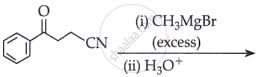
The major product of the following reaction is: