Advertisements
Advertisements
प्रश्न
The general solution of the differential equation \[\frac{dy}{dx} + y\] g' (x) = g (x) g' (x), where g (x) is a given function of x, is
विकल्प
g (x) + log {1 + y + g (x)} = C
g (x) + log {1 + y − g (x)} = C
g (x) − log {1 + y − g (x)} = C
none of these
Advertisements
उत्तर
g (x) + log {1 + y − g (x)} = C
We have,
\[\frac{dy}{dx} + y g'\left( x \right) = g\left( x \right)g'\left( x \right) . . . . . \left( 1 \right)\]
Clearly, it is a linear differential equation of the form
\[\frac{dy}{dx} + Py = Q\]
\[\text{ where }P = g'\left( x \right)\text{ and }Q = g\left( x \right)g'\left( x \right) . \]
\[ \therefore I . F . = e^{\int P\ dx} \]
\[ = e^{\int g'\left( x \right) dx} \]
\[ = e^{g\left( x \right)} \]
Multiplying both sides of (1) by I.F. , we get
\[ e^{g\left( x \right)} \left( \frac{dy}{dx} + yg'\left( x \right) \right) = e^{g\left( x \right)} g\left( x \right)g'\left( x \right)\]
\[ \Rightarrow e^{g\left( x \right)} \frac{dy}{dx} + e^{g\left( x \right)} y g'\left( x \right) = e^{g\left( x \right)} g\left( x \right)g'\left( x \right)\]
Integrating both sides with respect to x, we get
\[y e^{g\left( x \right)} = \int e^{g\left( x \right)} g\left( x \right)g'\left( x \right) dx + K\]
\[ \Rightarrow y e^{g\left( x \right)} = I + K\]
\[ \text{ where }I = \int e^{g\left( x \right)} g\left( x \right)g'\left( x \right) dx\]
Now,
\[I = \int e^{g\left( x \right)} g\left( x \right)g'\left( x \right) dx\]
\[\text{Putting }g\left( x \right) = t, \text{ we get }\]
\[g'\left( x \right) dx = dt\]
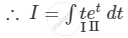
\[ = t\int e^t dt - \int\left[ \frac{d}{dx}\left( t \right)\int e^t dt \right]dt\]
\[ = t e^t - e^t \]
\[ = g\left( x \right) e^{g\left( x \right)} - e^{g\left( x \right)} \]
\[ \therefore y e^{g\left( x \right)} = g\left( x \right) e^{g\left( x \right)} - e^{g\left( x \right)} + K\]
\[ \Rightarrow y e^{g\left( x \right)} + e^{g\left( x \right)} - g\left( x \right) e^{g\left( x \right)} = K\]
\[ \Rightarrow y + 1 - g\left( x \right) = K e^{- g\left( x \right)} \]
Taking log on both sides, we get
\[\log\left\{ y + 1 - g\left( x \right) \right\} = - g\left( x \right) + \log K\]
\[ \Rightarrow g\left( x \right) + \log\left\{ 1 + y - g\left( x \right) \right\} = C ...........\left(\text{Where, }C = \log K \right)\]
APPEARS IN
संबंधित प्रश्न
Solve : 3ex tanydx + (1 +ex) sec2 ydy = 0
Also, find the particular solution when x = 0 and y = π.
Find the particular solution of differential equation:
`dy/dx=-(x+ycosx)/(1+sinx) " given that " y= 1 " when "x = 0`
Find the particular solution of the differential equation x (1 + y2) dx – y (1 + x2) dy = 0, given that y = 1 when x = 0.
Verify that the given function (explicit or implicit) is a solution of the corresponding differential equation:
y = ex + 1 : y″ – y′ = 0
Verify that the given function (explicit or implicit) is a solution of the corresponding differential equation:
y = Ax : xy′ = y (x ≠ 0)
Verify that the given function (explicit or implicit) is a solution of the corresponding differential equation:
y – cos y = x : (y sin y + cos y + x) y′ = y
Verify that the given function (explicit or implicit) is a solution of the corresponding differential equation:
x + y = tan–1y : y2 y′ + y2 + 1 = 0
Find a particular solution of the differential equation`(x + 1) dy/dx = 2e^(-y) - 1`, given that y = 0 when x = 0.
Find `(dy)/(dx)` at x = 1, y = `pi/4` if `sin^2 y + cos xy = K`
The general solution of the differential equation \[\frac{dy}{dx} + y \] cot x = cosec x, is
The solution of the differential equation \[\frac{dy}{dx} = 1 + x + y^2 + x y^2 , y\left( 0 \right) = 0\] is
Write the solution of the differential equation \[\frac{dy}{dx} = 2^{- y}\] .
Find the particular solution of the differential equation \[\frac{dy}{dx} = \frac{x\left( 2 \log x + 1 \right)}{\sin y + y \cos y}\] given that
cos (x + y) dy = dx
x2 dy + (x2 − xy + y2) dx = 0
\[y^2 + \left( x + \frac{1}{y} \right)\frac{dy}{dx} = 0\]
For the following differential equation, find the general solution:- `y log y dx − x dy = 0`
Solve the following differential equation:-
\[\frac{dy}{dx} - y = \cos x\]
Solve the following differential equation:-
\[x\frac{dy}{dx} + 2y = x^2 , x \neq 0\]
Solve the following differential equation:-
\[\frac{dy}{dx} + \frac{y}{x} = x^2\]
Find the differential equation of all non-horizontal lines in a plane.
Solution of the differential equation `"dx"/x + "dy"/y` = 0 is ______.
The general solution of the differential equation x(1 + y2)dx + y(1 + x2)dy = 0 is (1 + x2)(1 + y2) = k.
Find the general solution of `(x + 2y^3) "dy"/"dx"` = y
Solve the differential equation (1 + y2) tan–1xdx + 2y(1 + x2)dy = 0.
If y = e–x (Acosx + Bsinx), then y is a solution of ______.
Integrating factor of `(x"d"y)/("d"x) - y = x^4 - 3x` is ______.
The integrating factor of the differential equation `("d"y)/("d"x) + y = (1 + y)/x` is ______.
y = aemx+ be–mx satisfies which of the following differential equation?
The solution of `x ("d"y)/("d"x) + y` = ex is ______.
The general solution of `("d"y)/("d"x) = 2x"e"^(x^2 - y)` is ______.
Solution of the differential equation `("d"y)/("d"x) + y/x` = sec x is ______.
General solution of the differential equation of the type `("d"x)/("d"x) + "P"_1x = "Q"_1` is given by ______.
The solution of differential equation coty dx = xdy is ______.
The member of arbitrary constants in the particulars solution of a differential equation of third order as
Find the general solution of the differential equation `x (dy)/(dx) = y(logy - logx + 1)`.
