Advertisements
Advertisements
प्रश्न
The general solution of the differential equation \[\frac{dy}{dx} + y\] g' (x) = g (x) g' (x), where g (x) is a given function of x, is
पर्याय
g (x) + log {1 + y + g (x)} = C
g (x) + log {1 + y − g (x)} = C
g (x) − log {1 + y − g (x)} = C
none of these
Advertisements
उत्तर
g (x) + log {1 + y − g (x)} = C
We have,
\[\frac{dy}{dx} + y g'\left( x \right) = g\left( x \right)g'\left( x \right) . . . . . \left( 1 \right)\]
Clearly, it is a linear differential equation of the form
\[\frac{dy}{dx} + Py = Q\]
\[\text{ where }P = g'\left( x \right)\text{ and }Q = g\left( x \right)g'\left( x \right) . \]
\[ \therefore I . F . = e^{\int P\ dx} \]
\[ = e^{\int g'\left( x \right) dx} \]
\[ = e^{g\left( x \right)} \]
Multiplying both sides of (1) by I.F. , we get
\[ e^{g\left( x \right)} \left( \frac{dy}{dx} + yg'\left( x \right) \right) = e^{g\left( x \right)} g\left( x \right)g'\left( x \right)\]
\[ \Rightarrow e^{g\left( x \right)} \frac{dy}{dx} + e^{g\left( x \right)} y g'\left( x \right) = e^{g\left( x \right)} g\left( x \right)g'\left( x \right)\]
Integrating both sides with respect to x, we get
\[y e^{g\left( x \right)} = \int e^{g\left( x \right)} g\left( x \right)g'\left( x \right) dx + K\]
\[ \Rightarrow y e^{g\left( x \right)} = I + K\]
\[ \text{ where }I = \int e^{g\left( x \right)} g\left( x \right)g'\left( x \right) dx\]
Now,
\[I = \int e^{g\left( x \right)} g\left( x \right)g'\left( x \right) dx\]
\[\text{Putting }g\left( x \right) = t, \text{ we get }\]
\[g'\left( x \right) dx = dt\]
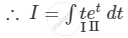
\[ = t\int e^t dt - \int\left[ \frac{d}{dx}\left( t \right)\int e^t dt \right]dt\]
\[ = t e^t - e^t \]
\[ = g\left( x \right) e^{g\left( x \right)} - e^{g\left( x \right)} \]
\[ \therefore y e^{g\left( x \right)} = g\left( x \right) e^{g\left( x \right)} - e^{g\left( x \right)} + K\]
\[ \Rightarrow y e^{g\left( x \right)} + e^{g\left( x \right)} - g\left( x \right) e^{g\left( x \right)} = K\]
\[ \Rightarrow y + 1 - g\left( x \right) = K e^{- g\left( x \right)} \]
Taking log on both sides, we get
\[\log\left\{ y + 1 - g\left( x \right) \right\} = - g\left( x \right) + \log K\]
\[ \Rightarrow g\left( x \right) + \log\left\{ 1 + y - g\left( x \right) \right\} = C ...........\left(\text{Where, }C = \log K \right)\]
APPEARS IN
संबंधित प्रश्न
If x = Φ(t) differentiable function of ‘ t ' then prove that `int f(x) dx=intf[phi(t)]phi'(t)dt`
Find the particular solution of the differential equation
(1 – y2) (1 + log x) dx + 2xy dy = 0, given that y = 0 when x = 1.
Find the particular solution of the differential equation dy/dx=1 + x + y + xy, given that y = 0 when x = 1.
If y = etan x+ (log x)tan x then find dy/dx
Solution of the differential equation \[\frac{dy}{dx} + \frac{y}{x}=\sin x\] is
The solution of the differential equation x dx + y dy = x2 y dy − y2 x dx, is
The general solution of the differential equation \[\frac{dy}{dx} = e^{x + y}\], is
`y sec^2 x + (y + 7) tan x(dy)/(dx)=0`
`(2ax+x^2)(dy)/(dx)=a^2+2ax`
\[\frac{dy}{dx} + y = 4x\]
\[x\frac{dy}{dx} + x \cos^2 \left( \frac{y}{x} \right) = y\]
For the following differential equation, find a particular solution satisfying the given condition:- \[\frac{dy}{dx} = y \tan x, y = 1\text{ when }x = 0\]
Solve the following differential equation:-
\[\frac{dy}{dx} - y = \cos x\]
Solve the following differential equation:-
\[x\frac{dy}{dx} + 2y = x^2 , x \neq 0\]
Solve the following differential equation:-
\[\frac{dy}{dx} + 2y = \sin x\]
Solve the following differential equation:-
\[x\frac{dy}{dx} + 2y = x^2 \log x\]
Find a particular solution of the following differential equation:- (x + y) dy + (x − y) dx = 0; y = 1 when x = 1
Find the equation of a curve passing through the point (0, 1). If the slope of the tangent to the curve at any point (x, y) is equal to the sum of the x-coordinate and the product of the x-coordinate and y-coordinate of that point.
Solve the differential equation: ` ("x" + 1) (d"y")/(d"x") = 2e^-"y" - 1; y(0) = 0.`
The solution of the differential equation `x "dt"/"dx" + 2y` = x2 is ______.
If y(x) is a solution of `((2 + sinx)/(1 + y))"dy"/"dx"` = – cosx and y (0) = 1, then find the value of `y(pi/2)`.
The solution of `("d"y)/("d"x) + y = "e"^-x`, y(0) = 0 is ______.
The solution of the differential equation `("d"y)/("d"x) + (1 + y^2)/(1 + x^2)` is ______.
y = aemx+ be–mx satisfies which of the following differential equation?
The general solution of the differential equation (ex + 1) ydy = (y + 1) exdx is ______.
The solution of the differential equation `("d"y)/("d"x) = "e"^(x - y) + x^2 "e"^-y` is ______.
The number of arbitrary constants in the general solution of a differential equation of order three is ______.
General solution of the differential equation of the type `("d"x)/("d"x) + "P"_1x = "Q"_1` is given by ______.
The solution of the differential equation `x(dy)/("d"x) + 2y = x^2` is ______.
General solution of `("d"y)/("d"x) + y` = sinx is ______.
The integrating factor of `("d"y)/("d"x) + y = (1 + y)/x` is ______.
Polio drops are delivered to 50 K children in a district. The rate at which polio drops are given is directly proportional to the number of children who have not been administered the drops. By the end of 2nd week half the children have been given the polio drops. How many will have been given the drops by the end of 3rd week can be estimated using the solution to the differential equation `"dy"/"dx" = "k"(50 - "y")` where x denotes the number of weeks and y the number of children who have been given the drops.
The value of c in the particular solution given that y(0) = 0 and k = 0.049 is ______.
Find the particular solution of the differential equation `x (dy)/(dx) - y = x^2.e^x`, given y(1) = 0.
Find the general solution of the differential equation `x (dy)/(dx) = y(logy - logx + 1)`.
Find the general solution of the differential equation:
`(dy)/(dx) = (3e^(2x) + 3e^(4x))/(e^x + e^-x)`
