Advertisements
Advertisements
प्रश्न
Suggest a way to determine the \[\ce{\Lambda^{\circ}_m}\] value of water.
Advertisements
उत्तर
Water is a weak electrolyte. Its \[\ce{\Lambda^{\circ}_m}\] value can be determined with the help of Kohlrausch’s law.
\[\ce{\Lambda^{\circ}_m(HCl) = \Lambda^{\circ}_m(H+) + \Lambda^{\circ}_m(Cl^-)}\] ...(i)
\[\ce{\Lambda^{\circ}_m(NaOH) = \Lambda^{\circ}_m(Na+) + \Lambda^{\circ}_m(OH^-)}\] ...(ii)
\[\ce{\Lambda^{\circ}_m(NaCl) = \Lambda^{\circ}_m(Na+) + \Lambda^{\circ}_m(Cl^-)}\] ...(iii)
Adding (i) and (ii) and subtracting (iii), we get,
\[\ce{\Lambda^{\circ}_m(H2O) = \Lambda^{\circ}_m(H+) + \Lambda^{\circ}_m(OH^-)}\]
= \[\ce{\Lambda^{\circ}_m(HCl) + \Lambda^{\circ}_m(NaOH) - \Lambda^{\circ}_m(NaCl)}\]
APPEARS IN
संबंधित प्रश्न
The conductivity of 0.20 M solution of KCl at 298 K is 0.025 S cm−1. Calculate its molar conductivity.
State Kohlrausch Law.
Define limiting molar conductivity.
Why does the conductivity of a solution decrease with dilution?
Define the following terms: Molar conductivity (⋀m)
10.0 grams of caustic soda when dissolved in 250 cm3 of water, the resultant gram molarity of solution is _______.
(A) 0.25 M
(B) 0.5 M
(C) 1.0 M
(D) 0.1 M
Write mathematical expression of molar conductivity of the given solution at infinite dilution.
Calculate the degree of dissociation (α) of acetic acid if its molar conductivity (Λm) is 39.05 S cm2 mol−1.
(Given \[\ce{\lambda^{\circ}_{(H^+)}}\] = 349.6 S cm2 mol−1 and \[\ce{\lambda^{\circ}_{(CH_3COO^-)}}\] = 40.95 S cm2 mol−1)
The S.I. unit of cell constant for conductivity cell is __________.
In the plot of molar conductivity (∧m) vs square root of concentration (c1/2) following curves are obtained for two electrolytes A and B : 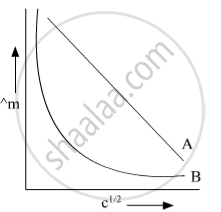
Answer the following:
(i) predict the nature of electrolytes A and B.
(ii) What happens on the extrapolation of ∧m to concentration approaching for electrolytes A and B?
\[\ce{\Lambda^0_m(NH4OH)}\] is equal to ______.
Solutions of two electrolytes ‘A’ and ‘B’ are diluted. The Λm of ‘B’ increases 1.5 times while that of A increases 25 times. Which of the two is a strong electrolyte? Justify your answer.
Why on dilution the m Λm of \[\ce{CH3COOH}\] increases very fast, while that of \[\ce{CH3COONa}\] increases gradually?
Match the items of Column I and Column II on the basis of data given below:
`E_("F"_2//"F"^-)^Θ` = 2.87 V, `"E"_(("Li"^(+))//("Li"^-))^Θ` = − 3.5V, `"E"_(("Au"^(3+))//("Au"))^Θ` = 1.4 V, `"E"_(("Br"_(2))//("Br"^-))^Θ` = 1.09 V
| Column I | Column II |
| (i) F2 | (a) metal is the strongest reducing agent |
| (ii) Li | (b) metal ion which is the weakest oxidising agent |
| (iii) Au3+ | (c) non metal which is the best oxidising agent |
| (iv) Br– | (d) unreactive metal |
| (v) Au | (e) anion that can be oxidised by Au3+ |
| (vi) Li+ | (f) anion which is the weakest reducing agent |
| (vii) F– | (g) metal ion which is an oxidising agent |
Assertion: `"E"_("Ag"^+ //"Ag")` increases with increase in concentration of Ag+ ions.
Reason: `"E"_("Ag"^+ //"Ag")` has a positive value.
The limiting molar conductivities Λ° for NaCl, KBr and KCl are 126, 152 and 150 S cm2 mol–1 respectively. The limiting molar conductivity Λ° for NaBr is ______.
The molar conductivity of 0.007 M acetic acid is 20 S cm2 mol−1. What is the dissociation constant of acetic acid? Choose the correct option.
\[\begin{array}{cc}
\end{array}\]\[\begin{bmatrix}
\ce{\Lambda^{\circ}_{H^+} = 350 S cm^2 mol^{-1}}\\
\ce{\Lambda^{\circ}_{CH_3COO^-} = 50 S cm^2 mol^{-1}}
\end{bmatrix}\]
The variation of molar conductivity with concentration of an electrolyte (X) m aqueous solution is shown in the given figure.

The electrolyte X is ______.
