Advertisements
Advertisements
प्रश्न
The conductivity of 0.001 mol L-1 solution of CH3COOH is 3.905× 10⁻⁵ S cm-1. Calculate its molar conductivity and degree of dissociation (α) Given λ°(H+)= 349.6 S cm2 mol-1 and λ°(CH3COO)= 40.9S cm2mol-1.
Advertisements
उत्तर
Given:
Conductivity (k) = 3.905 x 10⁻⁵ S cm-1
Concentration ofelectrolyte (c) = 0.001 mol L-1
`^^_m=k/cxx1000=39.05S cm^2mol^(-1)`
`^^_m^@=lambda_(CH_3COO^-)^@+lambda_(H+)^@`
= 40.9 + 349.6
= 390.5 S cm2 mol-1
Degree of dissociation = `39.05/390.5=0.1`
APPEARS IN
संबंधित प्रश्न
Define “Molar conductivity”.
The conductivity of sodium chloride at 298 K has been determined at different concentrations and the results are given below:
| Concentration/M | 0.001 | 0.010 | 0.020 | 0.050 | 0.100 |
| 102 × κ/S m−1 | 1.237 | 11.85 | 23.15 | 55.53 | 106.74 |
Calculate ∧m for all concentrations and draw a plot between ∧m and c1/2. Find the value of `Lambda_m^0`.
The conductivity of 0.02 M AgNO3 at 25°C is 2.428 × 10⁻³ Ω−1 cm−1. What is its molar conductivity?
The S.I. unit of cell constant for conductivity cell is __________.
In the plot of molar conductivity (∧m) vs square root of concentration (c1/2) following curves are obtained for two electrolytes A and B : 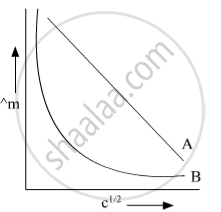
Answer the following:
(i) predict the nature of electrolytes A and B.
(ii) What happens on the extrapolation of ∧m to concentration approaching for electrolytes A and B?
In the plot of molar conductivity (∧m) vs square root of concentration (c1/2), following curves are obtained for two electrolytes A and B:
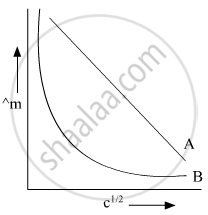
Answer the following:
(i) Predict the nature of electrolytes A and B.
(ii) What happens on extrapolation of ∧m to concentration approaching zero for electrolytes A and B?
Write the cell reaction of a lead storage battery when it is discharged. How does the density of the electrolyte change when the battery is discharged?
The limiting molar conductivities Λ° for NaCl, KBr and KCl are 126, 152 and 150 S cm2 mol–1 respectively. The limiting molar conductivity Λ° for NaBr is ______.
The solution of two electrolytes A and B are diluted. ^m of B increases 1.5 times while that of A increases 25 times. Which of the two is a strong electrolyte? Give a reason.
Discuss the variation of conductivity and molar conductivity with concentration.
