Advertisements
Advertisements
प्रश्न
State how has Agrobacterium tumifaciens been made a useful cloning vector to transfer DNA to plant cells.
Advertisements
उत्तर
Agrobacterium is a bacterium that infects plant tissues by transferring its plasmid T-DNA to the plant genome. This property of Agrobacterium is exploited in the biotechnology industry.
The desired gene that has to be to transferred to a particular plant is inserted in a plasmid T-DNA of Agrobacterium. Then, this engineered Agrobacterium is allowed to infect that particular plant, so that it can transfer the desired gene to the plant genome through its T-DNA. In this way, the desired changes are made in the plant.
APPEARS IN
संबंधित प्रश्न
What is ‘Ori’ ? State its importance during cloning of a vector.
Answer the following question.
β galactosidase enzyme is considered a better selectable marker. Justify the statement.
Answer the following question.
Expand ‘YAC’ and mention what it was used for.
A clone is a ______.
Which of the following is correctly matched?
Describe the role of CaCl2 in the preparation of competent cells?
For selection of recombinants, insertional inactivation of antibiotic marker has been superceded by insertional inactivation of a marker gene coding for a chromogenic substrate. Give reasons.
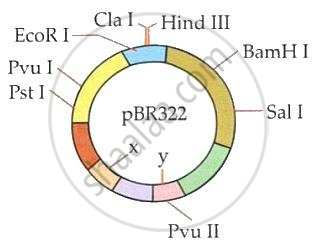
The following diagram showing restriction sites in E. coli cloning vector pBR322. Find the role of ‘X’ and ‘Y’ genes:
Which of the following describes the function of a selectable marker in a cloning vector?
Which vector derived from \(\textit{Agrobacterium tumefaciens}\) is utilized for delivering foreign genes into plants?
