Advertisements
Advertisements
प्रश्न
Answer the following question.
β galactosidase enzyme is considered a better selectable marker. Justify the statement.
Advertisements
उत्तर
The selective marker is used in the selection of recombinants on the basis of the ability to produce colour in the presence of a chromogenic substrate. β-galactosidase is an enzyme that converts galactose into lactose. In this, a recombinant DNA is inserted within the coding sequence of enzyme, β-galactosidase, which results in inactivation of an enzyme referred to as "insertional inactivation".
The coding sequence for the enzyme β-galactosidase is preferred over antibiotic resistance genes because recombinants can be easily visualized.
APPEARS IN
संबंधित प्रश्न
Name the selectable markers in the cloning vector pBR322. Mention the role they play.
Draw a schematic sketch of pBR 322 plasmid and label the following in it:
(a) Any two restriction sites.
(b) Ori and rop genes.
(c) An antibiotic resistant gene.
How does the β-galactosidase coding sequence act as a selectable marker? Why is it a preferred selectable marker to antibiotic resistance genes? Explain.
The genetic material of virus includes:
Which of the following is not a genetic vector?
A plasmid without a selectable marker was chosen as vector for cloning a gene. How does this affect the experiment?
Describe the role of CaCl2 in the preparation of competent cells?
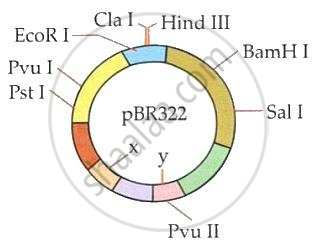
The following diagram showing restriction sites in E. coli cloning vector pBR322. Find the role of ‘X’ and ‘Y’ genes:
What is the primary role of a cloning site in a vector?
In blue–white screening, what do the white colonies indicate?
