Advertisements
Advertisements
प्रश्न
Show how will you synthesize pentan-1-ol using a suitable alkyl halide.
Advertisements
उत्तर
Hydrolysis of 1-bromopentane by aqueous NaOH gives pentan-1-ol.
\[\ce{\underset{1-bromopentane}{CH3 - CH2 - CH2 - CH2 - CH2 - Br} + NaOH ->[\Delta][S_N2 Hydrolysis ] \underset{pentan-1-ol}{CH3CH2CH2CH2 - CH2 - OH} + NaBr}\]
APPEARS IN
संबंधित प्रश्न
Write the mechanism of the following reaction :

Write the mechanism of the following reaction :

Ortho and para nitrophenols are more acidic than phenol. Draw the resonance structures of the corresponding phenoxide ions.
Name the reagent used in the following reaction:
Oxidation of a primary alcohol to aldehyde.
Write the mechanism (using curved arrow notation) of the following reaction :

In the reduction \[\ce{R - CHO + H2 -> RCH2OH}\] the catalyst used is:
Dehydration of 2-butanol yields:
Which of the following is not true in case of reaction with heated copper at 300°C?
Which one of the following on oxidation gives a ketone?
Primary and secondary alcohols on the action of reduced copper give:
Identify the secondary alcohols from the following set:
- \[\ce{CH3CH2CH(OH)CH3}\]
- \[\ce{(C2H5)3COH}\]
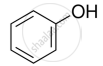

Mark the correct increasing order of reactivity of the following compounds with HBr/HCl.
| (a) | 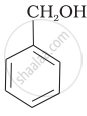 |
| (b) |  |
| (c) | 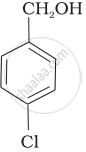 |
Suggest a reagent for the following conversion.
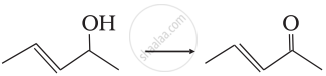
In Kolbe’s reaction, instead of phenol, phenoxide ion is treated with carbon dioxide. Why?
What happens when (CH3)3 C – OH is heated with Cu/573 K?
Write the chemical equation in support of your answer.
Write the mechanism of acid dehydration of ethanol to yield ethene.
Write the mechanism of acid dehydration of ethanol to yield ethene.
Write the mechanism of acid-catalysed dehydration of ethanol to yield ethene.
Write the mechanism of acid dehydration of ethanol to yield ethene.
