Advertisements
Advertisements
प्रश्न
Ethers can be prepared by Williamson synthesis in which an alkyl halide is reacted with sodium alkoxide. Di-tert-butyl ether can’t be prepared by this method. Explain.
Advertisements
उत्तर
In tert-butyl halides, elimination is favoured over substitution, so alkene is the only reaction product and ether is not formed.
\[\begin{array}{cc}
\phantom{....}\ce{CH3}\phantom{.........}\ce{CH3}\phantom{.......................................}\ce{CH3}\phantom{}\\
\phantom{.}|\phantom{.............}|\phantom{..........................................}|\phantom{}\\
\ce{CH3-C-Br + \overset{+}{N}a\overset{-}{O}C-CH3 -> CH3-C=CH2 + NaBr + CH3-C-OH}\\
\phantom{.}|\phantom{.............}|\phantom{..................}|\phantom{........................}|\phantom{}\\
\phantom{}\ce{\underset{(tert-butyl bromide)}{CH3}}\phantom{....}\ce{CH3}\phantom{..........}\ce{\underset{(2-methylprop-1-ene)}{CH3}}\phantom{..............}\ce{CH3}\phantom{...}
\end{array}\]
APPEARS IN
संबंधित प्रश्न
Give reasons for the following:
o-nitrophenol is more acidic than o-methoxyphenol.
Write the mechanism of the following reaction:

Write the mechanism of the following reaction :

Write the mechanism of the following reaction :

Ortho and para nitrophenols are more acidic than phenol. Draw the resonance structures of the corresponding phenoxide ions.
Give the equation of the following reaction:
Treating phenol with chloroform in the presence of aqueous NaOH.
Name the reagent used in the following reaction:
Oxidation of a primary alcohol to carboxylic acid.
Name the reagent used in the following reaction:
Oxidation of a primary alcohol to aldehyde.
When 3-methylbutan-2-ol is treated with HBr, the following reaction takes place:
\[\begin{array}{cc}
\phantom{...................................}\ce{Br}\\
\phantom{..................................}|\\
\ce{CH3 - CH - CH - CH3 ->[HBr] CH3 - C - CH2 - CH3}\\
|\phantom{.........}|\phantom{...................................}|\phantom{...........}\\
\ce{CH3}\phantom{...}\ce{OH}\phantom{...............................}\ce{CH3}\phantom{.......}\\
\end{array}\]
Give a mechanism for this reaction.
(Hint: The secondary carbocation formed in step II rearranges to a more
stable tertiary carbocation by a hydride ion shift from 3rd carbon atom.)
Which of the following is not true in case of reaction with heated copper at 300°C?
Mark the correct increasing order of reactivity of the following compounds with HBr/HCl.
| (a) | 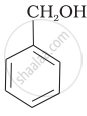 |
| (b) |  |
| (c) | 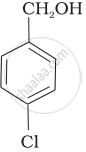 |
Suggest a reagent for the following conversion.
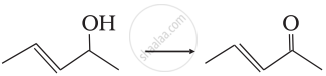
Alcohols react with active metals e.g. Na, K etc. to give corresponding alkoxides. Write down the decreasing order of reactivity of sodium metal towards primary, secondary and tertiary alcohols.
Why is the C – O – H bond angle in alcohols slightly less than the tetrahedral angle whereas the C – O – C bond angle in ether is slightly greater?
Assertion: Bond angle in ethers is slightly less than the tetrahedral angle.
Reason: There is a repulsion between the two bulky (–R) groups.
The correct geometry around oxygen in CH3OCH3 is
Which of the following alcohols will not undergo oxidation?
Write the mechanism of acid dehydration of ethanol to yield ethene.
Write the mechanism of acid dehydration of ethanol to yield ethene.
Write the mechanism of acid dehydration of ethanol to yield ethene.
