Advertisements
Advertisements
प्रश्न
Resorcinol on distillation with zinc dust gives _________.
विकल्प
Cyclohexane
Benzene
Toluene
Benzene-1, 3-diol
Advertisements
उत्तर
Resorcinol on distillation with zinc dust gives benzene.
Explanation:
Distillation of phenol with zinc dust gives benzene.
\[\ce{\underset{Phenol}{C6H5 - OH} + Zn ->[distillation] \underset{Benzene}{C6H6} + ZnO}\]
APPEARS IN
संबंधित प्रश्न
What is metamerism?
Name the following compound according to the IUPAC system.

Name the following compound according to the IUPAC system.
\[\begin{array}{cc}
\ce{CH3 - C = C - CH2OH}\\
|\phantom{......}|\phantom{.....}\\
\ce{CH3}\phantom{.}\ce{Br}\phantom{....}\\
\end{array}\]
Write the IUPAC name of the following compound:
\[\begin{array}{cc}
\ce{HO - CH2 - CH - CH2 - OH}\\
|\phantom{...}\\
\ce{OH}\phantom{.}\\
\end{array}\]
Write the IUPAC name of the following compound:
\[\begin{array}{cc}
\ce{CH3 - O - CH2 - CH - CH3}\\
\phantom{................}|\\
\phantom{....................}\ce{CH3}
\end{array}\]
Ethylidene dichloride when boiled with aqueous solution of NaOH yields _______.
(A) formaldehyde
(B) acetaldehyde
(C) acetone
(D) ethyl methyl ketone
Write the structure and IUPAC name of 'methyl-n-propyl ether'.
How is phenol converted into the following?
benzoquinone
How is phenol converted into the following?
picric acid
Write IUPAC name of the following compound (CH3)2 N − CH2CH3
Write the IUPAC name of the following compound:
How do you convert the Ethanal to Propanone
Write IUPAC names of the following

Glycerol is ____________.
One of the following is not a dihydroxy derivative of benzene.
Ethyl alcohol is industrially prepared from ethylene by:
n-Propyl alcohol and isopropyl alcohol can be chemically distinguished by which reagent?
The IUPAC name of the ether CH2 = CH–CH2OCH3 is:
The product of acid catalysed hydration of 2-phenylpropene is:
Give IUPAC name of the compound given below.
\[\begin{array}{cc}
\phantom{}\ce{CH3 - CH - CH2 - CH2 - CH - CH3}\phantom{.}\\
\phantom{.........}|\phantom{...................}|\phantom{...........}\\
\phantom{..}\ce{Cl}\phantom{.................}\ce{OH}\phantom{..}
\end{array}\]
Which of the following compounds will react with sodium hydroxide solution in water?
What happens when benzene diazonium chloride is heated with water?
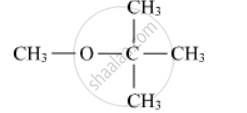
Match the structures of the compounds given in Column I with the name of the compounds given in Column II.
| Column I | Column II | |
| (i) |  |
(a) Hydroquinone |
| (ii) |  |
(b) Phenetole |
| (iii) | 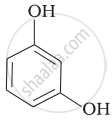 |
(c) Catechol |
| (iv) |  |
(d) o-Cresol |
| (v) |  |
(e) guinone |
| (vi) | 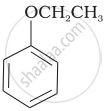 |
(f) Resorcinol |
| (g) Anisole |
Assertion: Addition reaction of water to but-1-ene in acidic medium yields butan-1-ol.
Reason: Addition of water in acidic medium proceeds through the formation of primary carbocation.
Write IUPAC name of the following compound:
\[\begin{array}{cc}
\phantom{................}\ce{CH3}\\
\phantom{.............}|\\
\ce{CH3 - CH - CH - C - CH3}\\
|\phantom{......}|\phantom{......}|\\
\phantom{...}\ce{CH3}\phantom{..}\ce{OH}\phantom{...}\ce{CH3}
\end{array}\]
Write structural formulae for:
Salicylic acid
Write IUPAC name of the following compound:
\[\begin{array}{cc}
\phantom{................}\ce{CH3}\\
\phantom{.............}|\\
\ce{CH3 - CH - CH - C - CH3}\\
|\phantom{......}|\phantom{......}|\\
\phantom{...}\ce{CH3}\phantom{...}\ce{OH}\phantom{...}\ce{CH3}
\end{array}\]
