Advertisements
Advertisements
प्रश्न
Prove that the straight lines (a + b) x + (a − b ) y = 2ab, (a − b) x + (a + b) y = 2ab and x + y = 0 form an isosceles triangle whose vertical angle is 2 tan−1 \[\left( \frac{a}{b} \right)\].
Advertisements
उत्तर
The given lines are
(a + b) x + (a − b ) y = 2ab ... (1)
(a − b) x + (a + b) y = 2ab ... (2)
x + y = 0 ... (3)
Let m1, m2 and m3 be the slopes of the lines (1), (2) and (3), respectively.
Now,
Slope of the first line = m1 = \[- \left( \frac{a + b}{a - b} \right)\]
Slope of the second line = m2 = \[- \left( \frac{a - b}{a + b} \right)\]
Slope of the third line = m3 = \[- 1\]
Let \[\theta_1\] be the angle between lines (1) and (2), \[\theta_2\] be the angle between lines (2) and (3) and \[\theta_3\] be the angle between lines (1) and (3).
\[\therefore \tan \theta_1 = \left| \frac{m_1 - m_2}{1 + m_1 m_2} \right|\]
\[ = \left| \frac{- \left( \frac{a + b}{a - b} \right) + \frac{a - b}{a + b}}{1 + \frac{a + b}{a - b} \times \frac{a - b}{a + b}} \right|\]
\[ \Rightarrow \tan \theta_1 = \left| \frac{2ab}{a^2 - b^2} \right|\]
\[ \Rightarrow \theta_1 = \tan^{- 1} \left| \frac{2ab}{a^2 - b^2} \right|\]
\[ = 2 \tan^{- 1} \left( \frac{a}{b} \right)\]
\[\therefore \tan \theta_2 = \left| \frac{m_2 - m_3}{1 + m_2 m_3} \right|\]
\[ = \left| \frac{- \left( \frac{a - b}{a + b} \right) + 1}{1 + \frac{a - b}{a + b}} \right|\]
\[ \Rightarrow \tan \theta_2 = \left| \frac{b}{a} \right|\]
\[ \Rightarrow \theta_2 = \tan^{- 1} \left( \frac{b}{a} \right)\]
\[\therefore \tan \theta_3 = \left| \frac{m_1 - m_3}{1 + m_1 m_3} \right|\]
\[ = \left| \frac{- \left( \frac{a + b}{a - b} \right) + 1}{1 + \frac{a + b}{a - b}} \right|\]
\[ \Rightarrow \tan \theta_3 = \left| \frac{b}{a} \right|\]
\[ \Rightarrow \theta_3 = \tan^{- 1} \left( \frac{b}{a} \right)\]
Here,
\[\theta_2 = \theta_3 \text { and } \theta = 2 \tan^{- 1} \left( \frac{a}{b} \right)\]
Hence, the given lines form an isosceles triangle whose vertical angle is \[2 \tan^{- 1} \left( \frac{a}{b} \right)\].
APPEARS IN
संबंधित प्रश्न
Draw a quadrilateral in the Cartesian plane, whose vertices are (–4, 5), (0, 7), (5, –5) and (–4, –2). Also, find its area.
Find the distance between P (x1, y1) and Q (x2, y2) when :
- PQ is parallel to the y-axis,
- PQ is parallel to the x-axis
Find the slope of a line, which passes through the origin, and the mid-point of the line segment joining the points P (0, –4) and B (8, 0).
Find the angle between the x-axis and the line joining the points (3, –1) and (4, –2).
Find the equation of the lines through the point (3, 2) which make an angle of 45° with the line x –2y = 3.
Find the slope of the lines which make the following angle with the positive direction of x-axis:
\[\frac{2\pi}{3}\]
What can be said regarding a line if its slope is negative?
Show that the line joining (2, −5) and (−2, 5) is perpendicular to the line joining (6, 3) and (1, 1).
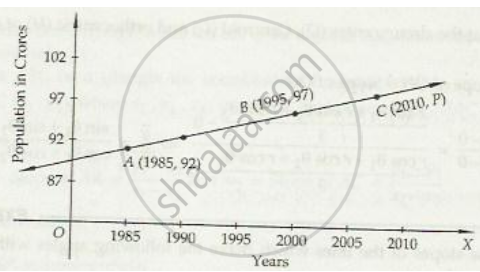
Consider the following population and year graph:
Find the slope of the line AB and using it, find what will be the population in the year 2010.
A quadrilateral has vertices (4, 1), (1, 7), (−6, 0) and (−1, −9). Show that the mid-points of the sides of this quadrilateral form a parallelogram.
Find the equation of a straight line with slope − 1/3 and y-intercept − 4.
Find the equation of the strainght line intersecting y-axis at a distance of 2 units above the origin and making an angle of 30° with the positive direction of the x-axis.
If the image of the point (2, 1) with respect to a line mirror is (5, 2), find the equation of the mirror.
Find the image of the point (3, 8) with respect to the line x + 3y = 7 assuming the line to be a plane mirror.
Find the angles between the following pair of straight lines:
3x + 4y − 7 = 0 and 4x − 3y + 5 = 0
Find the acute angle between the lines 2x − y + 3 = 0 and x + y + 2 = 0.
Find the tangent of the angle between the lines which have intercepts 3, 4 and 1, 8 on the axes respectively.
If two opposite vertices of a square are (1, 2) and (5, 8), find the coordinates of its other two vertices and the equations of its sides.
The angle between the lines 2x − y + 3 = 0 and x + 2y + 3 = 0 is
The coordinates of the foot of the perpendicular from the point (2, 3) on the line x + y − 11 = 0 are
If x + y = k is normal to y2 = 12x, then k is ______.
The line passing through (– 2, 0) and (1, 3) makes an angle of ______ with X-axis.
If the line joining two points A(2, 0) and B(3, 1) is rotated about A in anticlock wise direction through an angle of 15°. Find the equation of the line in new position.
If the slope of a line passing through the point A(3, 2) is `3/4`, then find points on the line which are 5 units away from the point A.
A ray of light coming from the point (1, 2) is reflected at a point A on the x-axis and then passes through the point (5, 3). Find the coordinates of the point A.
The two lines ax + by = c and a′x + b′y = c′ are perpendicular if ______.
The intercept cut off by a line from y-axis is twice than that from x-axis, and the line passes through the point (1, 2). The equation of the line is ______.
Show that the tangent of an angle between the lines `x/a + y/b` = 1 and `x/a - y/b` = 1 is `(2ab)/(a^2 - b^2)`
Find the equation of a straight line on which length of perpendicular from the origin is four units and the line makes an angle of 120° with the positive direction of x-axis.
Slope of a line which cuts off intercepts of equal lengths on the axes is ______.
Equation of the line passing through (1, 2) and parallel to the line y = 3x – 1 is ______.
The point (4, 1) undergoes the following two successive transformations:
(i) Reflection about the line y = x
(ii) Translation through a distance 2 units along the positive x-axis Then the final coordinates of the point are ______.
Equations of the lines through the point (3, 2) and making an angle of 45° with the line x – 2y = 3 are ______.
The line `x/a + y/b` = 1 moves in such a way that `1/a^2 + 1/b^2 = 1/c^2`, where c is a constant. The locus of the foot of the perpendicular from the origin on the given line is x2 + y2 = c2.
The equation of the line through the intersection of the lines 2x – 3y = 0 and 4x – 5y = 2 and
| Column C1 | Column C2 |
| (a) Through the point (2, 1) is | (i) 2x – y = 4 |
| (b) Perpendicular to the line (ii) x + y – 5 = 0 x + 2y + 1 = 0 is |
(ii) x + y – 5 = 0 |
| (c) Parallel to the line (iii) x – y –1 = 0 3x – 4y + 5 = 0 is |
(iii) x – y –1 = 0 |
| (d) Equally inclined to the axes is | (iv) 3x – 4y – 1 = 0 |
The three straight lines ax + by = c, bx + cy = a and cx + ay = b are collinear, if ______.
