Advertisements
Advertisements
प्रश्न
If θ is the angle which the straight line joining the points (x1, y1) and (x2, y2) subtends at the origin, prove that \[\tan \theta = \frac{x_2 y_1 - x_1 y_2}{x_1 x_2 + y_1 y_2}\text { and } \cos \theta = \frac{x_1 x_2 + y_1 y_2}{\sqrt{{x_1}^2 + {y_1}^2}\sqrt{{x_2}^2 + {y_2}^2}}\].
Advertisements
उत्तर
Let A (x1, y1) and B (x2, y2) be the given points.
Let O be the origin.
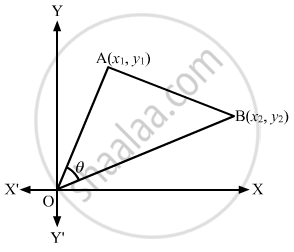
Slope of OA = m1 = \[\frac{y_1}{x_1}\]
Slope of OB = m2 = \[\frac{y_2}{x_2}\]
It is given that \[\theta\] is the angle between lines OA and OB.
\[\therefore \tan \theta = \frac{m_1 - m_2}{1 + m_1 m_2}\]
\[ = \frac{\frac{y_1}{x_1} - \frac{y_2}{x_2}}{1 + \frac{y_1}{x_1} \times \frac{y_2}{x_2}}\]
\[ \Rightarrow \tan \theta = \frac{x_2 y_1 - x_1 y_2}{x_1 x_2 + y_1 y_2}\]
Now,
As we know that
\[\cos \theta = \sqrt{\frac{1}{1 + \tan^2 \theta}}\]
\[\therefore \cos \theta = \frac{x_1 x_2 + y_1 y_2}{\sqrt{\left( x_2 y_1 - x_1 y_2 \right)^2 + \left( x_1 x_2 + y_1 y_2 \right)^2}}\]
\[\Rightarrow \cos \theta = \frac{x_1 x_2 + y_1 y_2}{\sqrt{{x_2}^2 {y_1}^2 + {x_1}^2 {y_2}^2 + {x_1}^2 {x_2}^2 + {y_1}^2 {y_2}^2}}\]
\[\Rightarrow \cos \theta = \frac{x_1 x_2 + y_1 y_2}{\sqrt{{x_1}^2 + {y_1}^2} \sqrt{{x_2}^2 + {y_2}^2}}\]
APPEARS IN
संबंधित प्रश्न
Find the slope of a line, which passes through the origin, and the mid-point of the line segment joining the points P (0, –4) and B (8, 0).
Find the angle between the x-axis and the line joining the points (3, –1) and (4, –2).
Find the slope of a line passing through the following point:
(3, −5), and (1, 2)
State whether the two lines in each of the following are parallel, perpendicular or neither.
Through (5, 6) and (2, 3); through (9, −2) and (6, −5)
State whether the two lines in each of the following is parallel, perpendicular or neither.
Through (3, 15) and (16, 6); through (−5, 3) and (8, 2).
Find the slope of a line (i) which bisects the first quadrant angle (ii) which makes an angle of 30° with the positive direction of y-axis measured anticlockwise.
Using the method of slope, show that the following points are collinear A (16, − 18), B (3, −6), C (−10, 6) .
What is the value of y so that the line through (3, y) and (2, 7) is parallel to the line through (−1, 4) and (0, 6)?
What can be said regarding a line if its slope is negative?
Show that the line joining (2, −3) and (−5, 1) is parallel to the line joining (7, −1) and (0, 3).
The slope of a line is double of the slope of another line. If tangents of the angle between them is \[\frac{1}{3}\],find the slopes of the other line.
Line through the points (−2, 6) and (4, 8) is perpendicular to the line through the points (8, 12) and (x, 24). Find the value of x.
By using the concept of slope, show that the points (−2, −1), (4, 0), (3, 3) and (−3, 2) are the vertices of a parallelogram.
Find the equation of a straight line with slope − 1/3 and y-intercept − 4.
Find the equation of the perpendicular to the line segment joining (4, 3) and (−1, 1) if it cuts off an intercept −3 from y-axis.
Find the equations of the straight lines which cut off an intercept 5 from the y-axis and are equally inclined to the axes.
If the image of the point (2, 1) with respect to a line mirror is (5, 2), find the equation of the mirror.
Find the image of the point (3, 8) with respect to the line x + 3y = 7 assuming the line to be a plane mirror.
Find the angles between the following pair of straight lines:
3x + 4y − 7 = 0 and 4x − 3y + 5 = 0
Find the angles between the following pair of straight lines:
(m2 − mn) y = (mn + n2) x + n3 and (mn + m2) y = (mn − n2) x + m3.
Prove that the straight lines (a + b) x + (a − b ) y = 2ab, (a − b) x + (a + b) y = 2ab and x + y = 0 form an isosceles triangle whose vertical angle is 2 tan−1 \[\left( \frac{a}{b} \right)\].
Write the coordinates of the image of the point (3, 8) in the line x + 3y − 7 = 0.
The acute angle between the medians drawn from the acute angles of a right angled isosceles triangle is
The reflection of the point (4, −13) about the line 5x + y + 6 = 0 is
Find k, if the slope of one of the lines given by kx2 + 8xy + y2 = 0 exceeds the slope of the other by 6.
If x + y = k is normal to y2 = 12x, then k is ______.
Point of the curve y2 = 3(x – 2) at which the normal is parallel to the line 2y + 4x + 5 = 0 is ______.
Find the equation of the straight line passing through (1, 2) and perpendicular to the line x + y + 7 = 0.
Find the equation to the straight line passing through the point of intersection of the lines 5x – 6y – 1 = 0 and 3x + 2y + 5 = 0 and perpendicular to the line 3x – 5y + 11 = 0.
The two lines ax + by = c and a′x + b′y = c′ are perpendicular if ______.
Find the angle between the lines y = `(2 - sqrt(3)) (x + 5)` and y = `(2 + sqrt(3))(x - 7)`
Slope of a line which cuts off intercepts of equal lengths on the axes is ______.
The equation of the straight line passing through the point (3, 2) and perpendicular to the line y = x is ______.
The points A(– 2, 1), B(0, 5), C(– 1, 2) are collinear.
The line `x/a + y/b` = 1 moves in such a way that `1/a^2 + 1/b^2 = 1/c^2`, where c is a constant. The locus of the foot of the perpendicular from the origin on the given line is x2 + y2 = c2.
The lines whose vector equations are `r = 2hati - 3hatj + 7hatk + lambda (2hati + phatj + 5hatk) and r = hati - 2hatj + 3hatk + µ(3hati + phatj + phatk)` are perpendicular for all values of λ and µ if p =
