Advertisements
Advertisements
प्रश्न
Plant the seed of a flower or fruit of your choice in a pot or in your garden. Note its growth every day and maintain a diary recording its progress.
Advertisements
उत्तर
Students are expected to attempt the above activities on their own.
APPEARS IN
संबंधित प्रश्न
You had gone on a trekking expendition with a group of friends. As night closed in, you realised that you were separated from the group. Describe your initial feelings and the place where you got lost. How did you spend the night alone before you were reunited with your group?
In the following items, sentence A is complete, while sentence B is not. Complete sentence B, making it as similar as possible to sentence A. Write sentence B.
(A) He loved his little daughter, but he was in mortal fear of her fierce temper.
(B) Although ..............................................................................
Read the passage given below and answer the questions (a), (b) and (c) that follow :
(1) At the Literary Society’s meeting, Isola read out the letters written to her Granny Pheen, when she was but a little girl. They were from a very kind man – a complete stranger. Isola told us how these letters came to be written.
(2) When Granny Pheen was nine years old, her cat died. Heartbroken, sitting in the middle of the road, she was sobbing her heart out.
(3) A carriage, driving far too fast, came within a whisker of running her down. A very big man in a dark coat with a fur collar, jumped out, leaned over Pheen, and asked if he could help her. Granny Pheen said she was beyond help. Muffin, her cat, was dead.
(4) The man said, ‘Of course, Muffin’s not dead. You do know cats have nine lives, don’t you?’ When Pheen said yes, the man said, ‘Well, I happen to know your Muffin was only on her third life, so she has six lives left.’ Pheen asked how he knew. He said he always knew - cats would often appear in his mind and chat with him. Well, not in words, of course, but in pictures.
(5) He sat down on the road beside her and told her to keep still – very still. He would see if Muffin wanted to visit him. They sat in silence for several minutes, when suddenly the man grabbed Pheen’s hand.
(6) ‘Ah – yes! There she is! She’s being born this minute! In a mansion – in France. There’s a little boy petting her, he’s going to call her Solange. This Solange has great spirit, great verve – I can tell already! She is going to have a long, venturesome life.’
(7) Granny Pheen was so rapt by Muffin’s new fate that she stopped crying. The man said he would visit Solange every so often and find out how she was faring.
(8) He asked for Granny Pheen’s name and the name of the farm where she lived, got back into the carriage, and left.
(9) Absurd as all this sounds, Granny Pheen did receive eight long letters. Isola then read them out. They were all about Muffin’s life as the French cat − Solange. She was, apparently, something of a feline musketeer. She was no idle cat, lolling about on cushions, lapping up cream – she lived through one wild adventure after another – the only cat ever to be awarded the red rosette of the Legion of Honour.
(10) What a story this man had made up for Pheen – lively, witty, full of drama and suspense. We were enchanted, speechless at the reading. When it was over (and much applauded), I asked Isola if I could see the letters, and she handed them to me.
(11) The writer had signed his letters with a grand flourish :
VERY TRULY YOURS,
O.F. O’F. W.W.
It was highly possible that Isola had inherited eight letters written by Oscar Wilde, for who else could have had such a preposterous name as Oscar Fingal O’Flahertie Willis Wilde.
Adapted from : The Guernsey Literary & Potato Peel Pie Society – By Mary Ann Shaffer & Annie Barrows
(a) (i) Given below are four words and phrases. Find the words which have a similar meaning in the passage :[4]
(1) adventurous
(2) cat-like
(3) appreciated
(4) received something on someone’s death
(ii) For each of the words given below, write a sentence of at least ten words using the same word unchanged in form, but with a different meaning from that which it carries in the passage :[4]
(1) kind (line 2)
(2) mind (line 13)
(3) still (line 15)
(4) sounds (line 26)
(b) Answer the following questions in your own words as briefly as possible:
(i) Where did Isola get the letters from to read at the Literary Society’s meeting?[2]
(ii) Who consoled Granny Pheen when she was heart-broken? What did he say about Muffin’s lives?[2]
(iii) What did the man say when Granny Pheen asked him how he knew about cats’ lives?[2]
(iv) According to the man, what was Muffin’s new fate?[3]
(c) In not more than 100 words, summarise why the eight letters were a treasure to Granny Pheen. (Paragraphs 2 to 10). Failure to keep within the word limit will be penalised. You will be required to write the summary in the form of a connected passage in about 100 words.[8]
Do you agree with his justification of the war? Why/ why not?
There are two pauses when Kaspar tells Wilhelmine in the last stanza that it was a famous victory. Nay … nay…my little girl, quoth he.What do these pauses show?
Dahl is annoyed that people – including children – watch too much television. Do you agree, or disagree? Why, or why not?
The poet compares the flowers to the milky way. Is the comparison apt?
Can the poem be taken as interpretation of human fickleness?
Which is the turning point in the poem?
What event is referred to in the poem?
What is the setting of “All Summer in a Day”?
Write a composition (350 - 400 words) on the following:
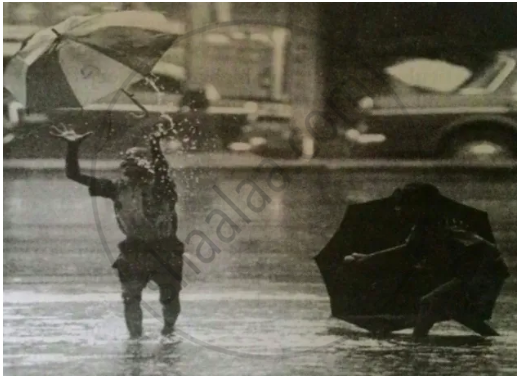
Study the picture given below. Write a story or a description or an account of what it suggests to you. Your composition may be about the subject of the picture or you may take suggestions from it; however, there must be a clear connection between the picture and your composition.

Fill in the blank with an appropriate word:
The soldier fought bravely__________ his country.
The delivery boy was requested to bring the parcel the next day. (Rewrite using direct speech)
Study the picture given below. Write a story or a description or an account of what it suggests to you. Your composition may be about the subject of the picture or you may take suggestions from it; however, there must be a clear connection between the picture and your composition.
Fill in the blank with an appropriate word:
Joan jumped ………. the river to rescue the child.
Re-write the following sentence according to the instructions are given. Make other changes that may be necessary, but do not change the meaning of the sentence.
As soon as the function got over. The crowd dispersed.
(Begin: Hardly had……….)
How does the story suggest that optimism helps to endure “the direst stress”?
Given below is an interesting combination of words. Explain why they have been used together.
ghostly dust devils
Given below is an interesting combination of words. Explain why they have been used together.
virtual body
What was John Garrideb's objective in inventing the story of Alexander Hamilton Garrideb and his legacy?
Look at the highlighted expressions in the following sentences from the text and explain their figurative meaning.
- 'I went through it, sir, with a fine-toothed comb and never a Garrideb could I catch.'
-
'They are my favourite covert for putting up a bird, and I would never have overlooked a cock pheasant as that.'
-
'There is no bolt-hole for you in this country.'
-
'When his castle in the air fell down, it burred him beneath the ruins.'
Collect information of the NGOs working for the underprivileged section of the society.
Multiple Choice Question:
Why did the quarrel take a serious turn?
Use the phrase in a sentence of your own, after finding out its meaning.
streaked over
We add ‘un-’ to make opposites. For example, true — untrue. Add ‘un’– to the word below to make its opposite. Then look up the meaning of the word you have formed in the dictionary.
attended: ____________
The cherry tree is a narrative poem. Features that make it a narrative poem are given below. Justify them with proper examples.
Characters are referred to.
'Agriculture is the backbone of the Indian economy'. Fill in the boxes supporting this statement. Complete the following web diagram.
Compose an imaginary dialogue between Sue and Johnsy, when they realise about what Behrman had done for Johnsy.
Watch the advertisements on TV. Choose any one of them for group discussion and analysis. Write your report in the advertisement.
Write what you think about the following thoughts and actions of Mathilde :
Mathilde worked very very hard to pay the debt.
Think and write in your own words.
Why did the traveller choose the road less travelled? What attribute of the traveller does it bring out?
Write a short autobiography of a brook. (20 to 30 lines)
Is the insect described in the poem a real insect? Think about an imaginary creature. Describe it in your own words. You may draw its picture and label it.
Work in pairs and discuss the factors that contribute towards making a choice and make a presentation to the class.
You are a volunteer in your locality to serve people who are affected by floods. How will you caution them to move to a safer place taking only their bare necessities? Describe.
Create a pamphlet for the following.
Make a pamphlet on ‘Dengue Awareness’ (Focus on its causes, preventions, symptoms, and precautions).
You have prepared some eco-friendly craft materials like paper mache dolls, greeting cards, book marks, festoons, garlands, quilling jewellery etc for an Art Mela to be conducted in your school premises. Describe in a few sentences how you made the craft work. Include the following details in your writing.
- Name of the craftwork
- Materials used
- Nature (handy / eco-friendly / longlasting / affordable price )
- Use (place / person / time)
Look at the picture and write a paragraph using the clues in the picture.
| GROW AND PROTECT TREES |

Arrange the picture in order by writing the numbers 1,2,3 and 4 in the given boxes and write this familiar story in about 100 words.
Make use of the words given below.
| thirsty, village, pitcher, disappointment, pebbles, water level |
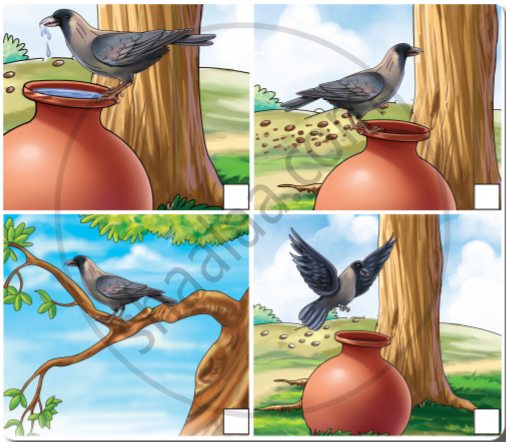
One hot day, a thirsty crow _____________________________________________________________
__________________________________________________________________________________________
Pick out the nouns from the poem. Write as many Cinquain poems as you can.
Fill in the blank by choosing the preposition from the option.
The children walked ______ the bridge.
Correct the use of the describing word in the following sentence.
This is the simpler problem of them all.
Find one word from the story that means
at once q ______.
Alice follows the strange rabbit because she wants to know a number of things. Re-arrange the words to make the questions that Alice has in her mind, and put a question mark (?).
talk rabbit a how can
Where do the following live ?
- Birds live in
- Rabbits live in
- Beavers live in
Make opposites with the words –
| dis ______ in______ |
| respect | |
| able | |
| efficient | |
| own | |
| capable | |
| secure |
Debate is an essential skill and your classroom is the best place to practice this skill. Your teacher will now divide the class into two groups and organize a debate on the topic “Fast food tastes better than nutritious food.” The following points may help you to participate and speak in a debate. One group will speak FOR the motion and the other group will speak AGAINST the motion. Now prepare a speech for the debate.
What caught his attention about the car door?
Why did Woman 1 panic more than the others?
What angered the author?
How did the author react on seeing his photograph?
‘Just one more installment and BABY’S REALLY OURS!’ This tells us that the couple
Answer the following question as briefly as possible and with close reference to the relevant text.
“Then paint the cut with iodine.” With reference to this line, what is your understanding of Klausner? Do you sympathise with him? Give your reasons.
You have planned to organize a health camp at school. Write a letter to the Manager of a supermarket requesting sponsorship for the event. Name the event and explain how it will benefit both the community as well as the supermarket.
These two passages are examples of a short introduction to works of art - a short review. They cover the following points:
- The name of the creator
- The theme or subject matter
- Type of art
- Individual style
- Presentation techniques
- Its effect on viewers
- Message or interpretation
Choose a book/film and review it in short using the points you have listed.
Write points and counter points on the following topic:
You must memorise the rules of grammar
Imagine someone has invited your family to a program, and you were the only person at home when the invitation was given orally.
Write a note (4–5 lines) to pass on the message to the other people in your family. Or, write an imaginary conversation in which you pass on the message to your parents.
Imagine someone has invited your family to a programme and you were the only person at home when the invitation was given orally.
Write a note (4-5 lines) to pass on the message to the other people in your family. Or, Write an imaginary conversation in which you pass on the message to your parents.
Read the passage given below and answer the questions (i), (ii) and (iii) that follow.
| (1) | “Can I see the Manager?” I said, and added solemnly, “Alone.” I don't know why I said “Alone.” “Certainly,” said the accountant and fetched him. | |
| (2) | The Manager was a grave, calm man. I held my fifty-six dollars clutched in a crumpled ball in my pocket. “Are you the Manager?” I asked. God knows I did not doubt it. “Yes,” he said. “Can I see you …. alone?” I asked. |
5 |
| (3) | The Manager looked at me in some alarm. He felt that I had an awful secret to reveal. “Come in here,” he said, and led the way to a private room. He turned the key in the lock. “We are safe from interruption here,” he said; “Sit down.” We both sat down and looked at each other. I found no voice to speak. “You are one of Pinkerton’s men, I presume,” he said. |
10 |
| (4) |
He had gathered from my mysterious manner that I was a detective. I knew what he was thinking, and it made me worse. |
15
20
|
| (5) | The Manager got up and opened the door. He called to the accountant. “Mr. Montgomery,” he said unkindly loud, “this gentleman is opening an account, he will deposit fifty-six dollars. Good morning.” I rose. A big iron door stood open at the side of the room. “Good morning,” I said, and stepped into the safe. “Come out,” said the Manager coldly and showed me the other way. |
30 |
| (6) | I went up to the accountant’s wicket and poked the ball of money at him with a quick convulsive movement as if I were doing a conjuring trick. My face was ghastly pale. “Here,” I said, “deposit it.” The tone of the words seemed to mean, “Let us do this painful thing while the fit is on us.” He took the money and gave it to another clerk. |
35 |
| (7) | He made me write the sum on a slip and sign my name in a book. I no longer knew what I was doing. The bank swam before my eyes. “Is it deposited?” I asked in a hollow, vibrating voice. “It is,” said the accountant. “Then I want to draw a cheque.” My idea was to draw out six dollars of it for present use. Someone gave me a chequebook through a wicket and someone else began telling me how to write it out. The people in the bank had the impression that I was an invalid millionaire. I wrote something on the cheque and thrust it in at the clerk. He looked at it. |
40
45 |
| (8) | “What! Are you drawing it all out again?” he asked in surprise. Then I realised that I had written fifty-six instead of six. I was too far gone to reason now. I had a feeling that it was impossible to explain the thing. I had burned my boats. All the clerks had stopped writing to look at me. Reckless with misery, I made a plunge. “Yes, the whole thing.” “You withdraw all your money from the bank?” “Every cent of it.” “Are you not going to deposit anymore?” said the clerk, astonished. “Never.” |
50
55 |
| (9) | An idiot hope struck me that they might think something had insulted me while I was writing the cheque and that I had changed my mind. I made a wretched attempt to look like a man with a fearfully quick temper. | |
| (10) | The clerk prepared to pay the money. “How will you have it?” he said. This question came as a bolt from the blue. “What?” “How will you have it?” “Oh!”— I caught his meaning and answered without even trying to think— “in fifties.” He gave me a fifty-dollar bill. “And the six?” he asked dryly. “In sixes,” I said. He gave it to me and I rushed out. As the big door swung behind me. I caught the echo of a roar of laughter that went up to the ceiling of the bank. Since then, I bank no more. I keep my money in cash in my trousers pocket and my savings in silver dollars in a sock. |
60
65
70 |
| Adapted from: My Financial Career By Stephen Leacock |
||
-
- Find a single word from the passage that will exactly replace the underlined word or words in the following sentences. [3]
- The kind stranger went and got back the ball from where it had rolled into the bush.
- I took offence at the expression on his face that was clearly meant to insinuate I was a liar.
- The firm experienced a financial loss when the contract went to a contender who had just entered the business.
- For each of the words given below, choose the correct sentence that uses the same word unchanged in spelling, but with a different meaning from that which it carries in the passage. [3]
- alarm (line 8)
- The silence from the other end set off alarm bells in her head.
- The pallor of his skin alarmed those standing around.
- I set my alarm for six o’clock but slept through it.
- The sound of the approaching jets caused some alarm in the war room.
- wicket (line 44)
- The wicketkeeper was the true saviour of the day for that one match.
- The team wanted to bat while the wicket was still dry.
- The man at the window handed us our tickets through the wicket.
- The quick loss of wickets demoralised the team.
- reason (line 48)
- After the tragedy, his ability to reason is severely diminished.
- They reasoned they could get better seats if they arrived early.
- Recipients of funds were selected without rhyme or reason.
- We have every reason to celebrate.
- alarm (line 8)
- Find a single word from the passage that will exactly replace the underlined word or words in the following sentences. [3]
- Answer the following questions as briefly as possible in your own words.
- With reference to the passage, explain the meaning of the expression of the ‘I had burned my boats?’ [2]
- Cite any two instances of the behaviour of the bank employees that indicate the insignificance of a deposit of fifty-six dollars. [2]
- Why do you think the people in the bank thought of the narrator as an “invalid millionaire?” [2]
- Summarise why the narrator decided ‘to bank no more’ (paragraphs 6 to 10). You are required to write the summary in the form of a connected passage in about 100 words. Failure to keep within the word limit will be penalised. [8]
