Advertisements
Advertisements
प्रश्न
On the basis of valence bond theory explain the nature of bonding in [CoF6]3 ion.
Advertisements
उत्तर
The oxidation state of cobalt in this complex is +3. Hence, we have
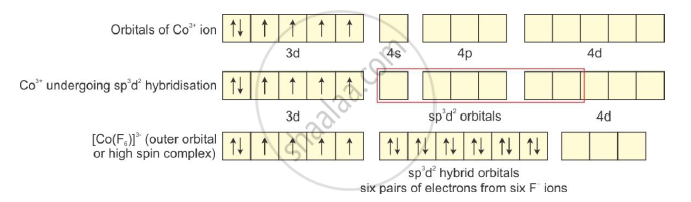
F− ion provides a weak ligand field and is unable to pair up the unpaired electrons of the 3d orbitals. Hence, six equivalent hybrid orbitals are obtained by mixing of one 4s, three 4p and two 4d orbitals. Six empty sp3d2 hybrid orbitals are filled up by six electron pairs provided by F− ion. The highly paramagnetic nature of the complex further confirms the presence of four unpaired electrons.
As d-orbitals of the outermost shell take part in hybridisation, the complexes thus formed are called outer orbital complexes.
APPEARS IN
संबंधित प्रश्न
[NiCl4]2− is paramagnetic, while [Ni(CO)4] is diamagnetic, though both are tetrahedral. Why? (Atomic number of Ni = 28)
Explain on the basis of valence bond theory that [Ni(CN)4]2− ion with square planar structure is diamagnetic and the [NiCl4]2− ion with tetrahedral geometry is paramagnetic.
[Cr(NH3)6]3+ is paramagnetic while [Ni(CN)4]2− is diamagnetic. Explain why?
Discuss the nature of bonding in the following coordination entity on the basis of valence bond theory:
[FeF6]3−
Explain the geometry of `[Co(NH_3)_6]^(3+)` on the basis of hybridisation. (Z of Co = 27)
Write the hybridisation and number of unpaired electrons in the complex `[CoF_6]^(3-)`. (Atomic No. of Co = 27)
[NiCl4]2- is paramagnetic while [Ni(CO)4] is diamagnetic though both are tetrahedral. Why? (Atomic no. Ni = 28)
Using valence bond theory, explain the following in relation to the complexes given below:
\[\ce{[Mn(CN)6]^{3-}}\]
(i) Type of hybridisation.
(ii) Inner or outer orbital complex.
(iii) Magnetic behaviour.
(iv) Spin only magnetic moment value.
Using valence bond theory, explain the following in relation to the complexes given below:
\[\ce{[Cr(H2O)6]^{3+}}\]
(i) Type of hybridisation.
(ii) Inner or outer orbital complex.
(iii) Magnetic behaviour.
(iv) Spin only magnetic moment value.
Using valence bond theory, explain the following in relation to the complexes given below:
\[\ce{[FeCl6]^{4-}}\]
(i) Type of hybridisation.
(ii) Inner or outer orbital complex.
(iii) Magnetic behaviour.
(iv) Spin only magnetic moment value.
How many radial nodes for 3p orbital?
Which of the statement given below is incorrect about H2O2?
When the hybridization state of carbon changes from sp3 to sp2 and finally to sp, the angle between hybridized orbital will
As the s-character of hybridised orbital increases, the bond angle
Which of the following methods is used for measuring bond length?
Which of the following has square planar structures?
In Fe(CO)5, the Fe – C bond possesses
Using Valence bond theory, explain the following in relation to the paramagnetic complex [Mn(CN)6]3−
- type of hybridization
- magnetic moment value
- type of complex – inner, outer orbital complex
Using valence bond theory, predict the hybridization and magnetic character of the following:
[CoF6]3– [Atomic number of Co = 27]
Write the hybridisation and magnetic behaviour of [CoF6]3−.
[Given: Atomic number of Co = 27]
[Ni(CO)4] has tetrahedral geometry while [Ni(CN)4]2− has square planar, yet both exhibit diamagnetism. Explain.
[Atomic number: Ni = 28]
During chemistry class, a teacher wrote \[\ce{[Ni(CN)4]^2-}\] as a coordination complex ion on the board. The students were asked to find out the magnetic behaviour and shape of the complex. Pari, a student, wrote the answer paramagnetic and tetrahedral whereas another student Suhail wrote diamagnetic and square planer.
Evaluate Pari’s and Suhail’s responses.
Which of the following are paramagnetic?
- [NiCl4]2−
- Ni(CO)4
- [Ni(CN)4]2−
- [Ni(H2O)6]2+
- Ni(PPh3)4
Choose the correct answer from the options given below:
Given below are two statements:
Statement I: Both [Co(NH3)6]3+ and [CoF6]3− complexes are octahedral but differ in their magnetic behavior.
Statement II: [Co(NH3)6]3+ is diamagnetic whereas [CoF6]3− is paramagnetic.
In the light of the above statements, Choose the correct answer form the options given below:
