Advertisements
Advertisements
प्रश्न
[NiCl4]2- is paramagnetic while [Ni(CO)4] is diamagnetic though both are tetrahedral. Why? (Atomic no. Ni = 28)
Advertisements
उत्तर
[NiCl4]2-
Ni is in + 2 oxidation state.
3d8 configuration 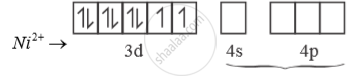
Cl- is weak field ligand. So, pairing doesnot occur.
sp3 hybridised orbitals of 2 Ni2+ 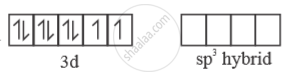
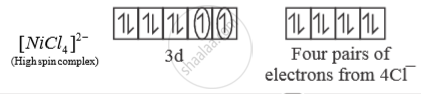
[ ] NiCl is paramagnetic as n = 2
4 [ ( ) ] Ni CO Ni is in ‘0’ oxidation state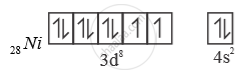
In presence of ‘CO’ pairing of e– takes place ‘CO’ is strong field ligand. So, with ‘CO
[Ni(CO)4] → 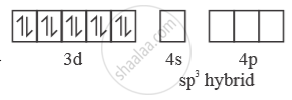
[Ni(CO)4] → 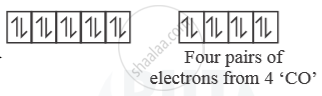
So, [Ni(CO)4] is diamagnetic as n = 0.
APPEARS IN
संबंधित प्रश्न
Predict the number of unpaired electrons in the square planar [Pt(CN)4]2− ion.
Discuss the nature of bonding in the following coordination entity on the basis of valence bond theory:
[Co(C2O4)3]3−
Explain the geometry of `[Co(NH_3)_6]^(3+)` on the basis of hybridisation. (Z of Co = 27)
Using valence bond theory, explain the following in relation to the complexes given below:
\[\ce{[Mn(CN)6]^{3-}}\]
(i) Type of hybridisation.
(ii) Inner or outer orbital complex.
(iii) Magnetic behaviour.
(iv) Spin only magnetic moment value.
Using valence bond theory, explain the following in relation to the complexes given below:
\[\ce{[Co(NH3)6]^{3+}}\]
(i) Type of hybridisation.
(ii) Inner or outer orbital complex.
(iii) Magnetic behaviour.
(iv) Spin only magnetic moment value.
Using valence bond theory, explain the following in relation to the complexes given below:
\[\ce{[Cr(H2O)6]^{3+}}\]
(i) Type of hybridisation.
(ii) Inner or outer orbital complex.
(iii) Magnetic behaviour.
(iv) Spin only magnetic moment value.
Write the hybridization and shape of the following complexes:
[Ni(CN)4]2−
Which of the statement given below is incorrect about H2O2?
Valence bond theory is based on the assumption that the bonds formed between the metal ions and ligands are ______
The geometry and magnetic behaviour of the complex [Ni(CO)4] are ______.
