Advertisements
Advertisements
प्रश्न
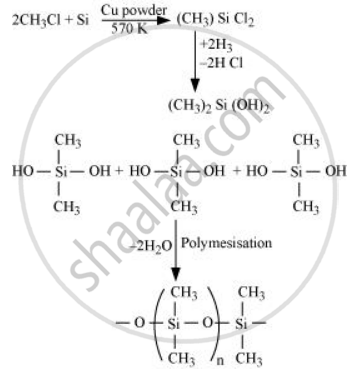
Explain the following reaction.
Silicon is heated with methyl chloride at high temperature in the presence of copper.
Advertisements
उत्तर
When silicon reacts with methyl chloride in the presence of copper (catalyst) and at a temperature of about 537 K, a class of organosilicon polymers called methyl-substituted chlorosilanes (MeSiCl3, Me2SiCl2, Me3SiCl, and Me4Si) are formed
संबंधित प्रश्न
Explain the difference in properties of diamond and graphite on the basis of their structures.
Rationalise the given statement and give a chemical reaction:
Lead (II) chloride reacts with Cl2 to give PbCl4.
Write suitable chemical equations to show the nature of the following oxide.
Tl2O3
Rationalise the given statement and give a chemical reaction:
Lead (IV) chloride is highly unstable towards heat.
Rationalise the given statement and give a chemical reaction:
Lead is known not to form an iodide, PbI4.
Classify the following oxide as neutral, acidic, basic or amphoteric:
B2O3
Classify the following oxide as neutral, acidic, basic or amphoteric:
SiO2
Classify the following oxide as neutral, acidic, basic or amphoteric:
CO2
Classify the following oxide as neutral, acidic, basic or amphoteric:
Al2O3
Write suitable chemical equations to show the nature of the following oxide.
SiO2
Write suitable chemical equations to show the nature of the following oxide.
Al2O3
Write suitable chemical equations to show the nature of the following oxide.
PbO2
The linear shape of CO2 is due to:
(i) sp3 hybridisation of carbon.
(ii) sp hybridisation of carbon.
(iii) pπ – pπ bonding between carbon and oxygen.
(iv) sp2 hybridisation of carbon.
Give reasons for the following:
CCl4 is immiscible in water, whereas SiCl4 is easily hydrolysed.
Explain the following:
Silicon forms \[\ce{SiF^{2-}6}\] ion whereas corresponding fluoro compound of carbon is not known.
Carbon and silicon both belong to the group 14, but inspite of the stoichiometric similarity, the dioxides, (i.e., carbon dioxide and silicon dioxide), differ in their structures. Comment.
Explain the following:
BF3 does not hydrolyse.
Explain the following:
Why does the element silicon, not form a graphite like structure whereas carbon does.
\[\ce{SiCl4 ->[H2O] (A) ->[\Delta] (B) ->[Na2CO3][heat] (C)}\]. The Compound C is ______.
