Advertisements
Advertisements
Question
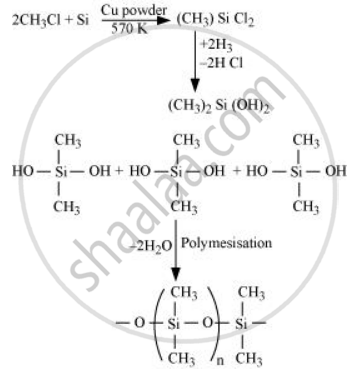
Explain the following reaction.
Silicon is heated with methyl chloride at high temperature in the presence of copper.
Advertisements
Solution
When silicon reacts with methyl chloride in the presence of copper (catalyst) and at a temperature of about 537 K, a class of organosilicon polymers called methyl-substituted chlorosilanes (MeSiCl3, Me2SiCl2, Me3SiCl, and Me4Si) are formed
RELATED QUESTIONS
Write suitable chemical equations to show the nature of the following oxide.
Tl2O3
Classify the following oxide as neutral, acidic, basic or amphoteric:
CO
Classify the following oxide as neutral, acidic, basic or amphoteric:
B2O3
Classify the following oxide as neutral, acidic, basic or amphoteric:
CO2
Classify the following oxide as neutral, acidic, basic or amphoteric:
Al2O3
Classify the following oxide as neutral, acidic, basic or amphoteric:
PbO2
Classify the following oxide as neutral, acidic, basic or amphoteric:
Tl2O3
Write suitable chemical equations to show the nature of the following oxide.
CO2
Write suitable chemical equations to show the nature of the following oxide.
PbO2
Explain the following:
CO2 is a gas whereas SiO2 is a solid.
Explain the following:
Silicon forms \[\ce{SiF^{2-}6}\] ion whereas corresponding fluoro compound of carbon is not known.
The +1 oxidation state in group 13 and +2 oxidation state in group 14 becomes more and more stable with increasing atomic number. Explain.
A tetravalent element forms monoxide and dioxide with oxygen. When air is passed over heated element (1273 K), producer gas is obtained. Monoxide of the element is a powerful reducing agent and reduces ferric oxide to iron. Identify the element and write formulas of its monoxide and dioxide. Write chemical equations for the formation of producer gas and reduction of ferric oxide with the monoxide.
