Advertisements
Advertisements
प्रश्न
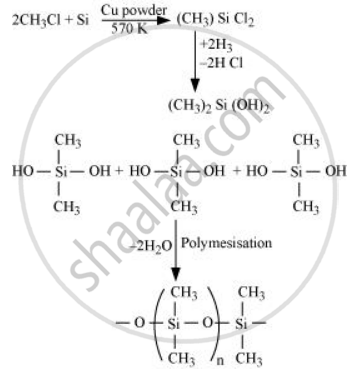
Explain the following reaction.
Silicon is heated with methyl chloride at high temperature in the presence of copper.
Advertisements
उत्तर
When silicon reacts with methyl chloride in the presence of copper (catalyst) and at a temperature of about 537 K, a class of organosilicon polymers called methyl-substituted chlorosilanes (MeSiCl3, Me2SiCl2, Me3SiCl, and Me4Si) are formed
संबंधित प्रश्न
Discuss the pattern of variation in the oxidation states of B to Tl.
Explain the difference in properties of diamond and graphite on the basis of their structures.
Rationalise the given statement and give a chemical reaction:
Lead (II) chloride reacts with Cl2 to give PbCl4.
Classify the following oxide as neutral, acidic, basic or amphoteric:
B2O3
Classify the following oxide as neutral, acidic, basic or amphoteric:
CO2
Classify the following oxide as neutral, acidic, basic or amphoteric:
Al2O3
Classify the following oxide as neutral, acidic, basic or amphoteric:
PbO2
Classify the following oxide as neutral, acidic, basic or amphoteric:
Tl2O3
Write suitable chemical equations to show the nature of the following oxide.
Al2O3
Which of the following is a Lewis acid?
The reason for small radius of Ga compared to Al is:
(i) poor screening effect of d and f orbitals.
(ii) increase in nuclear charge.
(iii) presence of higher orbitals.
(iv) higher atomic number.
Give reasons for the following:
CCl4 is immiscible in water, whereas SiCl4 is easily hydrolysed.
Explain the following:
CO2 is a gas whereas SiO2 is a solid.
Carbon and silicon both belong to the group 14, but inspite of the stoichiometric similarity, the dioxides, (i.e., carbon dioxide and silicon dioxide), differ in their structures. Comment.
The principal ore of lead is ______.
Match List I with List II:
| List I | List II |
| Coke | Carbon atoms are sp3 hybridized. |
| Diamond | Used as a dry lubricant. |
| Fullerene | Used as a reducing agent. |
| Graphite | Cage like molecules |
Choose the correct answer from the options given below:
