Advertisements
Advertisements
प्रश्न
Explain aqueous alkaline hydrolysis of tert. butyl bromide.
Advertisements
उत्तर
i. Aqueous alkaline hydrolysis of tert. butyl bromide forms tert-butyl alcohol. The reaction can be given as,
\[\begin{array}{cc}
\ce{\phantom{....}CH3\phantom{.........................}}\ce{CH3\phantom{............}}\\
|\phantom{.............................}|\phantom{...........}\\
\ce{CH3 - C - Br +\underset{\text{Nucleophile}}{OH-} ->CH3 - C - OH +\underset{\text{Bromide ion}}{Br-}}\\
|\phantom{.............................}|\phantom{...........}\\
\ce{\underset{\text{Tert-Butyl bromide}}{CH3}\phantom{.................}}
\ce{\underset{\text{tert−Butyl alcohol}}{CH3}}\phantom{.........}\\
\end{array}\]
Rate = k [(CH3)3C − Br]
ii. The reaction follows the first-order kinetics. That is, the rate of this reaction depends on the concentration of only one species, which is the substrate molecule, tert-butyl bromide. Hence, it is called substitution nucleophilic unimolecular, SN1 mechanism.
iii. It can be seen in the reaction that the concentration of the only substrate appears in the rate equation that is, the concentration of the nucleophile does not influence the reaction rate.
iv. In other words, tert-butyl bromide reacts with hydroxide by a two steps mechanism.
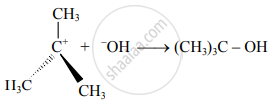
In the slow step C–X bond in the substrate undergoes heterolysis and in the subsequent fast step, the nucleophile uses its electron pair to form a new bond with the carbon undergoing change.
v. The SN1 mechanism is represented as,
- Step I:

- Step II:
APPEARS IN
संबंधित प्रश्न
Name the reagent used to bring about the following conversion.
1-Chloropropane to 1-nitropropane
Complete the following reaction sequence by writing the structural formulae of the organic compound 'A', 'B' and 'C'.
\[\ce{2-Bromobutane->[Alc.KOH]A->[][Br2]B->[][NaNH2]C}\]
Complete the following reaction sequence by writing the structural formulae of the organic compound 'A', 'B' and 'C'.
\[\ce{Isopropyl alcohol ->[\triangle][PBr3] A ->[][NH3 excess] B}\]
Observe the following and answer the question given below.

Comment on the bond length of C–X bond in it.
Propane nitrile can be prepared by heating ____________
The following will react faster by SN1 mechanism
Major product of the following reaction is _______________
\[\ce{CH3-CH2-Mg-Br + NH3 ->?}\]
Nucleophilic substitution reaction of 2, 4-dinitrochlorobenzene is faster than p-nitrochlorobenzene. Give reason.
Explain the factors affecting SN1 and SN2 mechanism.
The least reactive towards nucleophilic addition reactions is ____________.
Dehydrohalogenation of an alkyl halide is ____________.
Which one is most reactive towards nucleophilic addition reaction?
What type of hybridisation is present in carbocation formed during the alkaline hydrolysis of 1- bromo-1- phenyl ethane?
When C2H5Br is treated with excess of alc. NH3, the major product obtained is ____________.
The SN2 reaction of a compound containing an asymmetric carbon atom always gives ____________.
Write the product formed when alkyl halide reacts with silver nitrite.
The order of reactivities of the following alkyl halides for an SN2 reaction is ______.
The compound that reacts the fastest with sodium methoxide is ______.
Explain the dehydrohalogenation reaction of 2-chlorobutane.
Observe the following and answer the questions given below:

Name the type of halogen derivative.
Complete the following reactions giving major product.
\[\begin{array}{cc}
\ce{CH3}\phantom{................}\\
|\phantom{...................}\\
\ce{CH3 - C - CH2 - Cl ->[Na/dry ether] A}\\
|\phantom{...................}\\
\ce{CH3}\phantom{.................}
\end{array}\]
Complete the following reaction giving major product.
\[\begin{array}{cc}
\ce{CH3}\phantom{...............}\\
|\phantom{..................}\\
\ce{CH3 - C - CH2 - Cl->[Na/dry ether]A}\\
|\phantom{..................}\\
\ce{CH3}\phantom{...............}\\
\end{array}\]
What is the action of following on ethyl bromide?
alcoholic sodium hydroxide
Identify the chiral molecule from the following.
Complete the following reaction giving major product.
\[\begin{array}{cc}
\ce{CH3}\phantom{...............}\\
|\phantom{..................}\\
\ce{CH3 - C - CH2 - Cl ->[Na/dry ether]A}\\
|\phantom{...................}\\
\ce{CH3}\phantom{.................}
\end{array}\]
Complete the following reaction giving major product.
\[\begin{array}{cc}
\ce{CH3}\phantom{................}\\
|\phantom{..................}\\
\ce{CH3 - C - CH2 - Cl ->[Na/dry ether]A}\\
|\phantom{..................}\\
\ce{CH3}\phantom{................}
\end{array}\]
Which among the following is NOT benzylic halide?
Which of the following reagent is used for conversion of alkyl halide into nitrile?
