Advertisements
Advertisements
प्रश्न
Complete the following reaction giving major products.
\[\ce{CH3 - CH = CH2 ->[HBr][peroxide] A ->[alc. KOH] B}\]
Advertisements
उत्तर
\[\ce{\underset{Propene}{CH3 - CH} = CH2 ->[HBr][Peroxide]\underset{\underset{\overset{(A)}{(major product)}}{1-Bromopropane}}{CH3CH2CH2Br} ->[Alc.KOH]\underset{\underset{(B)}{propene}}{CH3CH} = CH2}\]
APPEARS IN
संबंधित प्रश्न
Complete the following reaction giving major products.
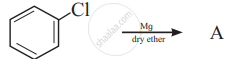
Convert the following:
Propene to propan-1-ol
Convert the following:
Ethanol to propane nitrile
Convert the following:
2-Chloropropane to propan-1-ol
Convert the following:
tert-Butyl bromide to isobutyl bromide
HCl is added to a hydrocarbon ‘A’ \[\ce{(C4H8)}\] to give a compound ‘B’ which on hydrolysis with aqueous alkali forms tertiary alcohol ‘C’ \[\ce{(C4H10O)}\]. Identify ‘A’ ,‘B’ and ‘C’.
In alkaline hydrolysis of tertiary butyl bromide, ____________.
Nitroalkanes are obtained in laboratory from primary or secondary alkyl halides by the action of ______.
Which of the following carbocation is the most stable?
Identify 'B' in the following reaction.
\[\ce{2-Bromobutane ->[KOH alc.][\Delta] A ->[HI] B}\]
The major product formed when 2-bromobutane is treated with alcoholic KOH is ______.
The order of reactivities of the following alkyl halides for an SN2 reaction is ______.
Which of the following statements is incorrect regarding the dehydrohalogenation of alkenes?
The order of reactivity of the given haloalkanes towards nucleophiles is:
Which among the following statements is not correct about SN2 reaction mechanism?
With which halogen the reactions, of alkanes are explosive?
Complete the following reactions giving a major product.
\[\begin{array}{cc}
\ce{CH3}\phantom{................}\\
|\phantom{..................}\\
\ce{CH3 - C - CH2 - Cl ->[Na/dry ether] A}\\
|\phantom{..................}\\
\ce{CH3}\phantom{................}
\end{array}\]
Discuss β - elimination reaction.
Define and explain the SN1 mechanism with a suitable example.
Complete the following reaction, giving a major product.
\[\begin{array}{cc}
\ce{CH3}\phantom{................}\\
|\phantom{...................}\\
\ce{CH3 - C - CH2 - Cl ->[Na/dry ether] A}\\
|\phantom{...................}\\
\ce{CH3}\phantom{................}
\end{array}\]
Complete the following reaction giving major product.
\[\begin{array}{cc}
\ce{CH3}\phantom{...............}\\
|\phantom{..................}\\
\ce{CH3 - C - CH2 - Cl ->[Na/dry ether]A}\\
|\phantom{...................}\\
\ce{CH3}\phantom{.................}
\end{array}\]
Identify the substrate 'X' in the following reaction.
\[\ce{\underset{}{X + O2} ->[i) Co-naphtenate 423 K][ii) dil HClΔ] \underset{\underset{}{}}{Phenol + Acetone}}\]
Which among the following is NOT benzylic halide?
Which of the following reagent is used for conversion of alkyl halide into nitrile?
