Advertisements
Advertisements
प्रश्न
Explain the dehydrohalogenation reaction of 2-chlorobutane.
Advertisements
उत्तर
When 2-chlorobutane is boiled with an alcoholic solution of potassium hydroxide, it undergoes the elimination of the hydrogen atoms from β-carbon and chlorine atoms from α-carbon resulting in the formation of But-2-ene and But-1-ene.
Reaction:

But according to Saytzeff's rule, in dehydrohalogenation reaction, the preferred product is that alkene which has a greater number of alkyl groups attached to doubly bonded carbon atoms.
Hence, But-2-ene is obtained as the major product in the dehydrohalogenation reaction of 2-chlorobutane.
APPEARS IN
संबंधित प्रश्न
Complete the following reaction giving major products.
\[\begin{array}{cc}\ce{CH3 - CH = CH3 ->[Red P/Br2] A ->[Ag2O/H2O]B}\\|\phantom{.........................}\\
\ce{OH\phantom{.......................}}\end{array}\]
Complete the following reaction giving major product.
\[\begin{array}{cc}\ce{CH3\phantom{................}}\\
|\phantom{...................}\\
\ce{CH3 - C - CH2 - Cl ->[Na/dry ether] A}\\
|\phantom{...................}\\
\ce{CH3\phantom{................}}
\end{array}\]
Complete the following reaction giving major products.
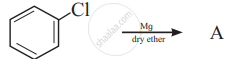
Name the reagent used to bring about the following conversion.
Ethyl bromide to ethyl isocyanide
Name the reagent used to bring about the following conversion.
Chlorobenzene to biphenyl
Convert the following:
Benzyl alcohol to benzyl cyanide
Convert the following:
2-Chloropropane to propan-1-ol
Convert the following:
tert-Butyl bromide to isobutyl bromide
Complete the following reaction sequence by writing the structural formulae of the organic compound 'A', 'B' and 'C'.
\[\ce{2-Bromobutane->[Alc.KOH]A->[][Br2]B->[][NaNH2]C}\]
Nucleophilic substitution reaction of 2, 4-dinitrochlorobenzene is faster than p-nitrochlorobenzene. Give reason.
What is dehydrohalogenation? State the rule for the formation of the preferred product of dehydrohalogenation.
Nitroalkanes are obtained in laboratory from primary or secondary alkyl halides by the action of ______.
The following mechanism has been proposed for the reaction of NO2 with F2 to form NO2F:
\[\ce{NO2_{(g)} + F2_{(g)} -> NO2F_{(g)} + F_{(g)} (slow)}\]
\[\ce{F_{(g)} + NO2_{(g)} -> NO2F_{(g)} (fast)}\]
The order of the reaction with respect to NO2(g)
The SN2 reaction of a compound containing an asymmetric carbon atom always gives ____________.
Identify 'B' in the following reaction.
\[\ce{2-Bromobutane ->[KOH alc.][\Delta] A ->[HI] B}\]
Write the product formed when alkyl halide reacts with silver nitrite.
Which among the following statements is not correct about SN2 reaction mechanism?
With which halogen the reactions, of alkanes are explosive?
Complete the following reaction sequences by writing the structural formulae of the organic compounds 'A', 'B' and 'C'.
\[\ce{2-Bromobutan ->[alc. KOH] A ->[][Br2] B ->[][NANH2] C}\]
What is the action of following on ethyl bromide?
alcoholic sodium hydroxide
Complete the reaction:
\[\ce{CH3CH2Cl ->[AgCN][alc.\Delta]}\] ?
Complete the following reaction giving major product.
\[\begin{array}{cc}
\ce{CH3}\phantom{................}\\
|\phantom{..................}\\
\ce{CH3 - C - CH2 - Cl ->[Na/dry ether]A}\\
|\phantom{..................}\\
\ce{CH3}\phantom{................}
\end{array}\]
Give a reason for the following:
Ethoxy ethane with conc. HI at 373 K gives C2H5OH and CH3I but not CH3OH and C2H5I.
Complete the following reaction giving major product.
\[\begin{array}{cc}
\ce{CH3}\phantom{................}\\
|\phantom{...................}\\
\ce{CH3 - C - CH2 - Cl->[Na/ dry ether]A}\\
|\phantom{...................}\\
\ce{CH3}\phantom{................}\\
\end{array}\]
Complete the following reaction giving major product.
\[\begin{array}{cc}
\ce{CH3}\phantom{.................}\\
|\phantom{...................}\\
\ce{CH3 - C - CH2 - Cl ->[Na/dry ether] A}\\
|\phantom{...................}\\
\ce{CH3}\phantom{.................}\\
\end{array}\]
Complete the following reaction giving major product.
\[\begin{array}{cc}
\ce{CH3}\phantom{................}\\
|\phantom{...................}\\
\ce{CH3 - C - CH2 - Cl ->[Na/dry ether] A}\\
|\phantom{...................}\\
\ce{CH3}\phantom{................}\\
\end{array}\]
