Advertisements
Advertisements
प्रश्न
Equal heat is given to two objects A and B of mass 1 g. Temperature of A increases by 3°C and B by 5°C. Which object has more specific heat? And by what factor?
Advertisements
उत्तर
`s = (DeltaQ)/(mDeltaT)`
Let Q cal of heat be given to both A and B.
For body A,
`s_1 = Q/(1 xx 3) = Q/3 "cal" g^(-1@)C^(-1)`
For body B,
`s_2 = Q/(1 xx 5) = Q/5 "cal" g^(-1@)C^(-1)`
Now,
`(s_1)/(s_2) = (Q/3)/(Q/5) = 5/3`
= `s_1 = 5/3 s_2`
Thus, specific heat capacity of body A is more than body B and by a factor of `5/3`.
APPEARS IN
संबंधित प्रश्न
A liquid X has the maximum specific heat capacity and is used as a coolant in Car Radiators. Name the liquid X.
A heater of power P watt raises the temperature of m kg of a liquid by Δt K in time t s. Express
the specific heat capacity of liquid in terms of above data.
How will global warming disturb the ecological balance?
What is carbon tax?
What is meant by specific heat capacity?
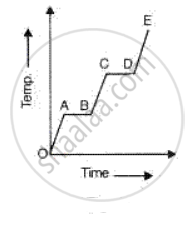
A substance is heated at a constant rate from a low temperature to a high temperature. A graph of temperature against time is shown in the figure. Which part or parts of the graph correspond(s) to the substance existing in two states?
Fill in the following blank using suitable word:
SI unit of heat is .........
What are the factors on which the quantity of heat given to a body depends?
Name the substance which has maximum specific heat capacity.
A certain amount of heat Q will warm 1 g of material X by 3°C and 1 g of material Y by 4°C. Which material has a higher specific heat capacity?
Why are athletes advised to put on extra clothes after competing on event?
Answer the following question.
Why do we generally consider two specific heats of a gas?
Explain how heat capacity of a solid can be determined by the method of mixture.
Read this activity and answer the following questions.
- Take three spheres of iron, copper and lead. the lead of equal mass.
- Put all the three spheres in boiling water in the beaker for some time.
- Take the three spheres out of the water.
- All the spheres will be at a temperature 100 °C.
- Put them immediately on the thick slab of wax.
- Note, the depth that each of the sphere goes into the wax.
Questions:
- Which property is determined from this activity?
- Give name to that property.
- Explain the term principal of heat exchange with the help of this activity.
If 'Cp' and 'Cv' are molar specific heats of an ideal gas at constant pressure and volume respectively. If 'λ' is the ratio of two specific heats and 'R' is universal gas constant then 'Cp' is equal to ______.
A monoatomic gas of pressure 'P' having volume 'V' expands isothermally to a volume '2V' and then adiabatically to a volume '16V'. The final pressure of the gas is ______.
(ratio of specific heats = `5/3`)
Two metals A and B have specific heat capacities in the ratio 2 : 3. If they are supplied the same amount of heat then
Which metal piece will show a greater rise in temperature given their masses is the same?
The specific heat capacity of water is ______.
A geyser heats water flowing at a rate of 2.0 kg per minute from 30°C to 70°C. If the geyser operates on a gas burner, the rate of combustion of fuel will be ______ g min-1.
[Heat of combustion = 8 × 10³ Jg-1 Specific heat of water = 4.2 Jg-1°C-1]
