Advertisements
Advertisements
प्रश्न
Equal heat is given to two objects A and B of mass 1 g. Temperature of A increases by 3°C and B by 5°C. Which object has more specific heat? And by what factor?
Advertisements
उत्तर
`s = (DeltaQ)/(mDeltaT)`
Let Q cal of heat be given to both A and B.
For body A,
`s_1 = Q/(1 xx 3) = Q/3 "cal" g^(-1@)C^(-1)`
For body B,
`s_2 = Q/(1 xx 5) = Q/5 "cal" g^(-1@)C^(-1)`
Now,
`(s_1)/(s_2) = (Q/3)/(Q/5) = 5/3`
= `s_1 = 5/3 s_2`
Thus, specific heat capacity of body A is more than body B and by a factor of `5/3`.
APPEARS IN
संबंधित प्रश्न
Two metallic blocks P and Q of masses in ratio 2: 1 are given the same amount of heat. If their temperature rise by the same amount, compare their specific heat capacities.
Name the radiations for which the green house gases are transparent ?
Name and state the principle used to measure the specific heat capacity of a substance.
104g of water at 30°C is taken in a calorimeter made of copper of mass 42 g. When a certain mass of ice at 0°C is added to it, the final steady temperature of the mixture after the ice has melted, was found to be 10°C. Find the mass of ice added. [Specific heat capacity of water = 4.2 Jg–1°C–1 ; Specific latent heat of fusion of ice = 336 Jg–1; Specific heat capacity of copper = 0.4 Jg–1°C–1] .
Define heat capacity.
State, with reason, which of the two, boiling water or steam both at 100°C will produce more severe burns.
Does the specific heat capacity of a substance depend upon its mass and rise in temperature only?
Write the approximate values of the specific latent heat of fusion of ice.
How much heat energy is released when 5 g of water at 20° C changes to ice at 0° C?
[Specific heat capacity of water = 4.2 J g-1 ° C-1 Specific latent heat of fusion of ice = 336 J g-1]
A piece of iron of mass 2.0 kg has a thermal capacity of 966 J/°C. What is its specific heat capacity in S.I. units?
The cold object the hot object enclosed in one box of heat-resistant material.
- What changes will occur in the two objects when temperature flows from those objects?
- Which principle can show that the energy exchange takes place between two objects only when kept in isolated system?
At same temperature and pressure of an ideal gas, ____________.
For a gas `"R"/"C"_"v" = 0.4,` where 'R' is the universal gas constant and 'Cv' is molar specific heat at constant volume. The gas is made up of molecules which are ______.
The diagram below shows a cooling curve for 200 g of water. The heat is extracted at the rate of 100 Js-1. Answer the questions that follow:
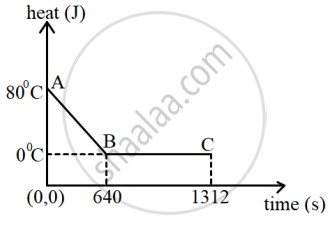
- Calculate specific heat capacity of water.
- Heat released in the region BC.
J/Kg °C is the unit of specific heat capacity.
A metal ball of heat capacity 50J/°C loses 2000 J of heat. By how much will its temperature fall?
Which method is used to determine the specific heat capacity of both solids and liquids by mixing a substance of unknown specific heat with water?
