Advertisements
Advertisements
Question
Equal heat is given to two objects A and B of mass 1 g. Temperature of A increases by 3°C and B by 5°C. Which object has more specific heat? And by what factor?
Advertisements
Solution
`s = (DeltaQ)/(mDeltaT)`
Let Q cal of heat be given to both A and B.
For body A,
`s_1 = Q/(1 xx 3) = Q/3 "cal" g^(-1@)C^(-1)`
For body B,
`s_2 = Q/(1 xx 5) = Q/5 "cal" g^(-1@)C^(-1)`
Now,
`(s_1)/(s_2) = (Q/3)/(Q/5) = 5/3`
= `s_1 = 5/3 s_2`
Thus, specific heat capacity of body A is more than body B and by a factor of `5/3`.
APPEARS IN
RELATED QUESTIONS
Water in lakes and ponds do not freeze at once in cold countries. Give a reason is support of your answer.
50 g of metal piece at 27°C requires 2400 J of heat energy so as to attain a temperature of 327°C . Calculate the specific heat capacity of the metal.
What do you mean by the following statement?
The heat capacity of a body is 50 JK-1?
In an experiment to determine the specific heat capacity of a solid following operations were
made:
Mass of calorimeter + stirrer = x kg
Mass of water = y kg
Initial temperature of water t1℃
Mass of solid = z kg
Temperature of solid = t2 ℃
Temperature of mixture = t ℃
Specific heat capacity of calorimeter and water are c1 and c2 respectively. Express the specific
heat capacity c of the solid in terms of the above data.
A heater of power P watt raises the temperature of m kg of a liquid by Δt K in time t s. Express
the specific heat capacity of liquid in terms of above data.
Explain the term boiling point ?
Name two green house gases ?
How will you prove experimentally that different substances have different specific heat capacities?
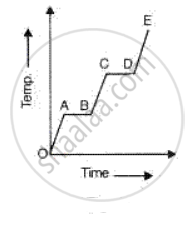
A substance is heated at a constant rate from a low temperature to a high temperature. A graph of temperature against time is shown in the figure. Which part or parts of the graph correspond(s) to the substance existing in two states?
A solid of mass 80 g at 80°C is dropped in 400 g water at 10°C. If final temp. is 30°C, find the sp. heat cap. of the solid.
Write the approximate values of the specific latent heat of fusion of ice.
63.2 g of copper at 50°C can just melt 3.8g of ice. If the specific latent heat of ice is 336 J/g, find the specific heat capacity of copper.
A vessel of negligible heat*capacity contains 40g of ice in it at 0°C, 8g of steam at 100°C is passed into the ice to melt it. Find the final temperature of the contents of the vessel.
(Specific latent heat of vaporization of steam = 2268 J/g, specific latent heat of fusion of ice = 336 J/f and specific heat capacity of water = 4.2 J/g°C)
Explain how heat capacity of a solid can be determined by the method of mixture.
Define specific heat capacity.
The heat capacity of the vessel of mass 100 kg is 8000 J/°K. Find its specific heat capacity.
The molar specific heat of an ideal gas at constant pressure and constant volume is 'Cp' and 'Cv' respectively. If 'R' is the universal gas constant and the ratio 'Cp' to 'Cv' is 'γ' then CV = ______.
A 0.2 kg metal at 150°C is placed in a copper calorimeter (water equivalent 0.025 kg) with 150 cm³ water at 27°C. Final temperature is 40°C. Find the specific heat of the metal.
