Advertisements
Advertisements
प्रश्न
Describe the general trends in the following properties of the elements in Groups 13 and 14.
Ionisation enthalpy
Advertisements
उत्तर
In group 13, the standardised trend of decrease of Ionisation enthalpy is not monitored.
As we move from Boron to Aluminium the atomic size increases and ionisation enthalpy decreases but when we move ahead from Aluminium to Gallium, the screening effect of 3d electrons comes into play. The poor shielding effect of the electrons lead to the increase in nuclear charge on the valence electrons and results in increase of ionisation enthalpy.
Moving from gallium to Indium, due to The shielding effect of 4d electrons the ionisation enthalpy decreases.
From Indium to thallium, 4f electrons come into action their poor shielding effect increases the effective nuclear charge on valence electrons hence the ionisation of Thallium energy further increases.
The decreasing order of ionization enthalpy for group-13 elements will be: B > Ti > Ga > Al > In
As we move down in group 14 the ionisation enthalpy decreases in the order: C > Si > Ge > Pb > Sn
On moving down the group the size of the atom increases which results in the large decrease in ionisation energy from carbon to silicon but as we move from silicon to heavier metals small decrease in the ionisation energy is observed. This is mainly due to the less screening effect of d-electrons in germanium and tin, and due to fully filled d and f electrons in lead.
APPEARS IN
संबंधित प्रश्न
How can you explain higher stability of BCl3 as compared to TlCl3?
How would you explain the lower atomic radius of Ga as compared to Al?
In some of the reactions thallium resembles aluminium, whereas in others it resembles with group I metals. Support this statement by giving some evidences.
Write a balanced equation for B2H6 + NH3 → ?
The geometry of a complex species can be understood from the knowledge of type of hybridisation of orbitals of central atom. The hybridisation of orbitals of central atom in [Be(OH)4]– and the geometry of the complex are respectively.
Which of the following oxides is acidic in nature?
Ionisation enthalpy (∆iH1kJ mol–1) for the elements of Group 13 follows the order.
In the structure of diborane ______.
Which of the following statements are correct. Answer on the basis of Figure.
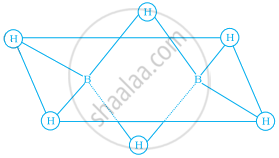
(i) The two birdged hydrogen atoms and the two boron atoms lie in one plane;
(ii) Out of six B – H bonds two bonds can be described in terms of 3 centre 2-electron bonds.
(iii) Out of six B – H bonds four B – H bonds can be described in terms of 3 centre 2 electron bonds;
(iv) The four-terminal B – H bonds are two centre-two electron regular bonds.
Explain the following:
Boron does not exist as B3+ ion.
Explain the following:
Pb4+ acts as an oxidising agent but Sn2+ acts as a reducing agent.
Match the species given in Column I with the hybridisation given in Column II.
| Column I | Column II |
| (i) Boron in [B(OH)4]– | (a) sp2 |
| (ii) Aluminium in [Al(H2O)6]3+ | (b) sp3 |
| (iii) Boron in B2H6 | (c) sp3d2 |
| (iv) Carbon in Buckminsterfullerene | |
| (v) Silicon in \[\ce{SiO^{4-}4}\] | |
| (vi) Germanium in [GeCl6]2– |
Describe the general trends in the following properties of the elements in Groups 13 and 14.
Atomic size
Describe the general trends in the following properties of the elements in Groups 13 and 14.
Oxidation states
Describe the general trends in the following properties of the elements in Groups 13 and 14.
Nature of halides
Three pairs of compounds are given below. Identify that compound in each of the pairs which has group 13 element in more stable oxidation state. Give reason for your choice. State the nature of bonding also.
AlCl3 , AlCl
Which one of the following is the correct statement?
Taking stability as the factor, which one of the following represents the correct relationship?
