Advertisements
Advertisements
प्रश्न
Choose the wrong option.
विकल्प
Inertial mass is a measure of difficulty of accelerating a body by an external force whereas the gravitational mass is relevant in determining the gravitational force on it by an external mass.
That the gravitational mass and inertial mass are equal is an experimental result.
That the acceleration due to gravity on earth is the same for all bodies is due to the equality of gravitational mass and inertial mass.
Gravitational mass of a particle like proton can depend on the presence of neighouring heavy objects but the inertial mass cannot.
Advertisements
उत्तर
Gravitational mass of a particle like proton can depend on the presence of neighouring heavy objects but the inertial mass cannot.
Explanation:
Inertial mass: It is the mass of the material body, which measures its inertia.
Gravitational Mass: It is the mass of the material body, which determines the gravitational pull acting upon it.
According to the principle of equivalence, the Gravitational mass of proton is equivalent to its inertial mass and is independent of the presence of neighbouring heavy objects.
Important point: Comparison between inertial and gravitational mass:
- Both are measured in the same units.
- Both are scalars.
- Both do not depend on the shape and state of the body.
- Inertial mass is measured by applying Newton’s second law of motion whereas gravitational mass is measured by applying Newton’s law of gravitation.
- Spring balance measures gravitational mass and inertial balance measure inertial mass.
APPEARS IN
संबंधित प्रश्न
What is the importance of the universal law of gravitation?
Calculate the force of gravitation between the earth and the Sun, given that the mass of the earth = 6 × 1024 kg and of the Sun = 2 × 1030 kg. The average distance between the two is 1.5 × 10¹¹ m.
Answer the following:
An astronaut inside a small space ship orbiting around the earth cannot detect gravity. If the space station orbiting around the earth has a large size, can he hope to detect gravity?
Let V and E represent the gravitational potential and field at a distance r from the centre of a uniform solid sphere. Consider the two statements:
(A) the plot of V against r is discontinuous.
(B) The plot of E against r is discontinuous.
Inside a uniform spherical shell
(a) the gravitational potential is zero
(b) the gravitational field is zero
(c) the gravitational potential is same everywhere
(d) the gravitational field is same everywhere
Derive an expression for the gravitational field due to a uniform rod of length L and mass M at a point on its perpendicular bisector at a distance d from the centre.
A tunnel is dug along a diameter of the earth. Find the force on a particle of mass m placed in the tunnel at a distance x from the centre.
The law of gravitation gives the gravitational force between :
A ball is thrown vertically upwards. It goes to a height 20 m and then returns to the ground. Taking acceleration due to gravity g to be 10 ms-2 , find :
the final velocity of the ball on reaching the ground .
Distinguish between gravity and gravitation
Where will you weigh more: at the moon's surface or at the earth's surface?
You can change the direction in which an object is moving by___________.
Name and state the action and reaction in the following case:
Hammering a nail.
Is there a gravitational attraction between you and the book? Explain.
Does the force of the earth's gravitation affect the motion of the moon? Explain your answer with reasons.
To project the rockets which of the following principle(s) is /(are) required?
Complete the chart below.
| F(N) | M1(kg) | M2(kg) | D(m) |
| (a) | 50 | 84 | 02 |
| 16 × 109 | 1.63 × 10²² | (b) | 34 |
Four identical particles of equal masses 1 kg made to move along the circumference of a circle of radius 1 m under the action of their own mutual gravitational attraction. The speed of each particle will be ______.
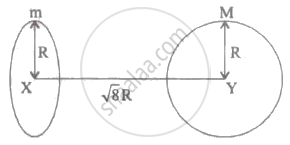
Find the gravitational force of attraction between the ring and sphere as shown in the diagram, where the plane of the ring is perpendicular to the line joining the centres. If `sqrt8` R is the distance between the centres of a ring (of mass 'm')and a sphere (mass 'M') where both have equal radius 'R'.
The gravitational force between two objects acts in which direction?
