Topics
Linear Equations in Two Variables
- Foundation of Linear Equations in Two Variables
- Simultaneous Linear Equations
- Graph of a Linear Equation in Two Variables
- Methods of Solving Linear Equations in Two Variables > Graphical Method
- Methods of Solving Linear Equations in Two Variables > Determinant method (Cramer’s Rule)
- Equations Reducible to Linear Equations
- Application of Simultaneous Equations
Quadratic Equations
- Concept of Quadratic Equations
- Factorisation Method
- Completing the Square Method
- Quadratic Formula (Shreedharacharya's Rule)
- Nature of Roots of a Quadratic Equation
- Relation Between Zeroes (Roots) and Coefficients of a Quadratic Equation
- Formation of a Quadratic Equation with Given Roots
- Application of Quadratic Equation
Arithmetic Progression
Financial Planning
Probability
Statistics
Definition: Simultaneous Linear Equations
A system of simultaneous linear equations is a pair of linear equations in the same two variables that must be satisfied together.
The standard form is:
\[ a_{1}x + b_{1}y + c_{1} = 0 \]
\[ a_{2}x + b_{2}y + c_{2} = 0 \]
A solution is an ordered pair (x,y) that satisfies both equations.
Method I: Substitution Method
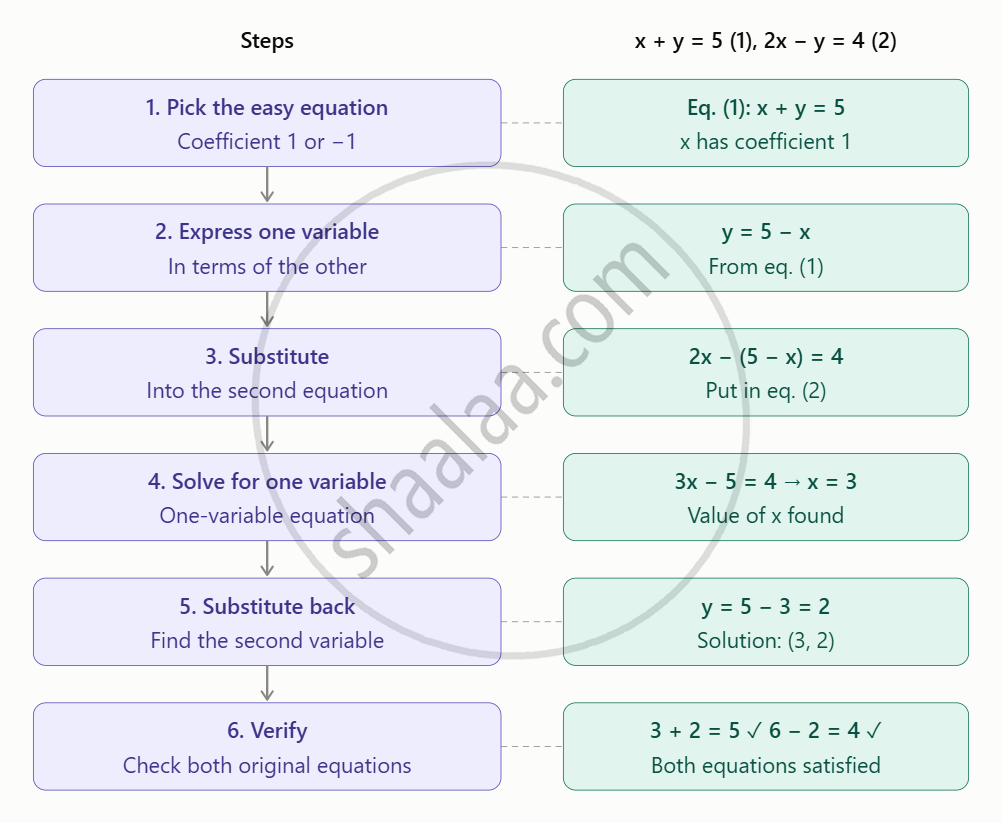
Use this method when one variable can be easily expressed in terms of the other.
Example
Given Equations:
\[ 5x - 3y = 8 \ldots (I) \]
\[ 3x + y = 2 \ldots (II) \]
Step-by-Step Solution:
Step 1: Pick the easy equation
Equation (II) \[ (3x + y = 2) \] is easier because the variable \[ y \] has a coefficient of \[ 1. \]
Step 2: Express one variable in terms of the other
\[ y = 2 - 3x \ldots (III) \]
Step 3: Substitute into the second equation
\[ 5x - 3(2 - 3x) = 8 \]
Step 4: Solve for \[ x \]
Expand the brackets: \[ 5x - 6 + 9x = 8 \]
Combine like terms: \[ 14x - 6 = 8 \]
Rearrange and solve:
\[ 14x = 8 + 6 \]
\[ 14x = 14 \]
\[ x = 1 \]
Step 5: Substitute back to find \[ y \]
Substitute \[ x = 1 \] into Equation (III):
\[ y = 2 - 3(1) \]
\[ y = 2 - 3 \]
\[ y = -1 \]
Final Answer:
\[ x = 1, y = -1 \] is the solution to the given pair of linear equations.
Method II: Elimination Method
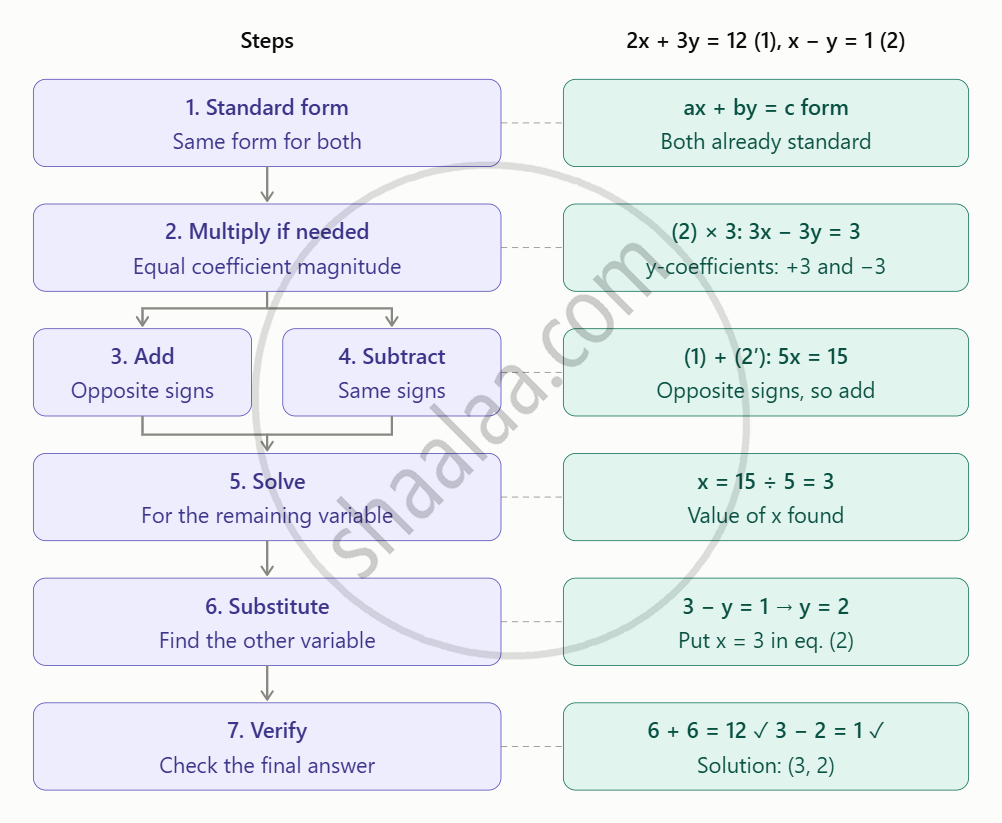
Use this method when coefficients of one variable can be made equal or opposite easily.
Example
Given Equations:
\[ 3x + 2y = 29 \ldots (I) \]
\[ 5x - y = 18 \ldots (II) \]
Step 1: Multiply equation (II) by 2 to align \[ y \] coefficients
\[ 5x \times \mathbf{2} - y \times \mathbf{2} = 18 \times \mathbf{2} \]
\[ \therefore 10x - 2y = \mathbf{36} \ldots (III) \]
Step 2: Add equations (I) and (III)
\[ \begin{array}{r} 3x + 2y = 29 \\ \mathbf{+10x - 2y = 36} \\ \hline \mathbf{13x = 65} \implies \therefore x = \mathbf{5} \end{array} \]
Step 3: Substitute \[ x = 5 \] into equation (I)
\[ 3 \times \mathbf{5} + 2y = 29 \]
\[ \therefore \mathbf{15} + 2y = 29 \]
\[ \therefore 2y = 29 - \mathbf{15} \]
\[ \therefore 2y = \mathbf{14} \implies \therefore y = \mathbf{7} \]
Final Answer:
\[ (x, y) = (5, 7) \] is the solution.
Key Points: Simultaneous Linear Equations
-
Simultaneous equations must be solved together.
-
A solution must satisfy both equations.
-
Substitution replaces one variable using an expression from the other equation.
-
Elimination removes one variable by adding or subtracting suitably modified equations.
