Topics
Linear Equations in Two Variables
- Foundation of Linear Equations in Two Variables
- Simultaneous Linear Equations
- Graph of a Linear Equation in Two Variables
- Methods of Solving Linear Equations in Two Variables > Graphical Method
- Methods of Solving Linear Equations in Two Variables > Determinant method (Cramer’s Rule)
- Equations Reducible to Linear Equations
- Application of Simultaneous Equations
Quadratic Equations
- Concept of Quadratic Equations
- Factorisation Method
- Completing the Square Method
- Quadratic Formula (Shreedharacharya's Rule)
- Nature of Roots of a Quadratic Equation
- Relation Between Zeroes (Roots) and Coefficients of a Quadratic Equation
- Formation of a Quadratic Equation with Given Roots
- Application of Quadratic Equation
Arithmetic Progression
Financial Planning
Probability
Statistics
Definition: Tax Invoice
A tax invoice is a bill issued by a registered GST dealer showing details of goods or services supplied, taxable value, GST charged (CGST, SGST or IGST), and total amount payable.
Definition: GSTIN (Goods and Services Tax Identification Number)
GSTIN is a 15-digit alphanumeric identification number allotted to every registered GST dealer for the purpose of tax administration.
-
Mandatory for dealers with turnover above ₹20 lakh.
-
Structure of GSTIN:
Part of GSTIN Meaning First 2 characters State code Next 10 characters PAN of the business 13th character Entity number 14th character Usually the letter ‘Z’ 15th character Check digit
Definition: HSN Code & SAC Code
Definition: HSN Code
HSN (Harmonised System of Nomenclature) is a numerical code used for the classification of goods under GST.
Definition: SAC Code
SAC (Services Accounting Code) is a numerical code used for the classification of services under GST.
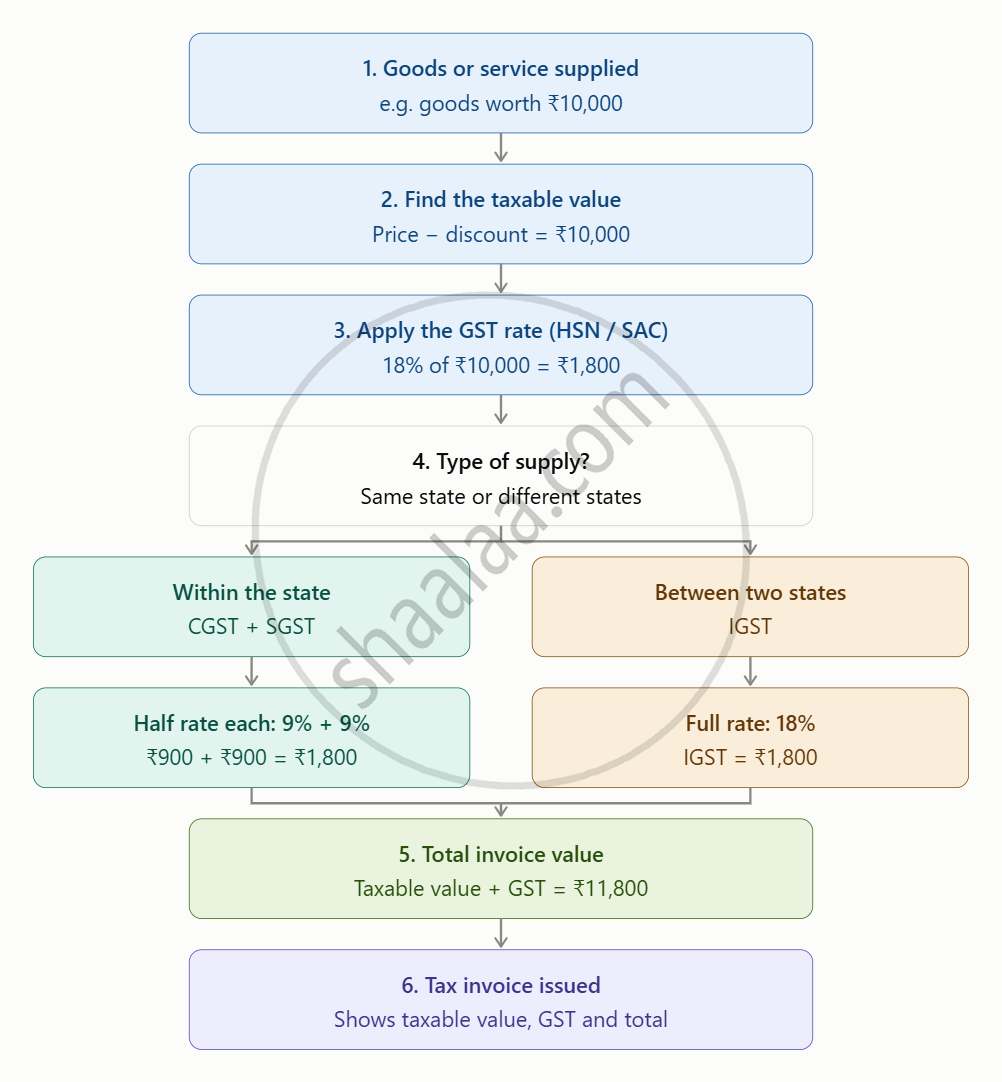
Formula: Calculation of Invoice Value
\[ \text{GST} = \text{Taxable Value} \times \text{GST Rate} \]
For an intra-state sale, GST is generally divided into two equal parts:
\[ \text{CGST} = \frac{\text{GST}}{2} \]
\[ \text{SGST} = \frac{\text{GST}}{2} \]
\[ \text{Invoice Value} = \text{Taxable Value} + \text{CGST} + \text{SGST} \]
Remember:
For intra-state transactions, CGST and SGST are usually equal. Together, they make up the total GST.
Structure of a GST Tax Invoice
Classification of Goods and Services under GST Slabs
| Slab | Tax Rate | Goods Examples | Services Examples |
|---|---|---|---|
| I | 0% (Zero Rated) | Food grains, milk, fresh vegetables | Education, healthcare, water transport |
| II | 5% (Low Rated) | LPG cylinder, tea, oil, spices | Railway & bus transport, economy air travel |
| III | 12% (Standard Slab I) | Butter, ghee, dry fruits, mobile phones | Printing job work, guest houses |
| IV | 18% (Standard Slab II) | Computers, CCTV, perfumes, marble | Courier, cinema, IT/broker services |
| V | 28% (Highly Rated) | Luxury cars, AC, fridge, tobacco | 5-star hotels, amusement parks, IPL games |
Key Points: Tax Invoice Under GST(Mathematics)
-
GST is an indirect tax on the supply of goods and services.
-
A tax invoice records the sale and the GST charged.
-
GSTIN is the 15-character identification number of a GST-registered business.
-
HSN code classifies goods.
-
SAC code classifies services.
-
Taxable value is the value on which GST is calculated.
-
CGST and SGST are equal parts of total GST for intra-state transactions.
-
Invoice value = Taxable value + CGST + SGST.
-
Apply discounts before calculating GST, unless the question says otherwise.
