Topics
Introduction of Commerce and Business
Trade
- Concept of Trade
- Internal Trade
- Wholesale Trade
- Retail Trade
- Types of Retailers> Itinerant Retailers
- Types of Retailers> Fixed Shop Retailer
- Small Scale Fixed Retailer
- Large Scale Fixed Retailers
- Departmental Stores
- Super Market Shop
- Chain Stores or Multiple Shops
- One Price Shop
- Concept of Mall
- International Trade
- Export Trade
- Procedure of Export Trade
- Import Trade
- Procedure of Import Trade
- Entrepot Trade
- Comparison of Different Types of Retailers and Trade Practices
Small Scale Industry and Business
Forms of Business Organisation - 1
- Private Sector Organisations
- Sole Trading Concern
- Partnership Firm
- Types of Partners
- Types of Partnerships Firms
- Hindu Undivided Family Business Or Joint Hindu Family Business
- Co-operative Society
- Types of Cooperative Societies
- Joint Stock Company
- Amul: A Successful Co-operative Movement in India
- Private Limited Company
- Public Limited Company
- Comparison of Different Forms of Business Organization
Forms of Business Organisation - 2
Institutes Supporting Business
Business Environment
- Concept of Business Environment
- Importance of Business Environment
- Dimensions of Business Environment
- Internal Factors
- External Factors> Natural Environment
- External Factors> Social Environment
- External Factors> Political Environment
- External Factors> Economic Environment
- External Factors> Technological Environment
- External Factors> Legal Environment
- New Economic Policy and Business
- Liberalisation
- Privatisation
- Globalisation
- Impact of New Economic Policy on Business
Introduction to Management
- Introduction
- Changes After the 1991 Economic Policy
- Impact of New Economic Policy on Business
- Key Point Summary
Maharashtra State Board: Class 11
Introduction
The New Economic Policy (NEP) of 1991 was a major turning point for Indian businesses. It shifted India from a tightly controlled, government-centered economy to a more open, market-driven environment. This brought not just new opportunities, but also many challenges for businesses.
Maharashtra State Board: Class 11
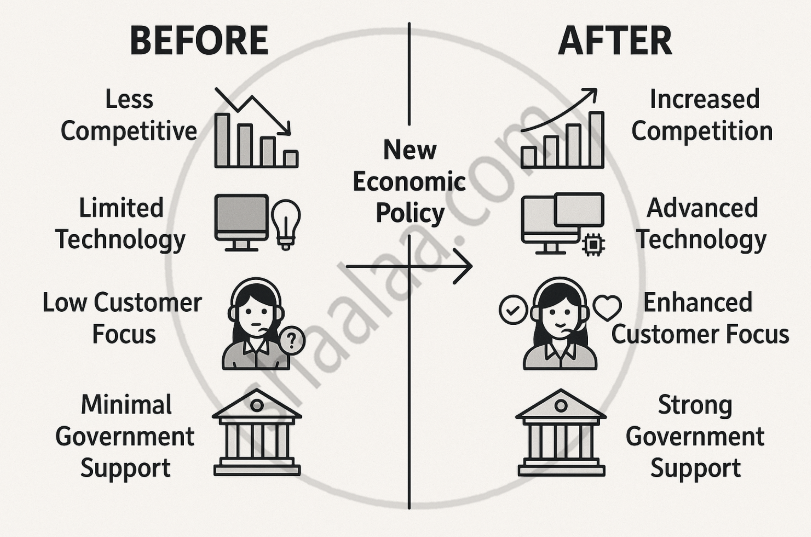
Changes After the 1991 Economic Policy
Maharashtra State Board: Class 11
Impact of New Economic Policy on Business
1. Increased Competition
- NEP allowed private & foreign firms into the market.
- Businesses must improve quality to survive.
- Example: Many soft drink brands now compete.
2. More Demanding Customers
- More choices = higher expectations.
- Example: Mobile users want fast, cheap, and reliable service.
3. Rapid Technological Changes
- Easy adoption of new tech post-NEP.
- Example: Banks use ATMs, online, and mobile banking.
4. Need for Constant Change
- Products, marketing, and management must adapt regularly.
5. Focus on Human Resources
- Need for skilled workers and training programs.
- Example: IT firms train staff on new tech.
6. Customer-Oriented Market
- Shift from production focus to customer needs.
- Example: Restaurants modify their menus based on customer feedback.
7. Reduced Government Support
- Fewer subsidies; public firms must earn profits.
- Example: Air India improved after subsidy cuts.
8. Need for Expertise
- Modern businesses require experts in various fields, including marketing, law, finance, and others.
9. Effort Needed for Survival
- Only adaptive, innovative, and customer-focused firms survive.
Maharashtra State Board: Class 11
Key Point Summary
- NEP increased competition and raised customer expectations.
- Technology, innovation, and skilled staff are essential for business success.
- Companies have to work harder and smarter without government support.
- Only adaptable and customer-focused firms thrive in the modern market.
