Topics
Controlling Air Pollution
- From Domestic Combustionc
- From Industries
- From Vehicles
- Traffic Management
- Economic Policy
Addressing Population
- The Link Between Growing Population and Environmental Degradation
- Theories of Population Growth
- Strategies for Controlling Growth of Population
- Poverty Alleviation Programmes and Their Target Sectors
Managing the Urban Environment
- Urbanisation in India
- Planning Environmental Improvement
- Rural Development to Counter Migration
- Development of Secondary Cities to Counter Migration
- Community Participation and Contribution of Private Enterprises
Managing Soil and Land
- Conserving Soil
- Land Reforms
- National Bank for Agriculture and Rural Development (NABARD)
- Role of Women and Community in Conservation
- Combating Deforestation
- Managing Forest Grazing
- Alternatives to Timber
Food
- Sustainable Agriculture
- Problem of Global Food Security, Food Aid
Biodiversity
- Biodiversity at Risk Due to Human Actions
- Conserving Our Genetic Resource: In-situ and Ex-situ; Harvesting Wildlife
- Conservation Strategies at National and International Levels
Energy
- Fossil Fuels Used to Produce Electricity
- A Sustainable Energy Future
Waste
- Solid Wastes
- Where Does the Trash Go?
- Solid Wastes
Environment and Development
- Global Environmental Pollution
- Economic Development and Environmental Degradation.
- International Trade
- Multinational Corporations
Towards a Sustainable Future
- Global Interdependence – Economic and Environmental
- International Cooperation
- Concept of Sustainable Development
- Role of Non-governmental Organisations
- Technology that Sustains
- Introduction
- Features
- Merits
- Demerits
- Real-Life Application
- Key Point Summary
Maharashtra State Board: Class 11
Introduction
A Multinational Corporation (MNC) is a large company that controls or owns businesses in more than one country.
- Has its main office (headquarters) in one country and branches or factories in other countries.
- Also referred to as “transnational” or “international” corporations.
- Examples include Tata Motors, Infosys, Apple, Samsung, and Coca-Cola.
Maharashtra State Board: Class 11
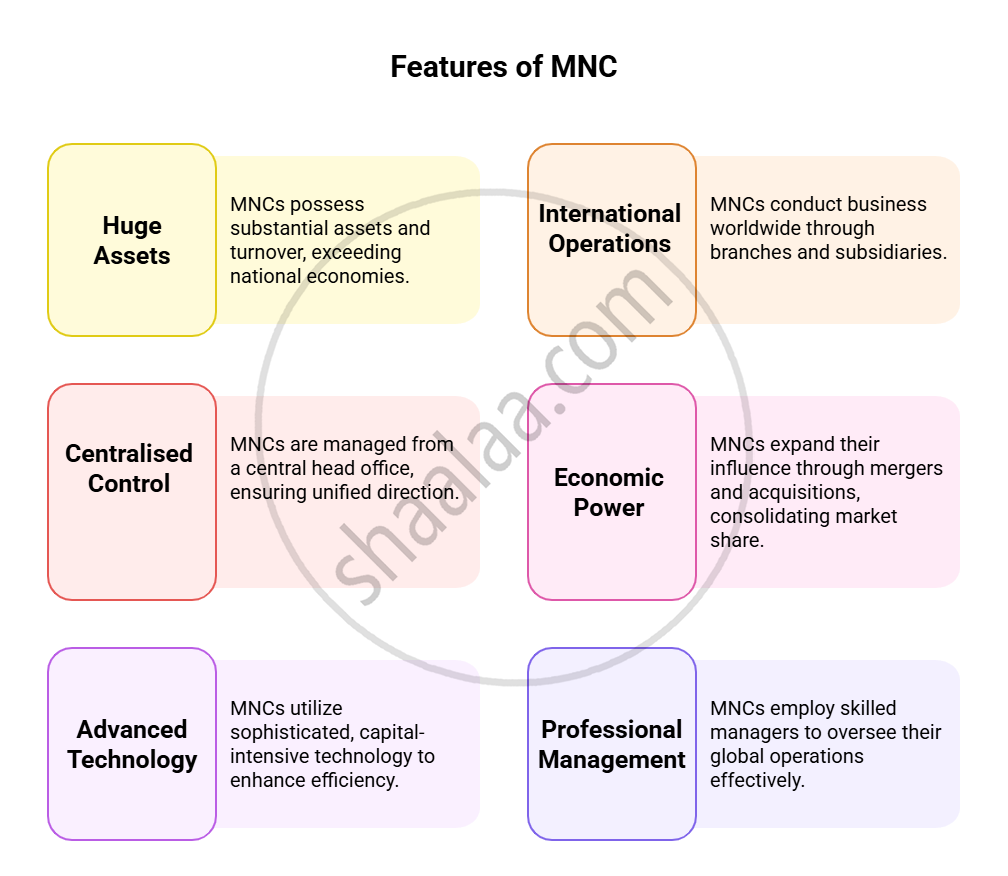
Features
Maharashtra State Board: Class 11
Merits
- Employment Generation: MNCs create jobs in host countries.
- Inflow of Foreign Capital: MNCs bring investment, boosting the economy.
- Proper Use of Idle Resources: MNCs make good use of unused resources.
- Technical Development: MNCs transfer technology to host countries.
- Managerial Development: MNCs improve management practices.
- End of Local Monopolies: MNCs increase competition, improving quality.
- Improvement in Standard of Living: MNCs raise living standards with quality products.
- Promotion of International Brotherhood and Culture: MNCs promote global unity and culture.
Maharashtra State Board: Class 11
Demerits
- Danger for Domestic Industries: MNCs threaten local industries, causing shutdowns.
- Repatriation of Profits: MNCs send profits back home, draining foreign exchange.
- Interference: MNCs may meddle in local politics.
- Disregard of National Interests: MNCs prioritize profit over the host country’s needs.
- Misuse of Mighty Status: MNCs use power to dominate and eliminate local competition.
- Exploitation of Natural Resources: MNCs deplete resources, harming the host country.
- Selfish Promotion of Alien Culture: MNCs push foreign culture, affecting local traditions.
- Exploitation of People: MNCs create monopolies, exploiting workers and concentrating power.
Maharashtra State Board: Class 11
Real-Life Application
| Indian MNC | Key Sector | Foreign Countries Present In |
|---|---|---|
| Tata Group | Automobiles, Steel | UK, USA, South Africa, etc. |
| Infosys | IT Services | USA, Europe, Australia |
| Mahindra & Mahindra | Vehicles, Agri | Africa, USA, South Asia |
Maharashtra State Board: Class 11
Key Point Summary
- MNCs operate in many countries, controlling huge assets and advanced technology.
- They generate jobs and investments but may harm local industries and culture.
- Wise policies can help maximize their benefits for the country.
