Sandeep Garg solutions for Introductory Microeconomics [English] Class 11 chapter 9 - Supply [Latest edition]
Chapters
1: Introduction
UNIT 5: Consumer's Equilibrium and Demand
2: Consumer's Equilibrium
3: Demand
4: Elasticity of Demand
UNIT 6: Producer Behaviour and Supply
5: Production Function
6: Cost
7: Revenue
8: Producer's Equilibrium
▶ 9: Supply
UNIT 7: Forms of Market and Price Determination Under Perfect Competition With Simple Applications
Chapter 10: Main Market Forms
Chapter 11: Price Determination and Simple Applications
Advertisements
Advertisements
Solutions for Chapter 9: Supply
Below listed, you can find solutions for Chapter 9 of CBSE Sandeep Garg for Introductory Microeconomics [English] Class 11.
Advertisements
Sandeep Garg solutions for Introductory Microeconomics [English] Class 11 9 Supply INTEX QUESTIONS [Pages 9.4 - 9.16]
Test Yourself
Identify the following as a change in quantity supplied or change in supply:
The market price of almonds rises. Thus, the quantity supplied of almonds also increases.
Identify the following as a change in quantity supplied or change in supply:
The price of oranges decreases, so, the annual production of grapes increases.
Identify the following as a change in quantity supplied or change in supply:
Automobile workers get a 5 percent wage increase and so, the production of automobiles decreases.
Identify the following as a change in quantity supplied or change in supply:
Due to a fall in the price of paper, the production of paper decreases.
Test Yourself
Identify the following as expansion, contraction, decrease or increase in supply.
| Price (₹) | Supply (units) |
| 10 | 100 |
| 10 | 140 |
Identify the following as expansion, contraction, decrease or increase in supply.
| Price (₹) | Supply (units) |
| 15 | 16 |
| 15 | 12 |
Identify the following as expansion, contraction, decrease or increase in supply.
| Price (₹) | Supply (units) |
| 2 | 20 |
| 1 | 15 |
Identify the following as expansion, contraction, decrease or increase in supply.
| Price (₹) | Supply (units) |
| 7 | 90 |
| 7 | 60 |
Identify the following as expansion, contraction, decrease or increase in supply.
| Price (₹) | Supply (units) |
| 5 | 80 |
| 4 | 65 |
Identify the following as expansion, contraction, decrease or increase in supply.
| Price (₹) | Supply (units) |
| 5 | 100 |
| 7 | 120 |
Sandeep Garg solutions for Introductory Microeconomics [English] Class 11 9 Supply OBJECTIVE QUESTIONS [Pages 9.44 - 9.53]
Fill in the Blanks
Supply relates to a __________ of time, while stock relates to a particular __________ of time.
__________ refers to a graphical representation of supply schedule.
Law of supply states the __________ relationship between price and quantity supplied, __________.
Slope of Supply Curve `= ("Change in Price" (triangleP))/?`
A fall in the productivity of rice due to a cyclone will lead to __________ the supply curve of rice.
All the supply curves, which pass through the origin are __________ elastic.
`"Elasticity of Supply" = ("Percentage Change in Supply") / ?`.
Style Ltd. produces both Trousers and Shirts. An increase in the price of Trousers will lead to a __________ shift in the supply curve of shirts.
If quantity supplied increases by 75% due to a 50% increase in price, then elasticity of Supply is __________.
A 5% rise in the price of X leads to a 20% rise in its supply. In the case of Good Y, a 3% rise in price leads to a 9% rise in its supply. In the given case, commodity __________ is more elastic.
The supply function of a product X is given as: SX = 4PX + 2, where PX stands for price. The firm will be willing to supply 22 pieces in the market at a price of __________.
A positive sign with a coefficient of price elasticity of supply denotes __________ relation between price and quantity supplied.
The supply function of a product X is given as: SX = 9PX + 2, where PX stands for price. The supply at a price of ₹ 4 will be __________ units.
A supply curve forms an angle of 45° at the origin. Its price elasticity of supply will be equal to __________.
If quantity supplied does not change at all as price changes, then price elasticity of supply is __________.
With the decrease in GST from 28% to 18%, the tax liability of the producers has decreased. As a result, supply curve of the good will __________ towards __________.
When the price of a commodity becomes twice the original price, the quantity supplied increases by an amount equal to 3 times of the original quantity supplied. The coefficient of price elasticity of supply will be __________.
When percentage change in the quantity supplied is more than percentage change in price, then demand for such a commodity is said to be __________.
When two supply curves intersect each other, then the __________ curve is more elastic at the point of intersection.
True or False with Reason:
Contraction of supply occurs due to change in factors other than price of the given commodity.
True or False with Reason:
Supply is always unitary elastic for all supply curves starting from the origin.
True or False with Reason:
A producer changes the supply of a commodity only when there is a change in the price of the given commodity.
True or False with Reason:
In the case of zero elastic supply, supply curve is a horizontal straight line.
True or False with Reason:
A fall in the productivity of wheat due to a cyclone will lead to a downward movement along the same supply curve of wheat.
True or False with Reason:
The law of Supply does not indicate the magnitude of change in quantity supplied of a commodity due to a change in its price.
True or False with Reason:
A cost-saving technology shifts the supply curve of a commodity towards the left.
True or False with Reason:
An increase in excise tax leads to a fall in the supply of the given commodity without any change in its market price.
True or False with Reason:
A supply curve cutting quantity axis in its positive range has a highly elastic supply.
True or False with Reason:
A fall in the price of wheat will shift the supply curve of rice towards the left.
True or False with Reason:
Individual supply curves are steeper as compared to market supply curves.
True or False with Reason:
An increase in a number of firms leads to ‘Expansion in Supply’.
True or False with Reason:
An infinitely elastic supply curve is parallel to the price axis.
True or False with Reason:
The following supply schedule is unitary elastic.
| Price in ₹ | 1 | 2 | 3 | 4 | 5 |
| Supply in units | 100 | 200 | 300 | 400 | 500 |
True or False with Reason:
An increase in the price of Limca may reduce the supply of Coke.
True or False with Reason:
If the proportionate change in the quantity supplied of a commodity is less than the proportionate change in its price, price elasticity is greater than unity.
True or False with Reason:
Discoveries, innovations and technological development will lead to a fall in the supply of the given commodity.
True or False with Reason:
In market period, supply can adjust itself to the changing demand.
True or False with Reason:
The supply curve of a good shifts to the right when prices of other goods rise.
True or False with Reason:
Price elasticity of supply is equal to one only when the supply curve forms an angle of 45° at the origin.
Matching Type Questions
From the set of statements given in Column I and Column II, choose the correct pair of statements:
Column I Column II (a) Decrease in Supply (i) Rightward shift in supply curve Column I Column II (b) Contraction in Supply (ii) Downward movement along the supply curve Column I Column II (c) Increase in Supply (iii) Leftward shift in supply curve Column I Column II (d) Expansion in Supply (iv) Quantity supplied rises due to decrease in price
Match the statements given under A with the correct options given under B.
| (A) | (B) |
|---|---|
| (i) Slope of Supply Curve | a. `("Change in Quantity" (triangleQ))/("Change in price" (triangleP))` |
| b. `("Change in price" (triangleP))/("Change in Quantity" (triangleQ))` |
Match the statements given under A with the correct options given under B.
| (A) | (B) |
|---|---|
| (i) Change in Quantity Supplied | a. When supply for the given commodity changes due to factors other than price |
| (ii) Change in Supply | b. When supply of the given commodity changes due to change in its own price |
Match the statements given under (A) with the correct options given under (B).
| (A) | (B) |
|---|---|
| (i) Stock | a. Upward Movement |
| (ii) Increase in Supply | b. Total quantity available at a particular point of time |
| (iii) Expansion in Supply | c. States direct relationship between price and quantity supplied, ceteris paribus |
| (iv) Law of Supply | d. Supply rises at the same price |
Match the statements given under (A) with the correct options given under (B).
| (A) | (B) |
|---|---|
| (i) Decrease in Supply | a. Decrease in Quantity Supplied |
| (ii) Movement along Supply Curve | b. Straight line passing through the origin |
| (iii) Fall in price of factors of production | c. Supply remains same even at higher price |
| (iv) Contraction in Supply | d. Change in Quantity Supplied |
| (v) Unitary Elastic Supply | e. Rightward shift in the supply curve |
Match the statements given under A with the correct options given under B.
| (A) | (B) |
|---|---|
| (i) Es > 1 | a. Supply curve has an intercept on the X-axis |
| (ii) Es < 1 | b. Supply curve is a horizontal straight line |
| (iii) Es = 1 | c. Supply curve has an intercept on the Y-axis |
| d. Supply curve passes through the origin |
Match the statements given under A with the correct options given under B.
| (A) | (B) | ||||||
|---|---|---|---|---|---|---|---|
(i)
|
a. Contraction in Supply | ||||||
(ii)
|
b. Increase in Supply | ||||||
(iii)
|
c. Expansion in Supply | ||||||
(iv)
|
d. Decrease in Supply |
Match the statements given under A with the correct options given under B.
| (A) | (B) |
|---|---|
| (i) % Change in Supply > % Change in Price | a. Highly Elastic Supply |
| (ii) % Change in Supply = % Change in Price | b. Perfectly Elastic Supply |
| c. Less Elastic Supply | |
| d. Unitary Elastic Supply |
Multiple Choice Questions (MCQs)
In the long period, the supply for a commodity is ______.
Perfectly Inelastic
Less Elastic
Highly Elastic
Perfectly Elastic
The coefficient of price elasticity of supply of a good is 3. It is known as ______.
Unitary Elastic Supply
Perfectly Inelastic Supply
Elastic Supply
Inelastic Supply
Which one of the following is not an essential element of supply?
Price of the commodity
Period of time
Willingness to buy
Quantity of the commodity
Which one of the following is the result of an increase in the price of factors of production?
Rightward shift in supply curve
Leftward shift in supply curve
Expansion in supply
Contraction in supply
The market period is a time period during which ______.
Supply cannot be adjusted to meet changed demand conditions
Supply can be fully adjusted to meet changed demand conditions
Change in supply is limited to available capacity
Any change in supply is possible
In the case of ______, supply falls at the same price.
Decrease in supply
Contraction in supply
Increase in supply
Expansion in supply
In case of ______, supply curve is a vertical straight line parallel to the Y-axis.
Perfectly Elastic Supply
Unitary Elastic Supply
Perfectly Inelastic Supply
Less Elastic Supply
Which one of the following is not a determinant of individual supply?
Price of the given commodity
Taxation policy
State of technology
Number of firms
A straight-line supply curve cuts the Y-axis in its negative range. What is the elasticity of supply?
Highly elastic
Unitary elastic
Less elastic
Perfectly Inelastic Supply
Change in the price of the given commodity will lead to ______.
Expansion in Supply
Either (1) or (3)
Contraction in Supply
Neither (1) nor (2)
The given supply schedule represents ______.
| Price (₹) | 20 | 20 |
| Supply (Units) | 100 | 120 |
Expansion in supply
Increase in supply
Contraction in supply
Decrease in supply
Price Elasticity of Supply of a good is 2. It shows that ______.
When price falls by 1%, supply falls by 2%
When price rises by 1%, supply rises by 2%
When supply falls by 1%, price rises by 2%
Either (1) or (2)
Elasticity of supply is said to be perfectly inelastic when ______.
Supply doesn’t change with a change in price
There is an infinite supply at a particular price
When percentage change is supply is equal to percentage change is price
When percentage change is supply is more than percentage change is price
Which of the following statement is not valid with respect to ‘Law of Supply’?
Indicates the magnitude of change in supply due to change in price
States one-sided between price and quantity supplied
Does not establish a proportional relationship between change in price and change in supply
States the direct relationship between price and quantity supplied
Supply is said to be unitary elastic, when ______.
Supply curve is a straight line passing through the origin
Supply curve makes an intercept on the positive Y -axis
Supply curve makes an intercept on the positive X-axis
Supply curve is a horizontal straight line parallel to the X-axis
Due to installation of a machine with latest technology, the cost of production has decreased. It will lead to ______.
Expansion in supply
Increase in supply
Contraction in supply
Decrease in supply
The market supply of a commodity is affected by ______.
State of Technology
Number of firms
Government policy
All of the above
In case of less elastic supply, supply curve ______.
Makes an intercept on the positive X-axis
Is a vertical straight line parallel to the Y-axis
Makes an intercept on the positive Y-axis
Is a horizontal straight line parallel to the X-axis
“Increase in Supply” of a product is caused by ______.
Improvement in Technology
Fall in the Prices of other goods
Fall in Prices of Factors of Production
All of these
The supply curve of a given commodity is given to be S0. On the basis of this diagram, answer the following questions:
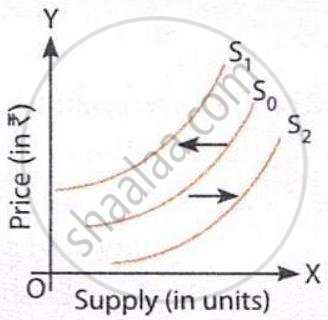
Movement from S0 to S1 is termed as:
Contraction in Supply
Expansion in Supply
Decrease in Supply
Increase in Supply
The supply curve of a given commodity is given to be S0. On the basis of this diagram, answer the following questions:
Increase in cost of production of this commodity will lead to:
Movement from S0 to S1
Movement from S0 to S2
Upward movement along the S0
No change at all
The supply curve of a given commodity is given to be S0. On the basis of this diagram, answer the following questions:
Movement from S0 to S2 is caused by:
Contraction in Supply
Expansion in Supply
Decrease in Supply
Increase in Supply
If quantity supplied increases by 60% due to a 50% increase in price, then elasticity of Supply is ______.
(−) 1.2
(+) 1.2
(−) 0.83
(+) 0.83
The supply function of a product X is given as: (Sx = 6Px + 3), where (Px) stands for price. The supply at price of ₹ 5 will be ______.
18
9
33
14
The supply function of a product X is given as: Sx = 6Px + 3, where Px stands for price. At what price the firm will be willing to supply 27 pieces in the market?
₹ 2
₹ 5
₹ 3
₹ 4
The supply function of a product X is given as: Sx = 6Px + 3, where Px stands for price. If there are 1,000 firms in the market, then market supply for the product at market price of ₹ 4 will be:
20,000 units
23,000 units
27,000 units
21,000 units
Which of the following diagram correctly depicts the situation of Unitary Elastic Supply?
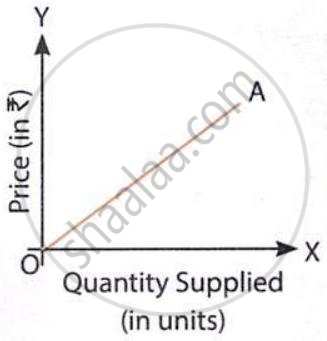
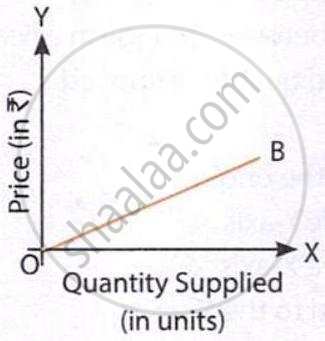
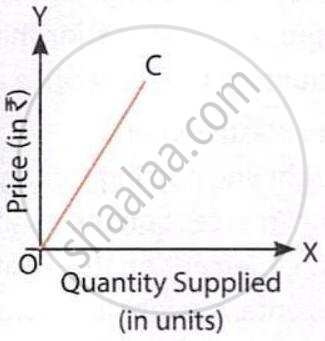
All of these
Expansion in Supply is shown in:
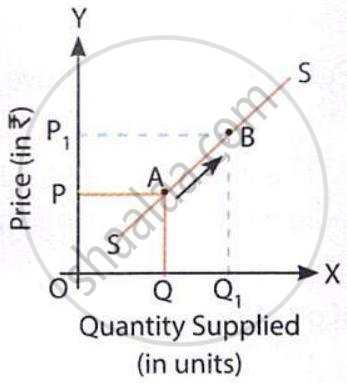
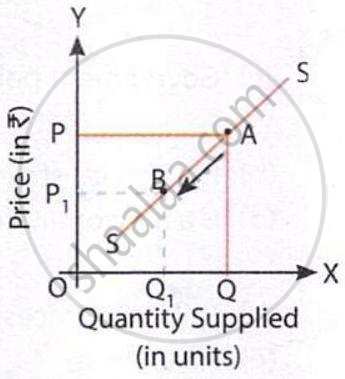
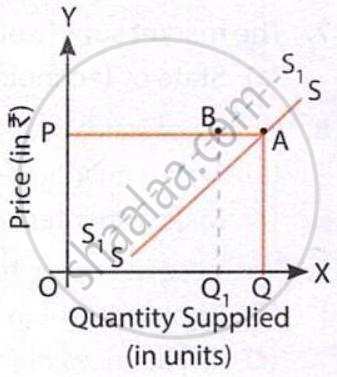
The given diagram is a case of ______ supply.

Less Elastic Supply
Highly Elastic Supply
Unitary Elastic Supply
Perfectly Elastic Supply
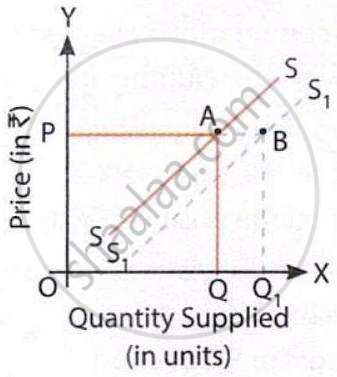
The following supply curve shifts from SS to S1S1. It may be due to:
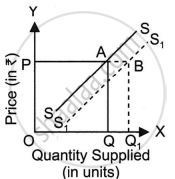
Decrease in Taxes
Upgradation of technology
Fall in the price of inputs
All of these
Degradation of technology will have the following effect on the supply curve:
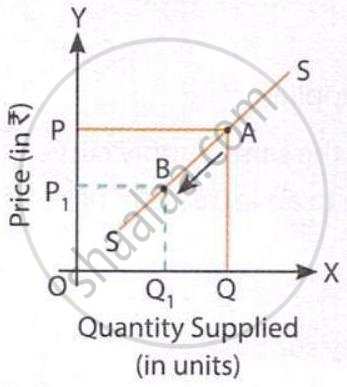
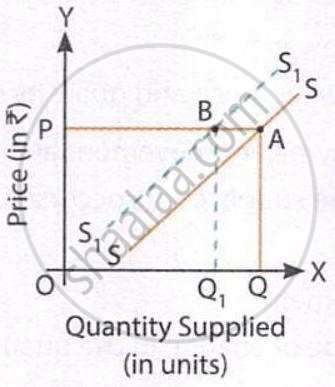
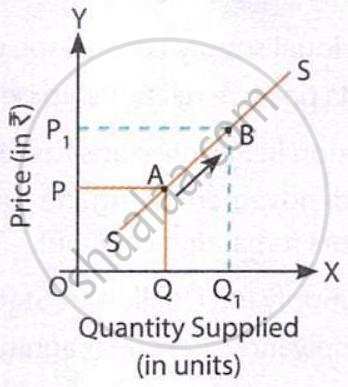
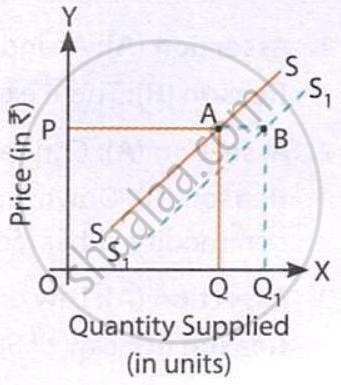
Which of the following measures of price elasticity shows elastic supply? (Choose the correct alternative)
0
0.5
1.0
1.5
Which of the following does not cause shift of supply curve of a good?
Price of input
Price of the good
Goods and Services Tax
Subsidy
If the percentage change in quantity supplied of commodity X is more than the percentage change in price of the commodity X, the coefficient of price elasticity of supply would be ______.
Es = 1
Es < 1
Es = 0
Es > 1
The following figure depicts the case of:
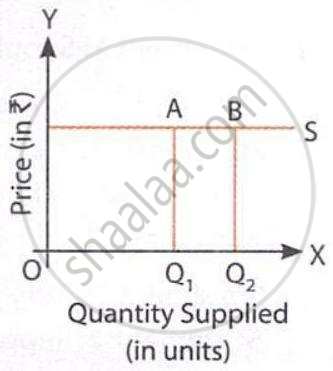
Highly Elastic Supply
Perfectly Inelastic Supply
Perfectly Elastic Supply
Unitary Elastic Supply
Which of the following statement is correct with respect to supply?
Price and quantity have direct relationship
Supply curve rises from left to right
Supply is affected by many factors
All the above
Assertion Reason Questions (ARQs)
In the following Question, read the following statements: Assertion (A) and Reason (R). Choose the correct alternative among them:
Assertion (A): An individual supply curve slope upwards.
Reason (R): There exists positive relationship between price and quantity supplied.
Both Assertion (A) and Reason (R) are True and Reason (R) is the correct explanation of Assertion (A).
Both Assertion (A) and Reason (R) are True and Reason (R) is not the correct explanation of Assertion (A).
Assertion (A) is True but Reason (R) is False.
Assertion (A) is False but Reason (R) is True.
In the following Question, read the following statements: Assertion (A) and Reason (R). Choose the correct alternative among them:
Assertion (A): Contraction in Supply leads to a downward movement along the same supply curve.
Reason (R): Downward movement along the same supply curve occurs due to an increase in price of the commodity, other factors remaining constant.
Both Assertion (A) and Reason (R) are True and Reason (R) is the correct explanation of Assertion (A).
Both Assertion (A) and Reason (R) are True and Reason (R) is not the correct explanation of Assertion (A).
Assertion (A) is True but Reason (R) is False.
Assertion (A) is False but Reason (R) is True.
In the following Question, read the following statements: Assertion (A) and Reason (R). Choose the correct alternative among them:
Assertion (A): Law of Supply is a Qualitative Statement.
Reason (R): Law of Supply indicates the magnitude of change in the quantity supplied.
Both Assertion (A) and Reason (R) are True and Reason (R) is the correct explanation of Assertion (A).
Both Assertion (A) and Reason (R) are True and Reason (R) is not the correct explanation of Assertion (A).
Assertion (A) is True but Reason (R) is False.
Assertion (A) is False but Reason (R) is True.
In the following Question, read the following statements: Assertion (A) and Reason (R). Choose the correct alternative among them:
Assertion (A): Price Elasticity of Supply is more than one in case of elastic supply.
Reason (R): Proportionate change in price is more than proportionate change in supply.
Both Assertion (A) and Reason (R) are True and Reason (R) is the correct explanation of Assertion (A).
Both Assertion (A) and Reason (R) are True and Reason (R) is not the correct explanation of Assertion (A).
Assertion (A) is True but Reason (R) is False.
Assertion (A) is False but Reason (R) is True.
In the following Question, read the following statements: Assertion (A) and Reason (R). Choose the correct alternative among them:
Assertion (A): In case of perfectly inelastic supply, supply curve is a vertical straight line supply curve.
Reason (R): Supply does not change with change in price in case of Es = 0.
Both Assertion (A) and Reason (R) are True and Reason (R) is the correct explanation of Assertion (A).
Both Assertion (A) and Reason (R) are True and Reason (R) is not the correct explanation of Assertion (A).
Assertion (A) is True but Reason (R) is False.
Assertion (A) is False but Reason (R) is True.
Statement Based Questions (SBQs)
In the following Question, read the following statement and choose the correct alternative among them:
Statement 1: Supply of a commodity can be expressed without reference to price.
Statement 2: Supply of a commodity comprises the entire stock of the commodity.
Both the Statements are true.
Both the Statements are false.
Statement 1 is true and Statement 2 is false.
Statement 2 is true and Statement 1 is false.
In the following Question, read the following statement and choose the correct alternative among them:
Statement 1: Whenever supply for the given commodity changes due to factors other than price, then such change in supply is known as ‘Change in Quantity Supplied’.
Statement 2: Individual supply is influenced by all the factors affecting market supply.
Both the Statements are true.
Both the Statements are false.
Statement 1 is true and Statement 2 is false.
Statement 2 is true and Statement 1 is false.
In the following Question, read the following statement and choose the correct alternative among them:
Statement 1: Supply Curve slope upwards due to positive relationship between price and quantity supplied.
Statement 2: Supply Curve can be drawn only for individual producer and not for all the producers in the market.
Both the Statements are true.
Both the Statements are false.
Statement 1 is true and Statement 2 is false.
Statement 2 is true and Statement 1 is false.
In the following Question, read the following statement and choose the correct alternative among them:
Statement 1: Market supply curve is obtained by horizontal summation of individual supply curves.
Statement 2: Market supply curve is flatter than all individual supply curves.
Both the Statements are true.
Both the Statements are false.
Statement 1 is true and Statement 2 is false.
Statement 2 is true and Statement 1 is false.
In the following Question, read the following statement and choose the correct alternative among them:
Statement 1: Slope of supply curve is based on the percentage change in price and quantity.
Statement 2: Due to direct relationship between price and supply, slope of supply curve is positive.
Both the Statements are true.
Both the Statements are false.
Statement 1 is true and Statement 2 is false.
Statement 2 is true and Statement 1 is false.
In the following Question, read the following statement and choose the correct alternative among them:
Statement 1: Law of supply is two sided as it explains the effect of change in price on supply and also the effect of change in supply on the price.
Statement 2: Law of supply indicates the direction of change in quantity supplied, but it does not indicate the magnitude of change.
Both the Statements are true.
Both the Statements are false.
Statement 1 is true and Statement 2 is false.
Statement 2 is true and Statement 1 is false.
In the following Question, read the following statement and choose the correct alternative among them:
Statement 1: Fall in price of the given commodity leads to a downward movement along the same supply curve.
Statement 2: Decrease in taxes leads to a rightward shift in the supply curve.
Both the Statements are true.
Both the Statements are false.
Statement 1 is true and Statement 2 is false.
Statement 2 is true and Statement 1 is false.
In the following Question, read the following statement and choose the correct alternative among them:
Statement 1: The coefficient of price elasticity of supply is independent of price and quantity units.
Statement 2: Depending upon degree of responsiveness of quantity supplied to the price change, there are seven kinds of price elasticities of supply.
Both the Statements are true.
Both the Statements are false.
Statement 1 is true and Statement 2 is false.
Statement 2 is true and Statement 1 is false.
In the following Question, read the following statement and choose the correct alternative among them:
Statement 1: In case of less elastic supply, the supply curve has an intercept on the X-axis.
Statement 2: All the supply curves, which pass through the origin are unitary elastic.
Both the Statements are true.
Both the Statements are false.
Statement 1 is true and Statement 2 is false.
Statement 2 is true and Statement 1 is false.
Solutions for 9: Supply
Sandeep Garg solutions for Introductory Microeconomics [English] Class 11 chapter 9 - Supply
Shaalaa.com has the CBSE Mathematics Introductory Microeconomics [English] Class 11 CBSE solutions in a manner that help students grasp basic concepts better and faster. The detailed, step-by-step solutions will help you understand the concepts better and clarify any confusion. Sandeep Garg solutions for Mathematics Introductory Microeconomics [English] Class 11 CBSE 9 (Supply) include all questions with answers and detailed explanations. This will clear students' doubts about questions and improve their application skills while preparing for board exams.
Further, we at Shaalaa.com provide such solutions so students can prepare for written exams. Sandeep Garg textbook solutions can be a core help for self-study and provide excellent self-help guidance for students.
Concepts covered in Introductory Microeconomics [English] Class 11 chapter 9 Supply are .
Using Sandeep Garg Introductory Microeconomics [English] Class 11 solutions Supply exercise by students is an easy way to prepare for the exams, as they involve solutions arranged chapter-wise and also page-wise. The questions involved in Sandeep Garg Solutions are essential questions that can be asked in the final exam. Maximum CBSE Introductory Microeconomics [English] Class 11 students prefer Sandeep Garg Textbook Solutions to score more in exams.
Get the free view of Chapter 9, Supply Introductory Microeconomics [English] Class 11 additional questions for Mathematics Introductory Microeconomics [English] Class 11 CBSE, and you can use Shaalaa.com to keep it handy for your exam preparation.
