Advertisements
Chapters
▶ 1: Introduction
UNIT 5: Consumer's Equilibrium and Demand
Chapter 2: Consumer's Equilibrium
Chapter 3: Demand
Chapter 4: Elasticity of Demand
UNIT 6: Producer Behaviour and Supply
Chapter 5: Production Function
Chapter 6: Cost
Chapter 7: Revenue
Chapter 8: Producer's Equilibrium
Chapter 9: Supply
UNIT 7: Forms of Market and Price Determination Under Perfect Competition With Simple Applications
Chapter 10: Main Market Forms
Chapter 11: Price Determination and Simple Applications
Advertisements
Solutions for Chapter 1: Introduction
Below listed, you can find solutions for Chapter 1 of CBSE Sandeep Garg for Introductory Microeconomics [English] Class 11.
Sandeep Garg solutions for Introductory Microeconomics [English] Class 11 1 Introduction OBJECTIVE QUESTIONS [Pages 1.30 - 1.43]
Fill in the Blanks
Scarcity refers to the limitation of ______ in relation to ______ for a commodity.
______ deals with study of jute industry.
______ Science deals with what ought to be or how the economic problems should be solved.
Microeconomics is that part of economic theory which studies the behaviour of ______ units of an economy.
______ is the cost of next best alternative foregone.
The problem of ______ involves selection of goods and services to be produced and the quantity to be produced of each selected commodity.
Production Possibility Frontier is ______ shaped because of increasing marginal rate of transformation.
Macroeconomics is also known as ______.
______ is also known as Price Theory.
______ is a system which provides people with the means to work and earn a living.
______ is that part of economic theory which studies the behaviour of aggregates of the economy as a whole.
__________ Economics deals with what are the economic problems and how are they actually solved.
Production Possibility Frontier is convex shaped when marginal rate of transformation is __________.
Two branches of Economics are __________ and __________.
Growth of resources shifts the production possibility frontier towards __________.
The part of economics which deals with the question of what, how and for whom to produce is known as __________.
The problem of __________ deals with technique of production.
PPF will shift towards __________ when there is technological degradation in case of both the goods.
__________ (Positive/Normative) statement is based upon facts and not suggestive in nature.
__________ measures the slope of Production Possibility Frontier.
Microeconomics and Macroeconomics are both __________ (Independent/Interdependent) Branches of Economics.
True or False with Reason:
The problem of ‘how to produce’ involves choice between consumer goods and capital goods.
True or False with Reason:
Economy always operates on production possibility frontier.
True or False with Reason:
Macroeconomics deals with study of cotton textile industry.
True or False with Reason:
If the economy is operating inside the production possibility frontier, it indicates that the economy is saving resources for growth and expansion in future.
True or False with Reason:
Central problems are found only in the developing economies like India and Bangladesh and not in developed countries like USA.
True or False with Reason:
Production possibility frontier shifts towards right when an economy moves from a situation of underutilisation to fuller utilisation of resources.
True or False with Reason:
Economy can never operate outside the production possibility frontier with the given resources and technology.
True or False with Reason:
Production possibility frontier is concave shaped as production of one good can be increased only by reducing quantity of another good.
True or False with Reason:
The problem of price determination of a product comes under the purview of macroeconomics.
True or False with Reason:
Growth of resources shifts the production possibility frontier towards right.
True or False with Reason:
Microeconomics is concerned with study of problems of the economy like inflation or unemployment.
True or False with Reason:
Microeconomics and macroeconomics are independent branches of economics.
True or False with Reason:
The opportunity cost of a machine which can produce only one product is high.
True or False with Reason:
Economising of resources refer to saving resources for future use.
True or False with Reason:
‘No Scarcity’ means no economic problem.
True or False with Reason:
The part of economics which deals with the question of what, how and for whom to produce is known as macroeconomics.
True or False with Reason:
Production Possibility Curve shows the point at which the economy actually operates.
True or False with Reason:
Main tools of Macroeconomics are demand and supply.
Matching Type Questions
From the set of statements given in Column I and Column II, choose the correct pair of statements:
Column I Column II (a) Microeconomics (i) Tools are aggregate demand and aggregate supply Column I Column II (b) Normative Economics (ii) Aims to determine the ideals Column I Column II (c) Opportunity Cost (iii) Cost of best alternative Column I Column II (d) Production possibility frontier (iv) Convex shaped
Match the statements given under A with the correct options given under B.
| (A) | (B) |
|---|---|
| (i) Macroeconomics | a. Aims to determine price of a commodity |
| b. Aims to determine income and employment level of the economy |
Match the statements given under A with the correct options given under B.
| (A) | (B) |
|---|---|
| (i) Positive Economics | a. It is suggestive in nature |
| (ii) Normative Economics | b. It is not suggestive in nature |
Match the statements given under A with the correct options given under B.
| (A) | (B) |
|---|---|
| (i) Opportunity Cost | a. Technique to be used for production of goods and services |
| (ii) Positive Economics | b. Concave Shaped |
| (iii) Production Possibility Frontier | c. Cost of next best alternative foregone |
| (iv) How to Produce | d. Deals with how the economic problems are actually solved |
Match the statements given under A with the correct options given under B.
| (A) | (B) |
|---|---|
| (i) Normative Economics | a. Transformation Curve |
| (ii) Microeconomics | b. Discovery of new natural resources |
| (iii) Growth of Resources | c. It is suggestive in nature |
| (iv) What to Produce | d. Cotton Industry |
| (v) Production Possibility Frontier | e. Selection of goods and services to be produced |
Match the statements given under A with the correct options given under B.
| (A) | (B) |
|---|---|
| (i) Concave PPF | a. Constant MRT |
| (ii) Convex PPF | b. Increasing MRT |
| c. Decreasing MRT |
Match the statements given under A with the correct options given under B.
| (A) | (B) |
|---|---|
| (i) Microeconomics | a. Income and Employment Theory |
| (ii) Macroeconomics | b. Positive Economics |
| c. Price Theory |
Multiple Choice Questions (MCQs)
The law of scarcity ______.
Does not apply to rich, developed countries
Applies only to the less developed countries
Implies that consumers want will be satisfied in a socialistic system
Implies that consumer’s wants will never be completely satisfied
Assume that a PPF for butter and guns is drawn so that it is a straight line. It means ______.
Less and less units of butter are sacrificed to gain an additional unit of gun
More and more units of butter are sacrificed to gain an additional unit of gun
Same units of butter are sacrificed to gain an additional unit of gun
None of these
Which of these is not an assumption of PPC?
Resources are fully and efficiently utilised
Resources in the economy are fixed
There is no change in level of technology
Resources are equally efficient in production of all products
In which situation, can PPC be a straight line:
When MRT is decreasing
When MRT is increasing
When MRT is constant
None of these
Which of these economic problem deals with technique of production?
What to Produce
How to Produce
For whom to Produce
None of these
Ramesh is working at a salary of ₹ 35,000 per month. He receives two job offers: (i) To work as an accountant at a salary of ₹ 30,000 per month; (ii) To work as a sales manager at a salary of ₹ 25,000 per month. In the given case, his opportunity cost will be:
₹ 25,000
₹ 30,000
₹ 35,000
₹ 65,000
PPF is concave to the origin because of ______.
Increasing MRT
Diminishing MRT
Constant MRT
None of these
An economy operate on PPF when there is ______.
Optimum utilisation of resources
Inefficient use of resources
Underemployment of resources
None of these
Identify the central problem which deals with deciding the quantity of goods to be produced ______.
What to Produce
How to Produce
For whom to Produce
None of these
Scarcity refers to limitation of ______ in relation to ______ for a commodity.
Demand, Sale
Demand, Supply
Supply, Demand
None of these
The word ‘Economics’ is most closely connected with the word ______.
Free
Scarcity
Unlimited
Restricted
A point outside the PPF indicates ______.
Fuller utilisation of resources
Unutilisation of resources
Unattainable combination
None of these
Opportunity cost is the ______.
Number of units sacrificed
Number of units gained
Cost of next best alternative foregone
None of these
Which economic problem involves selection of category of people who will ultimately consume the goods?
How to produce
For whom to produce
What to produce
None of these
Which of the following will not lead to shift in PPF?
Upgradation of Technology
Exploration of new oil reserves
Massive unemployment
Destruction of Resources
The fundamental economic problem being faced is ______.
Unlimited human wants
Limited wants and unlimited resources
Unlimited wants and scarcity of resources
Limited wants and limited resources
Which part of economic theory aims to determine income and employment level of the economy?
Microeconomics
Macroeconomics
Neither (a) nor (b)
Both (a) and (b)
What will happen to PPF if there is technological upgradation in case of both the goods?
Rightward shift in PPF
Leftward Shift in PPF
Rotation of PPF
None of these
Answer the following question with the help of following diagram:
Which of the following point represents underutilisation of resources? 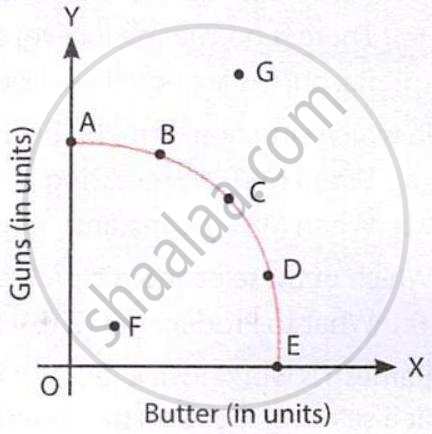
G
E
A
F
Which of the following point represents fuller and efficient utilisation of resources?
B
G
F
None of these
Which of the following point shows unattainable combination?
C
F
G
A
Labour-intensive techniques are chosen in a ______.
Labour-surplus economy
Capital-surplus economy
Developed economy
Developing economy
Which of the following is related to Microeconomics?
Inflation in the economy
Unemployment Problem
National income
Income from Postal department
Which of the following is a cause of economic problem?
Scarcity of Resources
Unlimited Wants
Alternative Uses
All of these
Which of the following is not a central problem of economy?
How to Produce
When to Produce
What to Produce
For whom to Produce
Which of the following illustrates a decrease in the unemployment using the PPC?
A movement down along the PPC
A rightward shift of the PPC
A movement from a point on the PPC to a point inside the PPC
A movement from a point inside the PPC to a point towards the PPC
The problem of ‘What to produce’ covers the issue relating to ______.
What goods are to be produced
What quantities of goods to be produced
Both (a) and (b)
Neither (a) nor (b)
Consider the following table:
| Production Possibilities | A | B | C | D | E |
| Guns (Units) | 0 | 1 | 2 | 3 | 4 |
| Butter (Units) | 10 | 9 | 7 | 4 | 0 |
The opportunity cost of increasing guns production from 2 to 3 units is ______ units of butter.
7
2
4
3
Consider the following table:
| Production Possibilities | A | B | C | D | E |
| Guns (Units) | 0 | 1 | 2 | 3 | 4 |
| Butter (Units) | 10 | 9 | 7 | 4 | 0 |
All possibilities A to E deal with ______.
Full use of available resources
Under-utilisation of available resources
No use of available resources
Demand for more resources
Consider the following table:
| Production Possibilities | A | B | C | D | E |
| Guns (Units) | 0 | 1 | 2 | 3 | 4 |
| Butter (Units) | 10 | 9 | 7 | 4 | 0 |
If at some other point say G, the economy produces 2 units of guns and 6 units of butter, then ______.
It represent under-utilisation of resources
Economy would operate at a point below PPF
Both (a) and (b)
Neither (a) nor (b)
Consider the following table:
| Production Possibilities | A | B | C | D | E |
| Guns (Units) | 0 | 1 | 2 | 3 | 4 |
| Butter (Units) | 10 | 9 | 7 | 4 | 0 |
If the above points A to E are depicted on a graph, then such PPF would be ______.
Convex to the origin
Concave to the origin
Straight line
Rectangular hyperbola
Economics is the study of ______.
How society manages its unlimited resources
How to reduce our wants until we are satisfied
How society manages its scarce resources
How to fully satisfy our limited wants
Which point on the following PPC shows a “productively efficient” level of output?
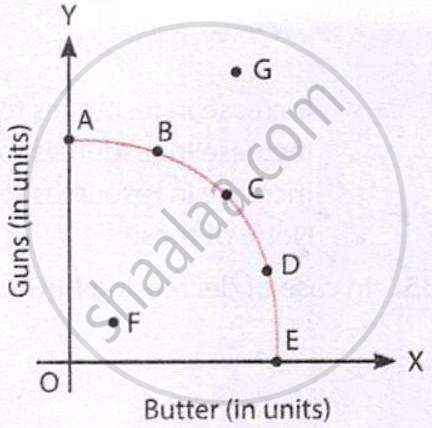
A
B
E
All of these
In deciding “How to produce”, the economy should consider ______.
Labour Intensive Techniques
Capital Intensive Techniques
Both (a) and (b)
Neither (a) nor (b)
Opportunity Costs arise ______.
When there is only course of action
When there are two or more alternative courses
Both (a) and (b)
Neither (a) nor (b)
Which of these statements is true about production possibility curve?
It shows various combinations of two goods which yield same level of satisfaction
It shows various combination of two goods which an economy can produce with a given amount of resources and technology
It shows various combination of two goods which an economy can produce with a given budget
It shows various combination of two goods which an economy can produce with a given time
The Production Possibility Frontier is generally ______.
Convex Shaped
Concave Shaped
Either (a) or (b)
Neither (a) nor (b)
Due to ‘Make in India’, there has been large inflow of foreign capital. It will lead to the following change in PPC:
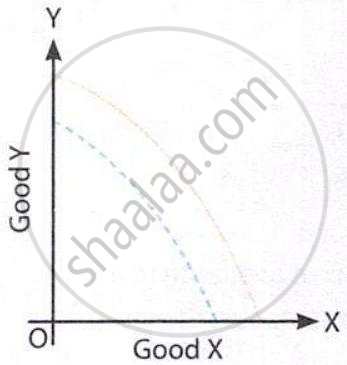
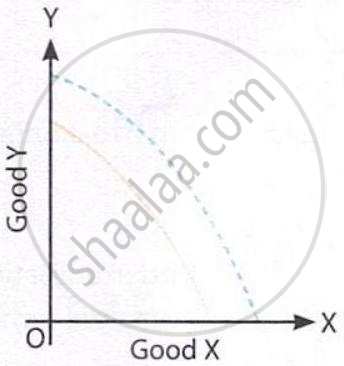
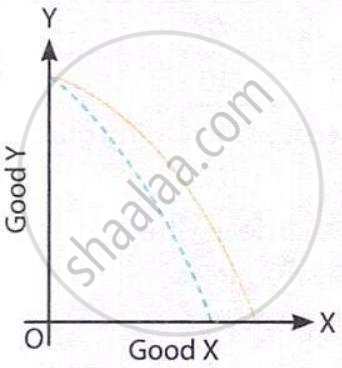
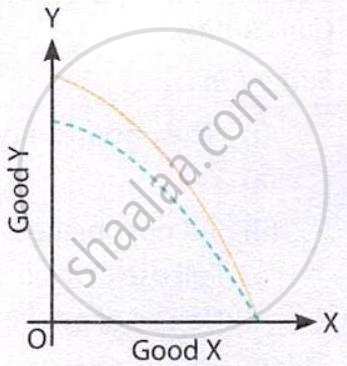
The shift in PPC is caused due to ______.
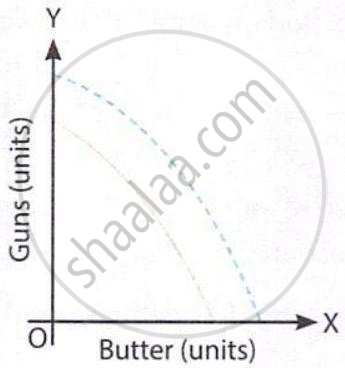
Increase in resources for production of both the goods
Increase in resources for production of butter only
Increase in resources for production of guns only
None of these
In case of decreasing MRT, the shape of PPC will be depicted by the following diagram:
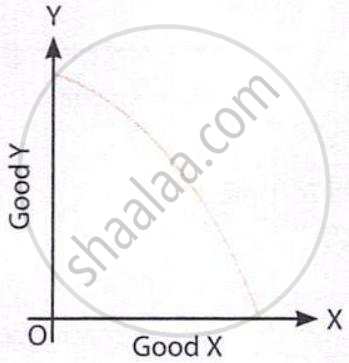
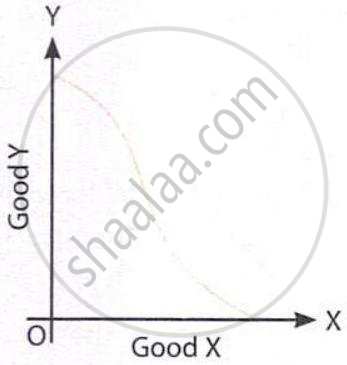
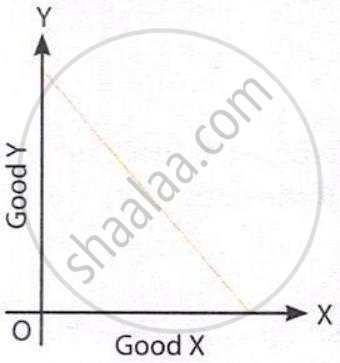
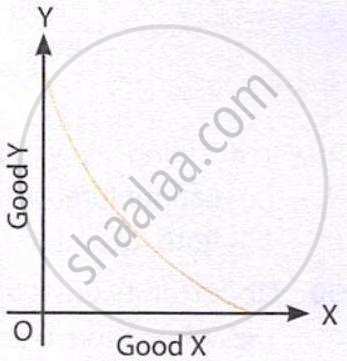
The following change in PPC is due to:
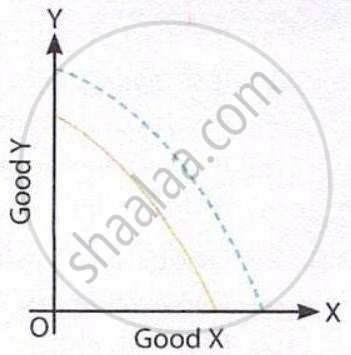
Massive Unemployment
Destruction of Resources
Increase in Resources
Fuller Utilisation of Resources
In the order of sequence, the points of ‘Underutilisation’ and ‘Unattainable’ are ______.
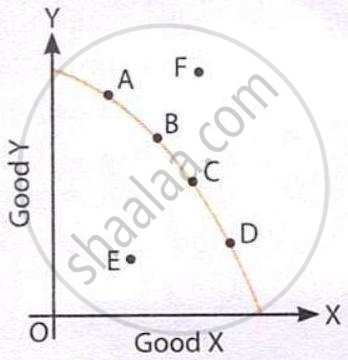
A and F
F and E
D and E
E and F
Which of the following is an assumption of Production Possibility Frontier?
Resources are not fully employed
Resources are not equally efficient for production of the two goods
Resources are not efficiently employed
Resources available are not fixed
Macroeconomics focuses on all of the following except ______.
Unemployment Problem
Inflation in the Economy
Aggregate Demand
Jute Industry
Which of the following is an example of a Positive Economy?
India should take steps to control rising prices
There are inequalities of income in our economy
India should not be an overpopulated country
Income inequalities should be reduced
The statements like ‘Economy should control pollution’ or ‘Unemployment in the economy ought to be reduced’ fall within the scope of ______.
Normative Statements
Positive Statements
Both (a) and (b)
None of these
An economy has 2 alternatives of production from the available resources: (i) 20X + 1Y; or (ii) 18X + 2Y. If the economy chooses the second alternative, then what is the MOC of producing Y?
1X
2X
1Y
None of these
The Opportunity Cost arises ______.
When there is just one alternative
When there are two or more alternatives
Either (a) or (b)
None of these
In the context of rising prices, following statements are made by two people:
Udit: Prices in the economy are continuously rising;
Shivam: The Government should take reasonable steps to control rising prices.
Identify the statements as Positive Statement and Normative Statement.
Udit: Positive; Shivam: Normative
Udit: Normative; Shivam: Positive
Both are Positive Statements
Both are Normative Statements
Production Possibility Frontier is ______.
Downward Sloping
Concave Shaped
Both (a) and (b)
Either (a) or (b)
In the given figure, the movement on the production possibility curve from point A to point B shows ______.
(Choose the correct alternative)
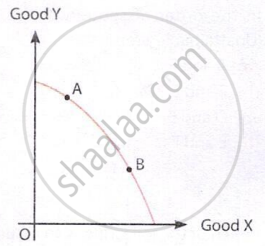
Growth of all the resources in the economy
Underutilisation of resources
Production of more units of Good X and less units of Good Y
Production of more units of Good Y and less units of Good X
In the given figure X1Y1 and X2Y2 are Production Possibility Curves in two different periods T1 and T2 respectively for Good X and Good Y. A1 and A2 represent actual outputs and P1 and P2 represent potential outputs respectively in the two time periods. The change in actual output of Goods X and Y over the two periods would be represented by movement from ______.
(Fill up the blank)
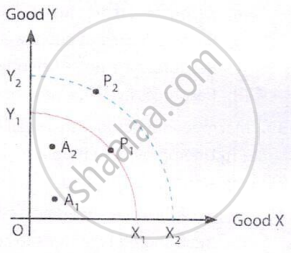
A2 to P2
A1 to P2
P1 to A2
A1 to A2
Shift from Point A on Production Possibility Curve X1Y1 to Point B on X2Y2 in the given figure indicates:
(Choose the correct alternative)
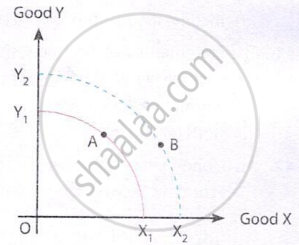
Decrease in resources
Increase in resources
Full and efficient utilisation of resources
Wastage of resources
In the given figure X1Y1 and X2Y2 are Production Possibility Curves in two different time periods T1 and T2 respectively. A1 and A2 represent actual outputs in T1 and T2 periods respectively. P1 and P₂ are potential outputs in T1 and T2 periods respectively. The change in potential production over the two periods would be represented by a shift from ______.
(Choose the correct alternative).
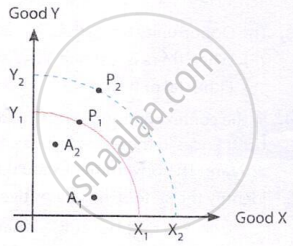
P2 to A2
A1 to A2
A2 to A1
P1 to P2
Positive Economic analysis is concerned with ______.
Opinions
Value Judgements
Facts and Figures
Ideals
‘Fit India Movement’ launched by the Indian Government will lead to ______.
Leftward Shift in PPC
Rightward Shift in PPC
Forward Rotation on X-axis
No Change in PPC
Out of the following, which one is Macro variable?
Production of Food Grains in India
Pricing decision by Tata Motors
Measurement of General Price Level
Fall in Petrol Prices
Which of the following is the salient feature of resources?
They are limited as compared to wants
They have alternative uses
Both (a) and (b)
They are unlimited
If there is unemployment in the economy, then we would be producing ______ the PPC.
Below
Above
On
None of the above
Assertion Reason Questions (ARQs)
In the following Question, read the following statement: Assertion (A) and Reason (R). Choose the correct alternative:
Assertion (A): Tools of microeconomics are demand and supply.
Reason (R): Microeconomics studies the behaviour of individual units of an economy.
Both Assertion (A) and Reason (R) are True and Reason (R) is the correct explanation of Assertion (A).
Both Assertion (A) and Reason (R) are True and Reason (R) is not the correct explanation of Assertion (A).
Assertion (A) is True but Reason (R) is False.
Assertion (A) is False but Reason (R) is True.
In the following Question, read the following statement: Assertion (A) and Reason (R). Choose the correct alternative:
Assertion (A): Production Possibility Frontier (PPF) is a Concave Shaped curve.
Reason (R): PPF shows all the maximum possible combination of two goods, which can be produced with the available resources and technology.
Both Assertion (A) and Reason (R) are True and Reason (R) is the correct explanation of Assertion (A).
Both Assertion (A) and Reason (R) are True and Reason (R) is not the correct explanation of Assertion (A).
Assertion (A) is True but Reason (R) is False.
Assertion (A) is False but Reason (R) is True.
In the following Question, read the following statement: Assertion (A) and Reason (R). Choose the correct alternative:
Assertion (A): Human wants differ in priorities.
Reason (R): For every individual, some wants are more important and urgent as compared to others.
Both Assertion (A) and Reason (R) are True and Reason (R) is the correct explanation of Assertion (A).
Both Assertion (A) and Reason (R) are True and Reason (R) is not the correct explanation of Assertion (A).
Assertion (A) is True but Reason (R) is False.
Assertion (A) is False but Reason (R) is True.
In the following Question, read the following statement: Assertion (A) and Reason (R). Choose the correct alternative:
Assertion (A): Macroeconomics is also known as Income and Employment Theory.
Reason (R): Macroeconomics aims to determine income and employment level of the economy.
Both Assertion (A) and Reason (R) are True and Reason (R) is the correct explanation of Assertion (A).
Both Assertion (A) and Reason (R) are True and Reason (R) is not the correct explanation of Assertion (A).
Assertion (A) is True but Reason (R) is False.
Assertion (A) is False but Reason (R) is True.
In the following Question, read the following statement: Assertion (A) and Reason (R). Choose the correct alternative:
Assertion (A): Positive Economics avoids economic value judgements.
Reason (R): Positive Statements can be verified as true or false by comparing with actual data.
Both Assertion (A) and Reason (R) are True and Reason (R) is the correct explanation of Assertion (A).
Both Assertion (A) and Reason (R) are True and Reason (R) is not the correct explanation of Assertion (A).
Assertion (A) is True but Reason (R) is False.
Assertion (A) is False but Reason (R) is True.
Statement Based Questions (SBQs)
In the following Question, read the following statements and choose the correct alternative:
Statement 1: Scarcity is universal as every individual, organisation and economy faces scarcity of resources.
Statement 2: There would have been no economic problem, if resources were not scarce.
Both the Statements are true.
Both the Statements are false.
Statement 1 is true and Statement 2 is false.
Statement 2 is true and Statement 1 is false.
In the following Question, read the following statements and choose the correct alternative:
Statement 1: Positive economics statements are statements of truth.
Statement 2: Positive economics aims to make real description of an economic activity.
Both the Statements are true.
Both the Statements are false.
Statement 1 is true and Statement 2 is false.
Statement 2 is true and Statement 1 is false.
In the following Question, read the following statements and choose the correct alternative:
Statement 1: Marginal Rate of Transformation measures the slope of Production Possibility Frontier.
Statement 2: In case of Production Possibility Frontier, marginal opportunity cost is always decreasing.
Both the Statements are true.
Both the Statements are false.
Statement 1 is true and Statement 2 is false.
Statement 2 is true and Statement 1 is false.
In the following Question, read the following statements and choose the correct alternative:
Statement 1: Production Possibility Frontier will shift towards left when there is decrease in resources with respect to both the goods.
Statement 2: An economy cannot operate at any point outside Production Possibility Frontier as it is unattainable with the available productive capacity.
Both the Statements are true.
Both the Statements are false.
Statement 1 is true and Statement 2 is false.
Statement 2 is true and Statement 1 is false.
In the following Question, read the following statements and choose the correct alternative:
Statement 1: Marginal rate of transformation increases because it is assumed that all resources are equally efficient in production of all goods.
Statement 2: There exists a direct relationship between change in quantity of one commodity and change in quantity of the other commodity in case of Production Possibility Frontier.
Both the Statements are true.
Both the Statements are false.
Statement 1 is true and Statement 2 is false.
Statement 2 is true and Statement 1 is false.
In the following Question, read the following statements and choose the correct alternative:
Statement 1: Microeconomics aims to determine price of a commodity or factors of production.
Statement 2: Microeconomics is also known as Income and Employment Theory.
Both the Statements are true.
Both the Statements are false.
Statement 1 is true and Statement 2 is false.
Statement 2 is true and Statement 1 is false.
Very Short Answer Type Questions (VSAQs)
What is meant by scarcity?
What is the basic reason for economic problem in all economies?
What is meant by economizing resources?
Define an economy.
What is meant by economic problem?
How is an economic problem, a choice-making activity?
Why does an economic problem arise? Explain.
State 2 features of resources that give rise to an economic problem.
What is economics all about?
Name the two important branches of Economics.
Define microeconomics.
Give two examples of microeconomics studies.
Define macroeconomics.
Give two examples of macroeconomic studies.
Is the study of cotton textile industry a macroeconomic study or a microeconomic study?
Why is the study of the problem of unemployment in India considered a macroeconomic study?
Is the study of general price level a macro economic study?
What are the central problems of an economy?
What is meant by the central problem of what to produces?
What is meant by the problem of “How to produce”?
What is meant by the problem of “For whom to produce”?
Why the problems of what, how and for whom to produce are known as central problems?
Define opportunity cost.
What is the opportunity cost of an input which has no alternative use?
Why does production possibility curve look concave to the origin?
What does a rightward shift of production possibility curve indicate?
Give examples of ‘Growth of resources’.
When does a PPF shift to the right?
Give an example of decrease in resources.
When is the fuller utilisation of available resources said to have taken place?
What does increasing marginal opportunity cost along a PPF mean?
State two characteristics of the economic resources which give rise to economic problem.
Harish earns ₹ 10 lakhs per year from his business. He gets an offer from a company to work at a salary of ₹ 8,40,000 per year. Determine opportunity cost of Harish.
Define ‘Marginal Rate of Transformation’.
What do you mean by alternate uses of resources?
How in any one way can an economy increase its production capacity?
A country’s resources are fully and efficiently employed. The problem of scarcity exists. What advice will be given to raise the efficiency level of the human resource to fight scarcity?
Unemployment is reduced due to the measures were taken by the government. State its economic value in the context of production possibilities frontier.
The government has started promoting foreign capital. What is its economic value in the context of Production Possibilities Frontier?
A large number of technical training institutions have been started by the government. State its economic value in the context of production possibilities frontier.
Name the economic value achieved through the spread of education in the context of production potential.
Name the economic value achievable when attempts are made to increase resources in the country.
State any two central problems under ‘problem of allocation of resources’.
What does concavity of PPC indicate?
What is the effect on marginal rate of transformation when we move downwards along a production possibility curve?
Define normative economics with a suitable example.
State any one assumption for the construction of the curve that shows the possibilities of potential production of two goods in an economy.
‘Pradhan Mantri Kisan Samman Nidhi’ which provides assured income support of ₹ 6,000 per year should provide a big relief to small and marginalized farmers. State with reason whether this statement is positive or normative.
Sandeep Garg solutions for Introductory Microeconomics [English] Class 11 1 Introduction REVISION EXERCISE [Pages 1.43 - 1.45]
Short Answer Type Questions
Why does an economic problem arise? Explain.
Distinguish between the following.
Micro Economics and Macro Economics.
What are the three central problems of an economy? Name them.
Why do central problems of an economy arise?
What is meant by the problem of allocation of resources?
Distinguish between positive economics and normative economics, with suitable examples.
Explain the central problem of how to produce.
OR
Explain the central problem of ‘choice of technique’.
Explain the problem “What to produce” with the help of an example.
OR
Explain the central problem of the choice of products to be produced.
Answer the following question.
Explain the central problem for whom to produce.
Explain the central problem of distribution in an economy.
What is opportunity cost? Explain with the help of a numerical example.
Discuss meaning of production possibility curve through a schedule and diagram.
Why do central problems arise? Explain.
Why is Production Possibilities Curve concave? Explain
Draw a production possibility curve and show the following situation:
Fuller utilisation of resources
Draw a production possibility curve and show the following situation:
Economic growth
Draw a production possibility curve and show the following situation:
Decrease in resources
Draw a production possibility curve and show the following situation:
Under utilisation of resources
What does a production possibility curve show? When will it shift to the right?
How is production possibility curve affected by unemployment in the economy? Explain.
What is meant by marginal opportunity cost?
Why is marginal opportunity cost increasing in case of PPF?
Give the various reasons for shift in production possibility curve.
What is ‘Marginal Rate of Transformation’? Explain with the help of an example.
Define Production Possibilities Curve.
Explain why the Production Possibilities Curve is downward sloping from left to right.
Explain the meaning of opportunity cost with the help of a production possibility schedule.
State any three assumptions on which a ‘Production Possibilities Curve’ is based.
State the meaning and properties of production possibilities frontier.
What will be the effect on PPC of Bihar if better job opportunities are created in Bihar?
Using a diagram, explain what will happen to the PPC of Bihar if the river Kosi causes widespread floods?
Explain the behaviour of’marginal rate of transformation’ along a production possibility curve.
What will likely be the impact of the large-scale inflow of foreign capital in India on Production Possibilities Curve and why?
Explain the concept of 'Marginal Rate of Substitution' with the help of a numerical example. Also, explain its behaviour along an indifference curve
In what circumstances may the production possibility frontier shift away from the origin? Explain.
Comment upon the shape of production possibility curve, if the marginal rate of transformation is constant.
Discuss briefly the concept of normative economics, with suitable example.
Unsolved Practicals
An unemployed person, Ramesh is looking out for a job. Ramesh received 2 job offers: one for ₹ 20,000 from ICICI Bank and other offer of ₹ 15,000 from HDFC Bank. What is the opportunity cost for Ramesh if he accepts the offer of ICICI Bank?
Calculate the marginal opportunity cost (MOC) of commodity X for the given combinations:
| Commodity X | 0 | 1 | 2 | 3 | 4 | 5 |
| Commodity Y | 100 | 95 | 85 | 70 | 50 | 25 |
A country produces two goods: A and B. Its production possibilities are shown in the following table. Calculate the values of MRT. Construct a PPF, with the help of given possibilities and discuss the shape of PPF.
| Possibilities | A | B | C | D | E | F |
| Good A | 0 | 1 | 2 | 3 | 4 | 5 |
| Good B | 100 | 95 | 85 | 70 | 50 | 25 |
Giving reason, comment on the shape of Production Possibilities curve based on the following schedule:
| Good X (units) | 0 | 1 | 2 | 3 | 4 |
| Good Y (units) | 8 | 6 | 4 | 2 | 0 |
Giving reason, comment on the shape of the Production Possibilities curve based on the following schedule:
| Good X (units) | 0 | 1 | 2 | 3 | 4 |
| Good Y (units) | 20 | 18 | 14 | 8 | 0 |
Giving reason, comment on the shape of Production Possibilities Curve based on the following table:
| Good X (units) | Good Y (units) |
| 0 | 4 |
| 1 | 3 |
| 2 | 2 |
| 3 | 1 |
| 4 | 0 |
Sandeep Garg solutions for Introductory Microeconomics [English] Class 11 1 Introduction REVISION TEST PAPERS (RTPs) [Pages 1.48 - 1.50]
Revision Test Paper - 1
Refer to the following conversation between four friends:
| Rohit: | Rise in prices of goods have made it difficult to make both the ends meet. |
| Sumit: | Yes, the cost of cultivation has also considerably increased. |
| Vinay: | The government should take steps to control the price rise and provide relief to the common man. |
| Mayank: | Yes, the Government should take strict action against hoarders and black marketers. |
In this conversation, the normative statement is made by:
Sumit and Mayank
Vinay and Mayank
Rohit and Sumit
Rohit and Mayank
Production Possibility Frontier is based on the following assumptions:
(i) The amount of resources in an economy is not fixed.
(ii) With the help of given resources, only two goods can be produced.
(iii) The level of technology is assumed to be constant.
(iv) Resources are equally efficient in the production of all products.
Alternatives:
(i), (ii) and (iv)
(i), (iii) and (iv)
(ii) and (iii)
(ii), (iii) and (iv)
Choose the incorrect statements:
(i) Resources are limited in relation to their demand.
(ii) All wants of humans have equal intensity.
(iii) All human wants can not be satisfied.
(iv) Economics is the study of satisfying limited wants.
Alternatives:
(i) and (ii)
(ii) and (iv)
(i), (ii) and (iii)
(i), (iii) and (iv)
‘There has been establishment of educational institutes for skill development of Human resources’. It will lead to following change in Production Possibility Curve (PPC) ______.
Rightward shift in PPC
Leftward Shift in PPC
Rotation of PPC
None of these
Economics is all about making choices in the presence of scarcity. (True/False)
In case of Production Possibility Curve, _______ (Decreasing/Increasing) Marginal Opportunity Cost operates because productivity and efficiency of factors of production _______ (Increase/Decrease) as they are shifted from one use to another.
From the set of statements given in Column I and Column II, choose correct pair of statements.
| Column I | Column II |
| A Microeconomics | (i) Study the aggregate of the economy as a whole |
| B Resources | (ii) Demand is limited in relation to supply |
| C Positive economics | (iii) How economic problems are actually solved |
| D Economics | (iv) Provides people with the means to work |
Alternatives:
A - (i)
B - (ii)
C - (iii)
D - (iv)
Read the following statements carefully and choose the correct alternative from the following:
Statement 1: Microeconomics studies the economy in general, while Macroeconomics concentrates on the working of the individual components. Statement 2: There is no degree of aggregation in microeconomics.
Both the Statements are True.
Both the Statements are False.
Statement 1 is True & Statement 2 is False.
Statement 2 is True & Statement 1 is False.
Cyclone Remal caused significant damage in West Bengal and a lot of production facilities were destroyed. How will it affect the Production Possibility Curve of an economy?
Discuss the concept of attainable and unattainable combinations in the Production Possibility Curve with the help of a diagram.
Revision Test Paper - 2
Which of the following statements are incorrect about the Production Possibility Frontier (PPF)?
(i) It slopes upwards as an increase in the production of one good requires an increase in production of the other.
(ii) It shows the maximum available possibilities.
(iii) An outward shift in PPF means that the economy can produce more of both commodities, which was not possible earlier.
(iv) It is concave shaped due to decreasing marginal rate of transformation.
(v) It will rotate when there is no change in productive capacity concerning both the goods.
Alternatives:
(i), (iv) and (v)
(ii) and (iii)
(i), (ii) and (iv)
None of these
Which of the following statements are not related to positive economics?
(i) It can be verified with actual data.
(ii) It aims to determine the ideals.
(iii) It is based upon facts.
(iv) It is suggestive in nature.
Alternatives:
(i) and (ii)
(ii) and (iii)
(ii) and (iv)
(iii) and (iv)
Rakesh is working as a Branch Manager at IDFC Bank at a salary ₹ 1,50,000 per month. He received 2 more job offers: An offer of ₹ 1,20,000 from HDFC Bank and an offer of ₹ 1,15,000 from Axis Bank. Opportunity Cost of Rakesh for working as a Branch Manager in IDFC Bank is:
Offer of ₹ 1,20,000 from HDFC Bank
Offer of ₹ 1,15,000 from Axis Bank
Both (a) and (b)
None of these
The main reasons for existence of economic problems are:
(i) Wants of people are unlimited and keep on multiplying and cannot be satisfied due to limited resources.
(ii) Resources are unlimited in relation to their demand and economy can produce all that people want.
(iii) Resources are not only scarce but they can also be put to various uses.
Alternatives:
(ii) and (iii)
(i) and (ii)
(i) and (iii)
All of the above
‘Around 22% of India’s population is below the poverty line.’ It is an example of Normative Economics. (True/False)
______ (Human wants/Resources) are scarce, while ______ (Human wants/Resources) are unlimited.
Read the following statements carefully and choose the correct alternative from the following:
Statement 1: Human wants are limited, but the means to satisfy them are unlimited. Statement 2: Resources differ in priorities, while human wants have alternative uses.
Both the Statements are True.
Both the Statements are False.
Statement 1 is True & Statement 2 is False.
Statement 2 is True & Statement 1 is False.
‘Riya says that India is larger than China in terms of land area, while Seema says that China is larger than India in terms of land area’. State whether both these statements are Positive or Normative.
‘Macroeconomics is more important branch of economics as compared to microeconomics.’ Defend or refute the given statement.
‘More of one good or service usually means less of others.’ In the light of given statement, discuss the relevant central problem.
Solutions for 1: Introduction
Sandeep Garg solutions for Introductory Microeconomics [English] Class 11 chapter 1 - Introduction
Shaalaa.com has the CBSE Mathematics Introductory Microeconomics [English] Class 11 CBSE solutions in a manner that help students grasp basic concepts better and faster. The detailed, step-by-step solutions will help you understand the concepts better and clarify any confusion. Sandeep Garg solutions for Mathematics Introductory Microeconomics [English] Class 11 CBSE 1 (Introduction) include all questions with answers and detailed explanations. This will clear students' doubts about questions and improve their application skills while preparing for board exams.
Further, we at Shaalaa.com provide such solutions so students can prepare for written exams. Sandeep Garg textbook solutions can be a core help for self-study and provide excellent self-help guidance for students.
Concepts covered in Introductory Microeconomics [English] Class 11 chapter 1 Introduction are .
Using Sandeep Garg Introductory Microeconomics [English] Class 11 solutions Introduction exercise by students is an easy way to prepare for the exams, as they involve solutions arranged chapter-wise and also page-wise. The questions involved in Sandeep Garg Solutions are essential questions that can be asked in the final exam. Maximum CBSE Introductory Microeconomics [English] Class 11 students prefer Sandeep Garg Textbook Solutions to score more in exams.
Get the free view of Chapter 1, Introduction Introductory Microeconomics [English] Class 11 additional questions for Mathematics Introductory Microeconomics [English] Class 11 CBSE, and you can use Shaalaa.com to keep it handy for your exam preparation.
