Advertisements
Chapters
1: Introduction
UNIT 5: Consumer's Equilibrium and Demand
2: Consumer's Equilibrium
3: Demand
▶ 4: Elasticity of Demand
UNIT 6: Producer Behaviour and Supply
Chapter 5: Production Function
Chapter 6: Cost
Chapter 7: Revenue
Chapter 8: Producer's Equilibrium
Chapter 9: Supply
UNIT 7: Forms of Market and Price Determination Under Perfect Competition With Simple Applications
Chapter 10: Main Market Forms
Chapter 11: Price Determination and Simple Applications
Advertisements
Solutions for Chapter 4: Elasticity of Demand
Below listed, you can find solutions for Chapter 4 of CBSE Sandeep Garg for Introductory Microeconomics [English] Class 11.
Sandeep Garg solutions for Introductory Microeconomics [English] Class 11 4 Elasticity of Demand OBJECTIVE QUESTIONS [Pages 4.34 - 4.41]
Fill in the Blanks
When percentage change in the quantity demanded is more than percentage change in price, then demand for such a commodity is said to be __________.
When two demand curves intersect each other, then the __________ curve is more elastic at the point of intersection.
Expensive goods have __________ demand, while demand for inexpensive goods is __________.
In case of __________ demand, percentage change in the quantity demanded is equal to percentage change in price.
A negative sign with coefficient of price elasticity of demand denotes __________ relation between price and quantity demanded.
A 4% fall in the price of X leads to a 9% rise in its demand. In case of Good Y, a 2% rise in price leads to a 8% fall in its demand. In the given case, commodity __________ is more elastic.
`"Elasticity of Demand" (E_d) = "Percentage Change in Demand"/?`.
If the demand for a good is made by a rich consumer, its demand is generally __________.
Medicines have __________ demand as their consumption cannot be postponed, while Coke has __________ demand as it has number of substitutes.
True or False with Reason:
When quantity demanded of a commodity does not change with change in price, then coefficient of price elasticity of demand is zero.
True or False with Reason:
A commodity with large number of close substitutes shows high elasticity of demand.
True or False with Reason:
When the percentage increase in demand of a commodity is more than percentage increase in price, then demand curve is steeper.
True or False with Reason:
In case of horizontal straight line demand curve, demand does not change even with change in price.
True or False with Reason:
A flatter demand curve is more elastic than a steeper demand curve at the point of intersection.
True or False with Reason:
In case of perfectly inelastic demand, expenditure on the commodity does not change with change in its price.
True or False with Reason:
If the proportionate change in the price of a commodity is more than the proportionate change in its quantity demand per unit of time, its price elasticity of demand is greater than unity.
True or False with Reason:
In measuring price elasticity, price is a dependent variable and quantity is an independent variable.
True or False with Reason:
The coefficient of price elasticity of demand is generally negative. However, minus sign is ignored for the sake of convenience.
True or False with Reason:
Commodity with diverse uses has generally less elastic demand.
True or False with Reason:
Demand is more elastic in the long period than in the short period.
True or False with Reason:
Price Elasticity of Demand of two goods A and B is (-) 3 and (-) 4 respectively. Good A has higher elasticity.
True or False with Reason:
Price Elasticity of Demand is infinity in case of horizontal straight line demand curve.
True or False with Reason:
Price Elasticity of Demand is same for the two commodities x and y if slope of their demand curves are same.
True or False with Reason:
Price Elasticity of Demand is zero if with 20% increase in price, expenditure on the commodity also rises by 20%.
True or False with Reason:
The coefficient of price elasticity of demand for the commodity is inversely related to the number of alternative uses of the commodity.
True or False with Reason:
Luxury goods often have lower price elasticity of demand.
True or False with Reason:
−6, −4, −1 is the correct order of increasing Price Elasticity of Demand.
True or False with Reason:
Using outlay method, we can never have unitary elastic demand.
True or False with Reason:
Total expenditure on a commodity will always fall when price of a commodity falls.
True or False with Reason:
If a commodity has unitary elastic demand, then according to total expenditure method, spending by a consumer will not change with change in price.
True or False with Reason:
According to total outlay method, expenditure decreases with rise in price of the given commodity in case of elastic demand.
Matching Type Questions
From the set of statements given in Column I and Column II, choose the correct pair of statements:
Column I Column II (a) Inelastic demand (i) Demand curve is flatter Column I Column II (b) Perfectly Elastic demand (ii) Demand curve is a vertical straight line parallel to Y-axis Column I Column II (c) Highly Elastic demand (iii) Demand curve is steeper Column I Column II (d) Perfectly Inelastic demand (iv) No change in demand with change in price
Match the statements given under A with the correct options given under B.
| (A) | (B) |
| (i) Unitary Elastic Demand | a. Demand curve is a rectangular hyperbola |
| b. Demand curve is flatter |
Match the statements given under A with the correct options given under B.
| (A) | (B) |
|---|---|
| (i) Elastic demand | a. Expensive Goods |
| (ii) Inelastic demand | b. Inexpensive Goods |
Match the statements given under A with the correct options given under B.
| (A) | (B) |
|---|---|
| (i) Highly Elastic Demand | a. Less Elastic Demand |
| (ii) Inexpensive Goods | b. \[ \frac{\Delta Q}{\Delta P}\times\frac{P}{Q} \] |
| (iii) Perfectly Inelastic demand | c. Horizontal straight line parallel to X-axis |
| (iv) Flatter Demand Curve | d. % Change in Demand > % Change in Price |
| (v) Perfectly Elastic Demand | e. Highly Elastic |
| (vi) Proportionate Method | f. Quantity Demanded does not change with change in price |
Match the statements given under A with the correct options given under B.
| (A) | (B) |
|---|---|
| (i) Rise in Price = 3%, Fall in Demand = 6% | a. Price Elasticity of Demand = (−) 0.2 |
| (ii) Rise in Price = 8%, Fall in Demand = 4% | b. Price Elasticity of Demand = (−) 2 |
| c. Price Elasticity of Demand = (−) 5 | |
| d. Price Elasticity of Demand = (−) 0.5 |
Match the statements given under A with the correct options given under B.
| (A) | (B) |
|---|---|
| (i) When it is not possible to postpone consumption | a. Demand is Highly Elastic |
| (ii) When large number of substitutes are available | b. Demand is Perfectly Elastic |
| c. Demand is Less Elastic |
Multiple Choice Questions (MCQs)
If there is no change in demand for commodity ‘X’, even after rise in its price, then its demand is ______.
Perfectly Elastic
Perfectly Inelastic
Less Elastic
Highly Elastic
The elasticity of demand for a product will not be higher ______.
When it is considered a necessity by its buyers
When more substitutes for the product are available
When it has several uses
When it is an expensive commodity
Demand for a good is less elastic when ______.
Percentage change in price (>) Percentage change in quantity demanded
Percentage change in quantity demanded > Percentage change in price
Percentage change in price = Percentage change in quantity demanded
Demand remains same even with change in price
Which of the following will have elastic demand?
Matchbox
NCERT Textbooks
Medicines
Air Conditioners
If the price elasticity of demand for a commodity is less than unity, a decrease in price would result in ______.
Proportionately less increase in the quantity demanded
Proportionately more increase in the quantity demanded
Increase in total expenditure on the product
None of these
Which one of the following statements is incorrect?
Higher numerical value of elasticity indicates larger effect of a price change on the quantity demanded
Elasticity of demand can vary only between −1 and +1
The demand curves for all commodities which have unitary elastic demand will be rectangular hyperbola
Elasticity of demand establishes a quantitative relationship between quantity demanded of a commodity and its price, while other factors remain constant
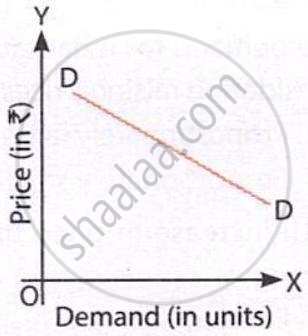
The following diagram represents ______ elastic demand for commodity X.
Less
Highly
Unitary
Perfectly
If the percentage increase in the quantity demanded of a commodity is less than the percentage fall in its price, then elasticity of demand is ______.
> 1
= 1
< 1
= O
Price elasticity of demand is best defined as ______.
Change in the tastes of consumers at different prices
Change in demand when income of the consumer increases
The rate of response of demand to a change in price
The rate of response of demand to change in price of related goods
Which of the following influence price elasticity of demand?
Nature of the commodity.
Income level.
ability of substitutes.
All of these.
A negative sign with coefficient of price elasticity of demand denotes ______.
Direct relation between price and quantity demanded
Inverse relation between price and quantity demanded
No relation between price and quantity demanded
None of these
A 5% fall in the price of Good X leads to a 10% rise in its demand. In case of Good Y, a 2% rise in price leads to a 6% fall in its demand. In the given case, ______ is more elastic.
X
Y
Both X and Y are equally elastic
Both X and Y are inelastic
In case of ______, there is an infinite demand at a particular price and demand becomes zero with a slight rise in price.
Perfectly inelastic demand
Highly elastic demand
Less elastic demand
Perfectly elastic demand
If a good takes up a significant share of consumers' budget, its demand will be ______.
Less elastic
Highly elastic
Unitary elastic
Perfectly elastic
If there is no change in quantity demanded to any charge in price, then demand is ______ and demand curve is a ______.
Perfectly elastic, horizontal straight line
Perfectly elastic, vertical straight line
Perfectly inelastic, horizontal straight line
Perfectly inelastic, vertical straight line
If the demand for a good is made by a rich consumer, its demand is generally ______.
Less elastic
Highly elastic
Unitary elastic
Perfectly elastic
A firm is currently selling 10,000 units of its product per month. The firm plans to reduce the retail price from ₹ 1 to ₹ 0.90. From the previous experience, the firm knows that the price elasticity of demand for the product is (−) 1.5. Assuming no other changes, the firm can now expect the sales of ______.
8,500 units
10,500 units
11,000 units
11,500 units
The demand for meals at a medium-priced restaurant is elastic. If the management of the restaurant is considering raising prices, it can expect a relatively ______.
Proportionately large fall in quantity demanded
No change in quantity demanded
Proportionately small fall in quantity demanded
Infinite change in quantity demanded
With increase in price of burgers by 22%, its demand falls by 25%. This indicates that demand for burgers is ______.
Elastic
Inelastic
Unitary elastic
Perfectly elastic
Price Elasticity of Demand of a good is (−) 3. It shows that:
When price falls by 1%, demand rises by 3%
When price rises by 1%, demand falls by 3%
Either (a) or (b)
Neither (a) nor (b)
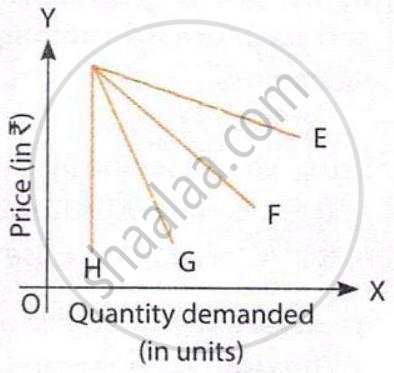
Among the following demand curves, which one is more elastic?
F
E
G
H
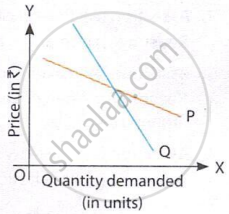
If a commodity has large number of substitutes, then its demand curve will be:
P
Q
Both (a) and (b)
Neither (a) nor (b)
Which of the following diagram correctly depicts the situation of Less Elastic Demand?
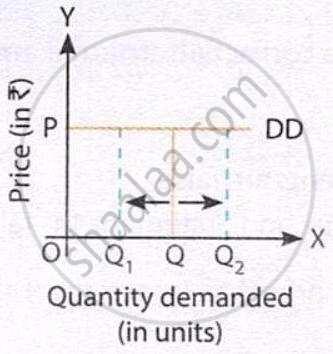
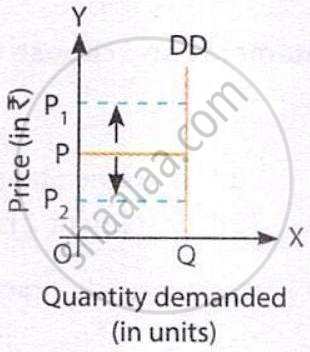
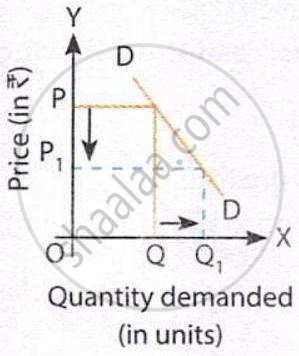
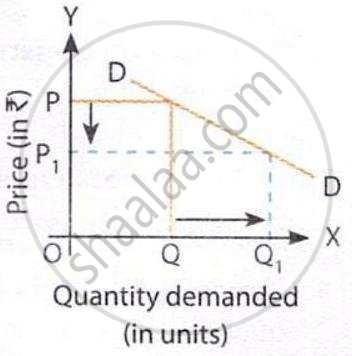
The Indian Government imposed heavy taxes on commodity to reduce its consumption by the public. Such heavy taxes will decrease the demand of the commodity only when ______.
Ed = 0
Ed > 1
Ed < 1
Ed = 1
Shyam spent ₹ 5,000 on a commodity and bought 25 units of it. When its price changed, he spent ₹ 6,000 and bought 20 units. The elasticity of demand by total expenditure method will be ______.
Ed < 1
Ed = 1
Ed > 1
Ed = 0
According to Total Expenditure method, rise in price of a commodity leads to ______ in total expenditure in case of less elastic demand.
Increase
No Change
Decrease
Either (a) or (c)
Out of the following four possibilities, which one leads to rise in total expenditure?
Ed = 1 and price rises
Ed > 1 and price rises
Ed < 1 and price rises
Ed < 1 and price falls
Assertion Reason Questions (ARQs)
In the following Question, read the following statement: Assertion (A) and Reason (R). Choose the correct alternative among those given:
Assertion (A): Degree of price elasticity is less than one in case of inelastic demand.
Reason (R): Proportionate change in demand is less than proportionate change in price.
Both Assertion (A) and Reason (R) are True and Reason (R) is the correct explanation of Assertion (A).
Both Assertion (A) and Reason (R) are True and Reason (R) is not the correct explanation of Assertion (A).
Assertion (A) is True but Reason (R) is False.
Assertion (A) is False but Reason (R) is True.
In the following Question, read the following statement: Assertion (A) and Reason (R). Choose the correct alternative among those given:
Assertion (A): Price Elasticity is infinity in case of horizontal straight line demand curve.
Reason (R): Demand is more elastic in case of long period as compared to short period.
Both Assertion (A) and Reason (R) are True and Reason (R) is the correct explanation of Assertion (A).
Both Assertion (A) and Reason (R) are True and Reason (R) is not the correct explanation of Assertion (A).
Assertion (A) is True but Reason (R) is False.
Assertion (A) is False but Reason (R) is True.
In the following Question, read the following statement: Assertion (A) and Reason (R). Choose the correct alternative among those given:
Assertion (A): Luxury goods often have high price elasticity of demand.
Reason (R): When price of luxury goods increase, then their demand falls considerably as they are put to urgent uses only.
Both Assertion (A) and Reason (R) are True and Reason (R) is the correct explanation of Assertion (A).
Both Assertion (A) and Reason (R) are True and Reason (R) is not the correct explanation of Assertion (A).
Assertion (A) is True but Reason (R) is False.
Assertion (A) is False but Reason (R) is True.
In the following Question, read the following statement: Assertion (A) and Reason (R). Choose the correct alternative among those given:
Assertion (A): Elasticity of Demand is a unit free measure.
Reason (R): Price elasticity of demand is not affected by absolute change in demand or price.
Both Assertion (A) and Reason (R) are True and Reason (R) is the correct explanation of Assertion (A).
Both Assertion (A) and Reason (R) are True and Reason (R) is not the correct explanation of Assertion (A).
Assertion (A) is True but Reason (R) is False.
Assertion (A) is False but Reason (R) is True.
Statement Based Questions (SBQs)
In the following Question, read the following statement and choose the correct alternative among those given:
Statement 1: Higher numerical value of elasticity means that change in price has larger effect on the quantity demanded.
Statement 2: The coefficient of price elasticity of demand is always a negative number.
Both the Statements are true.
Both the Statements are false.
Statement 1 is true and Statement 2 is false.
Statement 2 is true and Statement 1 is false.
In the following Question, read the following statement and choose the correct alternative among those given:
Statement 1: Elasticity is always measured and compared in absolute terms and not in algebraic terms.
Statement 2: Price elasticity of demand is affected by absolute change and not by percentage change in price or demand.
Both the Statements are true.
Both the Statements are false.
Statement 1 is true and Statement 2 is false.
Statement 2 is true and Statement 1 is false.
In the following Question, read the following statement and choose the correct alternative among those given:
Statement 1: Coefficient of price elasticity of demand ranges from one to infinity.
Statement 2: The coefficient of price elasticity of demand is a pure number and is independent of price and quantity units.
Both the Statements are true.
Both the Statements are false.
Statement 1 is true and Statement 2 is false.
Statement 2 is true and Statement 1 is false.
In the following Question, read the following statement and choose the correct alternative among those given:
Statement 1: Demand Curve is a horizontal straight line parallel to X-axis in case of perfectly inelastic demand.
Statement 2: The slope of less elastic demand curve is inclined more towards X-axis.
Both the Statements are true.
Both the Statements are false.
Statement 1 is true and Statement 2 is false.
Statement 2 is true and Statement 1 is false.
In the following Question, read the following statement and choose the correct alternative among those given:
Statement 1: Flatter demand curve is more elastic at the point of intersection.
Statement 2: Demand for a commodity with large number of substitutes is more elastic.
Both the Statements are true.
Both the Statements are false.
Statement 1 is true and Statement 2 is false.
Statement 2 is true and Statement 1 is false.
In the following Question, read the following statement and choose the correct alternative among those given:
Statement 1: Elasticity of demand for any commodity is generally less for higher income level groups.
Statement 2: A commodity having several uses has inelastic demand.
Both the Statements are true.
Both the Statements are false.
Statement 1 is true and Statement 2 is false.
Statement 2 is true and Statement 1 is false.
Very Short Answer Type Questions (VSAQs)
Define price elasticity of demand.
Solutions for 4: Elasticity of Demand
Sandeep Garg solutions for Introductory Microeconomics [English] Class 11 chapter 4 - Elasticity of Demand
Shaalaa.com has the CBSE Mathematics Introductory Microeconomics [English] Class 11 CBSE solutions in a manner that help students grasp basic concepts better and faster. The detailed, step-by-step solutions will help you understand the concepts better and clarify any confusion. Sandeep Garg solutions for Mathematics Introductory Microeconomics [English] Class 11 CBSE 4 (Elasticity of Demand) include all questions with answers and detailed explanations. This will clear students' doubts about questions and improve their application skills while preparing for board exams.
Further, we at Shaalaa.com provide such solutions so students can prepare for written exams. Sandeep Garg textbook solutions can be a core help for self-study and provide excellent self-help guidance for students.
Concepts covered in Introductory Microeconomics [English] Class 11 chapter 4 Elasticity of Demand are .
Using Sandeep Garg Introductory Microeconomics [English] Class 11 solutions Elasticity of Demand exercise by students is an easy way to prepare for the exams, as they involve solutions arranged chapter-wise and also page-wise. The questions involved in Sandeep Garg Solutions are essential questions that can be asked in the final exam. Maximum CBSE Introductory Microeconomics [English] Class 11 students prefer Sandeep Garg Textbook Solutions to score more in exams.
Get the free view of Chapter 4, Elasticity of Demand Introductory Microeconomics [English] Class 11 additional questions for Mathematics Introductory Microeconomics [English] Class 11 CBSE, and you can use Shaalaa.com to keep it handy for your exam preparation.
