Advertisements
Chapters
1: Introduction
UNIT 5: Consumer's Equilibrium and Demand
2: Consumer's Equilibrium
▶ 3: Demand
4: Elasticity of Demand
UNIT 6: Producer Behaviour and Supply
Chapter 5: Production Function
Chapter 6: Cost
Chapter 7: Revenue
Chapter 8: Producer's Equilibrium
Chapter 9: Supply
UNIT 7: Forms of Market and Price Determination Under Perfect Competition With Simple Applications
Chapter 10: Main Market Forms
Chapter 11: Price Determination and Simple Applications

Advertisements
Solutions for Chapter 3: Demand
Below listed, you can find solutions for Chapter 3 of CBSE Sandeep Garg for Introductory Microeconomics [English] Class 11.
Sandeep Garg solutions for Introductory Microeconomics [English] Class 11 3 Demand INTEX QUESTIONS [Pages 3.5 - 3.19]
Test Yourself
Identify the following as change in quantity demanded or change in demand:
People buy more ice-creams during summer than during winter.
Identify the following as change in quantity demanded or change in demand:
Consumer income falls and the number of automobiles purchased declines.
Identify the following as change in quantity demanded or change in demand:
LG reduces the price of its TV set by 10 percent and hence its sales increase.
Identify the following as change in quantity demanded or change in demand:
A college raises its tuition fee and as a result, the number of student enrollment forms falls.
Test Yourself
Identify the following as expansion, contraction, decrease or increase in demand.
| Price (₹) | Demand (units) |
| 10 | 100 |
| 8 | 140 |
Identify the following as expansion, contraction, decrease or increase in demand.
| Price (₹) | Demand (units) |
| 5 | 20 |
| 5 | 24 |
Identify the following as expansion, contraction, decrease or increase in demand.
| Price (₹) | Demand (units) |
| 10 | 100 |
| 12 | 60 |
Identify the following as expansion, contraction, decrease or increase in demand.
| Price (₹) | Demand (units) |
| 10 | 100 |
| 10 | 80 |
Identify the following as expansion, contraction, decrease or increase in demand.
| Price (₹) | Demand (units) |
| 5 | 100 |
| 4 | 120 |
Identify the following as expansion, contraction, decrease or increase in demand.
| Price (₹) | Demand (units) |
| 5 | 100 |
| 5 | 120 |
Sandeep Garg solutions for Introductory Microeconomics [English] Class 11 3 Demand OBJECTIVE QUESTIONS [Pages 3.36 - 3.47]
Fill in the Blanks
If the given commodity is an inferior good, then a decrease in income leads to __________ in demand.
Law of demand states the __________ relationship between price and quantity demanded, keeping other factors constant.
Cross demand is positive in case of __________ goods, while negative in case of __________ goods.
Substitute goods have __________ demand.
There will be a __________ in the demand curve of cars with an increase in the price of petrol.
__________ is also known as Decrease in Quantity Demanded.
In case of expansion in demand, there is a __________ movement along the same demand curve.
__________ goods are those goods which are used together to satisfy a particular want.
The sum total of both the substitution and the income effects is called the __________.
If demand for a commodity rises even without any change in its price, then it is known as __________.
__________ goods are those goods which can be used in place of one another for satisfaction of a particular want.
If a fall in the price of one good raises the demand for another good, the two goods are called __________.
__________ goods refer to those goods whose demand increases with an increase in income.
In case of decrease in demand, there is a __________ shift in the demand curve.
Complementary goods have __________ demand.
__________ shows the tabular presentation of various quantities of a commodity a consumer is willing to buy at different prices, during a given period of time.
A rise in price of tea will lead to an __________ movement in the demand curve of tea.
Cross price effect occurs in case of both __________ goods and __________ goods.
If a household buys less of a commodity due to rise in income, then the given commodity must be an __________ one.
True or False with Reasons
If a fall in price of Good X leads to a rise in demand for Good Y, then X and Y are substitute goods.
True or False with Reasons:
Increase in price of bulbs will shift its demand curve towards left.
True or False with Reasons:
Demand of a given commodity can be specified irrespective of its price.
True or False with Reasons:
A rise in price of tea will lead to an upward movement in the demand curve of coffee.
True or False with Reasons:
Due to fall in cost of making bicycles, its price has reduced. It will shift the demand curve of bicycles towards right.
True or False with Reasons:
Demand of a commodity may rise or fall even when price of the given commodity remains constant.
True or False with Reasons:
Demand curve of Pepsi will not shift with rise or fall in its price.
True or False with Reasons:
Cross price effect occurs in case of substitute goods only.
True or False with Reasons:
Demand curve for automobiles shift towards right due to opening up of a new automobile dealer in the town.
True or False with Reasons:
A shift in demand curve of the given commodity may be caused by change in any determinant of demand function.
True or False with Reasons:
Expansion in demand leads to an upward movement along the same demand curve.
True or False with Reasons:
Cross demand is positive in case of substitute goods.
True or False with Reasons:
Market demand curve is obtained by vertical summation of individual demand curves.
True or False with Reasons:
Market demand curve is flatter than individual demand curves.
True or False with Reasons:
Due to increase in one more member, the family expenditure on milk increased. It is an example of extension in demand.
True or False with Reasons:
The demand curve of a commodity may not obey the law of demand if price of its substitute rises.
True or False with Reasons:
In case of giffen goods, demand curve slope upwards.
True or False with Reasons:
Consumer’s taste and preferences must change in order to apply Law of Demand.
True or False with Reasons:
Size and composition of population affect the demand for an individual.
True or False with Reasons:
Law of Demand indicates the direction and amount of change in demand of a commodity due to change in its price.
True or False with Reasons:
If a household buys more of a commodity due to rise in income, then the given commodity must be an inferior one.
True or False with Reasons:
If X and Y are substitutes of one another, then relationship between the prices of good X and demand of good Y will be shown by a curve that will slope upwards.
True or False with Reasons:
‘Ceteris paribus’ clause in the law of Demand means that the price of the given commodity does not change.
True or False with Reasons:
The exceptions to the law of demand may be true for an individual but not for the whole market.
True or False with Reasons:
If more is demanded at the same price or the same quantity is demanded at a higher price, it is known as extension of demand.
True or False with Reasons:
Cross demand tells the relationship between the price and demand for a commodity.
True or False with Reasons:
If the goods X and Y are substitutes, a rise in price of X will result in a rightward shift in demand curve of Y.
True or False with Reasons:
The demand for a commodity always increases with increase in the price of other goods.
True or False with Reasons:
An increase in the income of a consumer would lead to an increase in demand for all types of goods demanded by him.
Matching Type Questions
From the set of statements given in Column I and Column II, choose the correct pair of statements:
Column I Column II (a) Substitute Goods (i) An increase in price of substitute leads to a decrease in the demand for given commodity Column I Column II (b) Complementary Goods (ii) An increase in price of complementary good leads to an Increase in the demand for given commodity Column I Column II (c) Normal Goods (iii) Goods whose demand does not change with an increase in income Column I Column II (d) Inferior Goods (iv) Goods whose demand decreases with an increase in income
Match the statements given under (A) with the correct options given under (B).
| (A) | (B) |
|---|---|
| (i) Decrease in Price of Substitute Goods | a. Rightward shift in demand curve |
| b. Leftward shift in demand curve |
Match the statements given under A with the correct options given under B.
| (A) | (B) |
|---|---|
| (i) Expansion in Demand | a. Upward movement along the same demand curve |
| (ii) Contraction in Demand | b. Downward movement along the same demand curve |
Match the statements given under A with the correct options given under B.
| (A) | (B) |
|---|---|
| (i) Substitute Goods | a. Car and Pen |
| (ii) Complementary Goods | b. Coke and Pepsi |
| c. Bread and Butter |
Match the statements given under A with the correct options given under B.
| (A) | (B) |
|---|---|
| (i) Normal Goods | a. Demand decreases with an increase in income |
| (ii) Inferior Goods | b. Demand decreases with an increase in price |
| c. Demand increases with an increase in price | |
| d. Demand increases with an increase in income |
Match the statements given under A with the correct options given under B.
| (A) | (B) |
|---|---|
| (i) Substitute Goods | a. Car and Petrol |
| (ii) Inferior Goods | b. Rightward shift in the demand curve |
| (iii) Expansion in Demand | c. Rice and Wheat |
| (iv) Complementary Goods | d. Increase in Quantity Demanded |
| (v) Increase in Demand | e. Demand decreases with an increase in income |
Match the statements given under A with the correct options given under B.
| (A) | (B) |
|---|---|
| (i) Normal Good | a. Relationship between demand of given commodity and prices of related goods |
| (ii) Decrease in Demand | b. Decrease in Quantity Demanded |
| (iii) Substitute Goods | c. Demand increases with increase in income |
| (iv) Cross Demand | d. Leftward shift in the demand curve |
| (v) Contraction in Demand | e. Competitive Demand |
Multiple Choice Questions (MCQs)
Which of the following is an example of complementary goods?
Tea and Coffee
Coke and Pepsi
Rice and Wheat
None of these
The demand for normal good ______ with an increase in income of the consumer.
Increases
Decreases
Remains same
Either increases or decreases
Increase in price of substitute good leads to ______.
Expansion in Demand
Increase in Demand
Decrease in Demand
Contraction in demand
A, B and C are three commodities, where A and B are complementary; whereas A and C are substitutes. With increase in price of commodity A ______.
Demand of all the commodities A, B and C will fall
Demand of commodities A and B will fall, whereas demand of C will rise
Demand of commodities A and C will fall, whereas demand of B will rise
Demand of commodities B and C will fall, whereas demand of A will rise
When two or more goods are demanded simultaneously, it is known as ______.
Joint Demand
Alternate Demand
Direct Demand
Composite Demand
There will be a ______ in the demand curve of cars with an increase in the price of petrol.
Rightward Shift
Upward Movement
Leftward Shift
Downward Movement
The demand curve for a commodity is generally drawn on the assumption that ______.
Prices of substitute goods do not change
Tastes and preferences of the consumer remain the same
Income of the consumer remains the same
All of these
Which one of these is not an example of substitute goods?
Tea and coffee
Coke and Pepsi
Ink pen and Ball pen
Bread and Butter
Law of Demand states the ______ relationship between price and quantity demanded.
Inverse
Positive
Proportional
None of these
Expansion in demand leads to ______.
Rightward Shift in demand curve
Downward Movement along the demand curve
Upward Movement along the demand curve
None of these
Which one of these is a determinant of Individual demand?
Size and composition of population
Season and Weather
Distribution of Income
None of these
From the given demand schedule, determine the effect on demand curve:
| Price (₹) | 20 | 20 |
| Demand (Units) | 100 | 70 |
Rightward Shift in demand curve
Leftward Shift in Demand curve
Upward Movement along the demand curve
Downward Movement along the demand curve
Expansion in demand occurs due to ______.
Rise in price of the given commodity
Fall in price of the given commodity
Rise in price of substitute goods
Fall in price of complementary goods
There is a sudden change in climatic conditions resulting in hot weather. Assuming no change in the price of the cold drinks, it will lead to ______.
Upward movement along the same market demand curve
Downward movement along the same market demand curve
Rightward shift in the market demand curve
Leftward shift in the market demand curve
A movement along the demand curve for soft drinks is best described as ______.
Increase in demand
Decrease in demand
Change in quantity demanded
Change in demand
If more is demanded at the same price or same quantity at a higher price, this fact of demand is known as ______.
Extension of demand
Increase in demand
Contraction of demand
Decrease in demand
Cross demand states the relationship between ______.
Demand of given commodity and price of related goods
Demand of given commodity and Income of the consumer
Demand of given commodity and taste and preferences
None of these
Which of the following is not an assumption of law of demand?
Price of substitute goods do not change
Income of the consumers remain same
There is no change in tastes and preferences of the consumers
Price of the given commodity does not change
If change in price of good A affects the demand for good B, then ______.
A is a substitute of good B
A is a complement of good B
Both (a) and (b)
Either (a) or (b)
In a typical demand schedule, quantity demanded ______.
Varies directly with price
Varies proportionately with price
Varies inversely with price
Is independent of price
Which of the following is a determinant of market demand?
Income of the consumers
Season and weather
Price of related goods
All of the above
Which of the following factors will lead to a leftward shift in the demand curve?
Increase in income in case of inferior goods
Increase in income in case of normal goods
Increase in Population
Expectation of future increase in price
Decrease in the price of the complementary goods leads to ______.
Upward movement along the same demand curve
Downward movement along the same demand curve
Rightward shift in the demand curve
Leftward shift in the demand curve
If price of good ‘X’ rises and it leads to a fall in demand for good ‘Y’, then the two goods are ______.
Substitute goods
Complementary goods
Normal goods
Inferior goods
Market demand curve is obtained by ______ summation of the individual demand curves.
Vertical
Horizontal
Both (a) and (b)
Neither (a) nor (b)
Ceteris paribus means ______.
Holding supply constant
Holding demand constant
Price being constant
Other factors being constant
An increase in real income of a consumer induces him to buy more of a commodity whose prices have fallen. This is known as ______.
Inducement Effect
Substitution Effect
Income Effect
Utility Effect
Expansion of Demand is associated with ______.
Rise in Price, Rise in quantity demanded
Fall in Price, Fall in quantity demanded
Fall in Price, Rise in quantity demanded
Rise in Price, Fall in quantity demanded
If X and Y are Complementary Goods, then with increase in price of X ______.
Demand of X will decrease and demand of Y will increase
Demand of X will increase and demand of Y will decrease
Demand of X and Y will increase
Demand of X and Y will decrease
If Tea and Coffee are substitutes, a fall in the prices of Tea leads to:
(i) Rise in the demand for Tea
(ii) Fall in the demand of Tea
(iii) Fall in the demand for Coffee
(iv) Rise in the demand of coffee
Alternatives:
Both (ii) and (iv)
Both (i) and (iii)
Both (ii) and (iii)
Both (iii) and (iv)
All except one of the following are assumed to remain same while drawing an individual’s demand curve for a product. Which one is it?
Tastes and Preferences of the individual
Monetary income
Price of the given product
Price of related goods
With fall in price of a commodity, demand of the commodity increases as it becomes relatively cheaper in comparison to other commodities. This effect is known as ______.
Substitution Effect
Income Effect
Law of Demand
Law of Diminishing Returns
The demand function of a product X is given as: Dx = 12 − 2 Px, where Px stands for price. The demand at price of ₹ 2 will be ______.
6
8
5
10
The demand function of a product X is given as: Dx = 20 − 3Px, where Px stands for price. If an Individual Y has a demand of 8 units, then market price of the product is ______.
₹ 4
₹ 5
₹ 3
₹ 4.5
The demand function of a product X is given as: Dx = 12 − 2Px, where Px stands for price. If there are 5,000 customers for the product, then market demand for the product at market price of ₹ 3 will be ______.
40,000
30,000
20,000
16,000
Two commodities A and B can be inferred as close substitutes of each other if ______.
Rise in price of one leads to an increase in demand of other and vice-versa
Rise in price of one leads to a decrease in demand of other and vice-versa
Fall in price of one lead to fall in demand of other one, but not the other way round
Rise in price of one lead to rise in demand of other one, but not the other way round
A goods can be considered a normal good if an increase in income of the consumer causes ______ in demand of the given good.
Increase
No change
Decrease
less than proportionate increase
Expansion and contraction in demand are caused by ______.
Change in price of the given good
Change in income
Change in prices of related goods
Change in population
When income of the consumer falls, the impact on price-demand curve of an inferior good is ______.
Shifts to the right
Shifts to the left
There is upward movement along the curve
There is downward movement along the curve
If due to fall in the price of good X, demand for good Y also falls, then the two goods are ______.
Substitutes
Complements
Not related
Competitive
If with the rise in price of good Y, demand for good X rises, the two goods are ______.
Substitutes
Complements
Not related
Jointly demanded
The demand curve of a good shifts from DD’ to dd’.
This shift can be caused by:
(Choose the correct alternative)
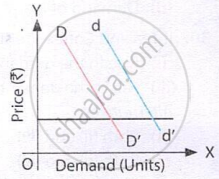
Fall in the price of the good
Rise in the price of the good
Rise in the price of substitute goods
Rise in the price of complementary goods
An increase in the price of Coffee will have the following effect on the demand curve of Tea:
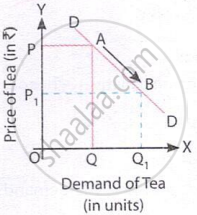
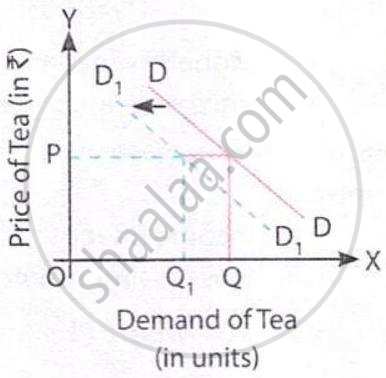
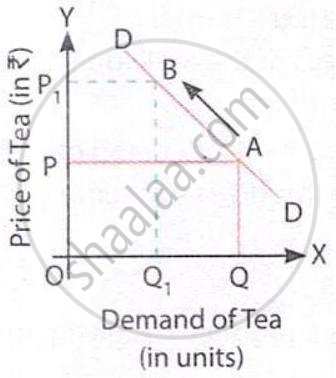
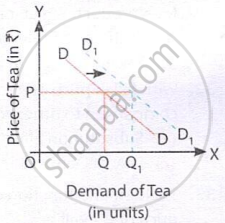
The following movement in the demand curve is because of:
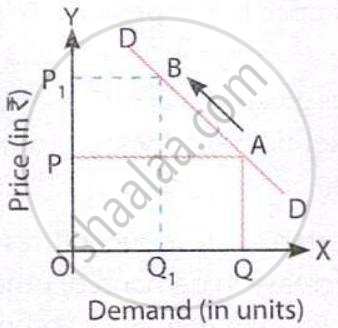
Increase in price of given commodity
Decrease in price of given commodity
Increase in price of substitute good
Decrease in price of complementary good
What does the following diagram represent?
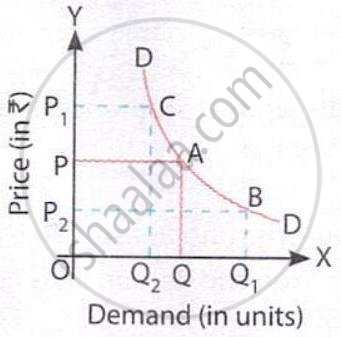
Change in Demand
Change in Quantity Demanded
Both (a) and (b)
Neither (a) nor (b)
Which of the following represents market demand curve?
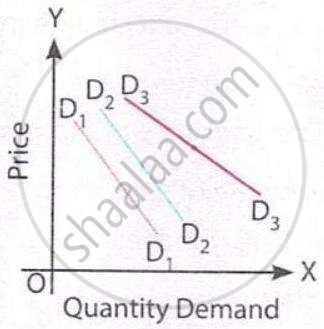
D1D1
D3D3
D2D2
None of the above
Which of the following diagram represents the situation of ‘Expansion in Demand’?
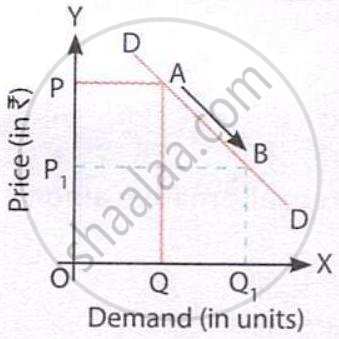
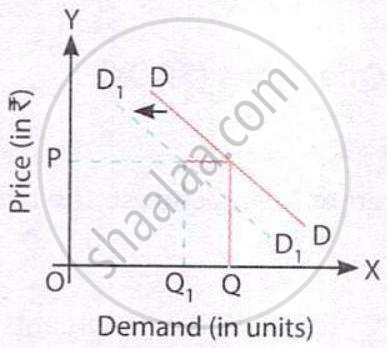
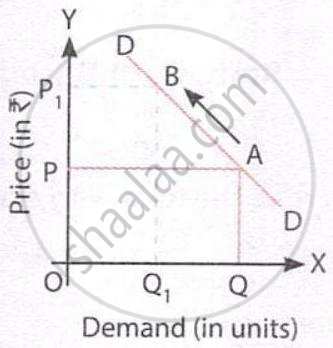
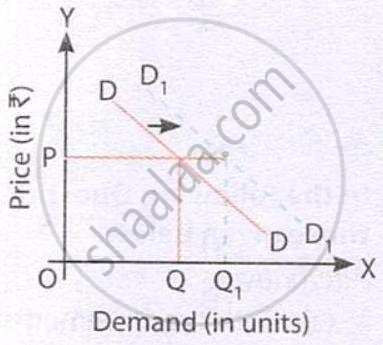
The slope of demand curve is generally ______.
Negative
Positive
Constant
Either (a) or (b)
Any statement about demand for a good is considered complete only when the following is/are mentioned in it ______.
Price of the good
Quantity of the good
Period of time
All of the above
Which of the following is a reason for ‘Change in Demand’?
Change in Income
Change in Price of related goods
Population increase
All of these
Assertion Reason Questions (ARQs)
In the following Question, read the following statement: Assertion (A) and Reason (R). Choose the correct alternative among those given below:
Assertion (A): Change in quantity demanded of one commodity due to a change in price of other commodity is cross demand.
Reason (R): Changes in consumer income leads to a change in demand.
Both Assertion (A) and Reason (R) are True and Reason (R) is the correct explanation of Assertion (A)
Both Assertion (A) and Reason (R) are True and Reason (R) is not the correct explanation of Assertion (A).
Assertion (A) is True but Reason (R) is False.
Assertion (A) is False but Reason (R) is True.
In the following Question, read the following statement: Assertion (A) and Reason (R). Choose the correct alternative among those given below:
Assertion (A): Complementary goods have joint demand.
Reason (R): Complementary goods are demanded simultaneously to satisfy a particular want.
Both Assertion (A) and Reason (R) are True and Reason ® is the correct explanation of Assertion (A).
Both Assertion (A) and Reason (R) are True and Reason ® is not the correct explanation of Assertion (A).
Assertion (A) is True but Reason (R) is False.
Assertion (A) is False but Reason (R) is True.
In the following Question, read the following statement: Assertion (A) and Reason (R). Choose the correct alternative among those given below:
Assertion (A): Cross demand is positive in case of substitute goods.
Reason (R): An increase in price of substitute good leads to a decrease in demand for given commodity.
Both Assertion (A) and Reason (R) are True and Reason (R) is the correct explanation of Assertion (A).
Both Assertion (A) and Reason (R) are True and Reason (R) is not the correct explanation of Assertion (A).
Assertion (A) is True but Reason (R) is False.
Assertion (A) is False but Reason (R) is True.
In the following Question, read the following statement: Assertion (A) and Reason (R). Choose the correct alternative among those given below:
Assertion (A): Market demand curve is flatter than individual demand curves.
Reason (R): Market demand curve is obtained by horizontal summation of individual demand curves.
Both Assertion (A) and Reason (R) are True and Reason (R) is the correct explanation of Assertion (A).
Both Assertion (A) and Reason (R) are True and Reason (R) is not the correct explanation of Assertion (A).
Assertion (A) is True but Reason (R) is False.
Assertion (A) is False but Reason (R) is True.
In the following Question, read the following statement: Assertion (A) and Reason (R). Choose the correct alternative among those given below:
Assertion (A): Expansion in Demand leads to an upward movement along the same demand curve.
Reason (R): Upward movement along the same demand curve occurs due to an increase in price of the given commodity.
Both Assertion (A) and Reason (R) are True and Reason (R) is the correct explanation of Assertion (A).
Both Assertion (A) and Reason (R) are True and Reason (R) is not the correct explanation of Assertion (A).
Assertion (A) is True but Reason ® is False.
Assertion (A) is False but Reason (R) is True.
Statement Based Questions (SBQs)
In the following Question, read the statements and choose the correct alternative among those given below:
Statement 1: Market demand curve slope downwards due to inverse relationship between price and quantity demanded.
Statement 2: Slope of demand curve is equal to change in quantity divided by change in price.
Both the Statements are true.
Both the Statements are false.
Statement 1 is true and Statement 2 is false.
Statement 2 is true and Statement 1 is false.
In the following Question, read the statements and choose the correct alternative among those given below:
Statement 1: Law of Demand makes a qualitative statement and not quantitative.
Statement 2: No proportional relationship between change in price and the resultant change in demand is established by Law of Demand.
Both the Statements are true.
Both the Statements are false.
Statement 1 is true and Statement 2 is false.
Statement 2 is true and Statement 1 is false.
In the following Question, read the statements and choose the correct alternative among those given below:
Statement 1: There is an upward movement along the same demand curve in case of expansion in demand.
Statement 2: Expansion in demand is also known as Extension in Demand or Increase in Quantity Demanded.
Both the Statements are true.
Both the Statements are false.
Statement 1 is true and Statement 2 is false.
Statement 2 is true and Statement 1 is false.
In the following Question, read the statements and choose the correct alternative among those given below:
Statement 1: Substitute goods have competitive demand.
Statement 2: Change in the price of substitutes directly affects the demand for a given commodity.
Both the Statements are true.
Both the Statements are false.
Statement 1 is true and Statement 2 is false.
Statement 2 is true and Statement 1 is false.
In the following Question, read the statements and choose the correct alternative among those given below:
Statement 1: Slope of demand curve is based on the percentage change in price and quantity.
Statement 2: Due to inverse relationship between price and demand, the demand curve slopes downwards.
Both the Statements are true.
Both the Statements are false.
Statement 1 is true and Statement 2 is false.
Statement 2 is true and Statement 1 is false.
In the following Question, read the statements and choose the correct alternative among those given below:
Statement 1: Income effect is negative in case of inferior goods.
Statement 2: In case of inferior goods, fall in income leads to decrease in demand for the good.
Both the Statements are true.
Both the Statements are false.
Statement 1 is true and Statement 2 is false.
Statement 2 is true and Statement 1 is false.
Very Short Answer Type Questions (VSAQs)
Define demand for a good.
Define market demand.
Define Substitute goods.
What is meant by complementary goods?
If the demand for good Y increases as the price of good X increases, how are the two goods related?
If the price of good X rises and this leads to a fall in the demand for good Y, how are the two goods related?
How will an increase in the price of petrol affect the demand curve of scooter?
When is a good called an inferior good?
What do you mean by a normal good?
Define the concept of demand schedule.
What is Law of demand?
Define change in quantity demanded.
What is an expansion of demand?
When the demand for a good falls due to a rise in its own price, what is the change in demand called?
Define ‘change in demand’.
What is increase in demand?
When the demand for a good falls due to an unfavourable change in the consumer’s preferences, what is the change in demand called?
Give one example, when a consumer buys less of a commodity at the same price.
OR
Give one reason for a leftward shift in demand curve.
Give one reason for a rightward shift in demand curve.
Suppose that good A is a substitute of good B. How will an increase in the price of good B affect the demand curve of good A?
What is meant by the purchasing power of money?
What causes an upward movement along a demand curve?
If price of petrol is expected to increase in future, what will be the effect on its demand in the present period?
Give one reason for shift in demand curve.
What does a rightward shift of demand curve indicate?
What is the relation between price of a good and demand of its complementary good?
Suggest any one economic measure by which the government can promote consumption of ‘Khadi’.
What economic measure can the Government take to reduce demand for commodity X which is harmful for health?
When does ‘decrease’ in demand take place?
Ceteris Paribus, if the government provides subsidies on electricity bills, what would be the likely change in the market demand of desert coolers?
Sandeep Garg solutions for Introductory Microeconomics [English] Class 11 3 Demand REVISION EXERCISE [Pages 3.47 - 3.49]
Short Answer Type Questions
Explain three factors that can bring about an increase in the market demand for a commodity.
Define market demand.
Explain the law of demand with its assumptions.
Explain the effect of increase in income of the consumer on demand for a good.
State and explain the law of demand with the help of a hypothetical schedule and graph.
Give any three factors that can cause a rightward shift of the demand curve.
Differentiate between a change in quantity demanded and a change in demand.
Explain the reasons for the inverse relationship between the price of a commodity and the quantity demanded of it.
Differentiate between movement along demand curve and shift in demand curve.
What is an expansion of demand?
With the help of a suitable diagram, explain expansion in demand.
Define or explain the following concept:
Increase in demand
Define decrease in demand.
Define contraction of demand (or decrease in quantity demanded).
Distinguish between expansion in demand and increase in demand.
OR
Distinguish between ‘increase in demand’ and increase in quantity demanded of a good.
Distinguish between ‘decrease in demand’ and ‘decrease in quantity demanded’ of a commodity.
Which changes can cause a leftward shift in the demand curve? Also state the change, which causes downward movement along the demand curve?
How is the demand of a commodity affected by changes in the price of related goods? Explain with the help of diagrams.
Explain the effect of a rise in the prices of ‘related goods’ on the demand for a good X.
Goods X and Y are substitutes. Explain the effect of fall in price of Y on demand for X.
What do you mean by a normal good?
What are inferior goods?
Distinguish between a normal good and an inferior good. Give example in each case.
Distinguish between substitute goods and complementary goods, with examples.
What is ‘market’ demand?
State four factors causing ‘increase’ in market demand.
What happens to the demand of a good when consumer's income changes? Explain
How does change in the price of a substitute good affect the demand of the given good? Explain with the help of an example.
How does change in the price of complementary good affect the demand for the given good? Explain with the help of an example.
Explain the effect of change in own price on demand of a good.
Explain the effect of change in price of substitute on demand of a good.
Distinguish between:
Individual demand schedule and Market demand schedule.
Explain briefly the factors which influence individual demand for a commodity.
Show that there is an inverse relation between price of a commodity and its quantity demanded. Use Utility Analysis.
If the income of a consumer increases, discuss briefly its likely impact on the demand for a inferior good, Good X.
How would the demand for a commodity be affected by a change in ‘tastes and preferences’ of the consumers in favour of the commodity? Explain using a diagram.
Explain the effect of the increase in the level of air pollution, on the market demand for “Air Purifiers”. (Use diagram)
Long Answer Type Questions
Define the following concept:
Demand
Explain any four factors affecting the demand for a commodity.
State and explain the law of demand with the help of a hypothetical schedule and graph.
Explain the causes behind law of demand.
OR
Why is there an inverse relationship between the price of a commodity and its quantity demanded?
Distinguish between Individual demand and Market demand.
Differentiate between a change in quantity demanded and a change in demand.
Explain the exceptions to the law of demand.
Explain the causes of a rightward shift in demand curve of a commodity of an individual consumer.
Explain with the help of diagram, the effect of the following change on the demand of a commodity:
Fall in the price of substitute good
Explain with the help of diagram, the effect of the following change on the demand of a commodity:
all in the income of its buyer.
Distinguish between a normal good and an inferior good. Give example in each case.
Explain with the help of diagram, the effect of the following changes on the demand of a commodity:
An unfavourable change in taste of the buyer for the commodity
Explain with the help of diagram, the effect of the following changes on the demand of a commodity:
A fall in the income of its buyer, if the commodity is inferior.
Explain causes of leftward shift in demand curve of a commodity.
A consumer consumes good ‘X’. Explain the effects of fall in the prices of related goods on the demand of ‘X’. Use diagrams showing demand for good ‘X’ on the x-axis and is price on y-axis.
Explain how do the following influence demand for a good:
Rise in income of the consumer.
Explain how do the following influence demand for a good:
Fall in prices of the related goods.
Explain the relationship between Prices of other goods and demand for the given good.
Explain the relationship between Income of the buyers and demand for a good.
Explain the effect of change in prices of the related goods on demand for the given good.
Unsolved Practicals
From the following data regarding individual demand schedules of households A, B and market demand schedule, prepare the demand schedule of household C, assuming that there are only three households in the market.
| Price (₹) | Individual Demand (units) | Market demand (units) | ||
|---|---|---|---|---|
| A | B | C | ||
| 7 | 20 | 16 | – | 51 |
| 8 | 18 | 15 | – | 46 |
| 9 | 16 | 12 | – | 39 |
| 10 | 13 | 10 | – | 32 |
Suppose there are 3 consumers in a particular market: A, B and C. Their demand schedules are given in the following table. Prepare the market demand schedule.
Price (₹) |
Individual Demand (units) |
||
|---|---|---|---|
| A | B | C | |
| 1 | 60 | 30 | 70 |
| 2 | 40 | 25 | 65 |
| 3 | 32 | 18 | 50 |
| 4 | 25 | 15 | 30 |
| 5 | 18 | 0 | 22 |
On the basis of information given in the following table, prepare the demand schedules for three commodities.
| Price (₹) | Total expenditure (in ₹) | ||
|---|---|---|---|
| A | B | C | |
| 2 | 6 | 6 | 6 |
| 3 | 6 | 5 | 7 |
| 4 | 6 | 4 | 8 |
The demand function of a commodity x is given by Qx = 20 − 3Px. Find out the values of Px when corresponding values of Qx are given as: 5, 8, 11 and 14.
Sandeep Garg solutions for Introductory Microeconomics [English] Class 11 3 Demand REVISION TEST PAPERS (RTPs) [Pages 3.52 - 3.54]
Revision Test Paper - 1
If demand for a commodity x rises from 150 units because of a fall in its price from ₹ 25 to ₹ 15 per unit, then:
(i) It leads to a downward movement along the same demand curve.
(ii) It leads to an upward movement along the same demand curve.
(iii) It is known as Expansion in Demand.
(iv) It is known as Contraction in Demand.
(i) and (iii)
(ii) and (iii)
(ii) and (iv)
(i) and (iv)
The slope of demand curve is equal to ______.
- \[ \frac{\text{Change in Quantity }(\Delta Q)}{\text{Change in Price }(\Delta P)} \]
\[ \frac{\text{Change in Price }(\Delta P)}{\text{Change in Quantity }(\Delta Q)} \]
\[ \frac{\text{Change in Price }(\Delta P)}{\text{Change in Quantity }(\Delta Q)} \]
- \[ \frac{\text{Price }(P)}{\text{Quantity }(Q)} \]
If demand for Apple changes due to a change in its own price, then such change is known as ______ and it leads to ______.
Change in Demand; Movement along the Demand Curve
Change in Demand; Shift in the Demand Curve
Change in Quantity Demanded; Movement along the Demand Curve
Change in Quantity Demanded; Shift in the Demand Curve
Market demand is also affected by ______.
(i) Income of the sellers
(ii) State of Technology
(iii) Season and weather
(iv) Composition of Population
(v) Number of firms in the market
(vi) Size of Population
Alternatives:
(i), (ii) and (iii)
(ii), (iii), (iv) and (v)
(iv), (v) and (vi)
(iii), (iv) and (vi)
A demand curve can be drawn for any commodity by plotting each combination of demand schedules on a graph. (True / False)
A change in the price of ______ (Substitute / Complementary) goods directly affects the demand for a given commodity, while a change in the price of ______ (Substitute / Complementary) goods inversely affects the demand for a given commodity.
Read the following statements carefully and choose the correct alternative from the following:
Statement 1: Slope of the demand curve measures its flatness or steepness.
Statement 2: Inferior goods always follow the law of demand, while the law of demand may fail in case of normal goods.
Both the Statements are True.
Both the Statements are False.
Statement 1 is True & Statement 2 is False.
Statement 2 is True & Statement 1 is False.
In which direction will there be movement along the demand curve in the situation of contraction in demand?
‘There are certain special determinants of market demand, which are not observed in case of individual demand’. Discuss them briefly.
Suppose a news is being circulated which states that noodles contain harmful chemical preservatives. What will be the impact of the news on the demand for noodles? Explain using diagram.
From the given demand schedule, determine the effect on demand curve:
| Price (₹) | Demand (units) |
| 40 | 120 |
| 50 | 100 |
Leftward shift in demand curve
Rightward shift in demand curve
Downward movement along the same demand curve
Upward movement along the same demand curve
Which of the following statements are incorrect about the Law of Demand?
(i) It states the direct relationship between price and quantity demanded.
(ii) It does not establish any proportional relation between change in price and change in demand.
(iii) It is one-sided as it only explains the effect of a change in price on the quantity demanded.
(iv) It makes quantitative statement only.
Alternatives:
(i) and (ii)
(ii) and (iii)
(i) and (iv)
All of these
If income of a consumer rises and he prefers to replace his basic mobile phone with a smartphone, then the demand for basic mobile phone will fall. In such case, basic mobile phone is a/an ______.
Inferior Good
Substitute Good
Normal Good
Complementary Good
When price of a commodity falls from ₹ 10 to ₹ 6 per unit, then the quantity demanded increases from 4 units to 6 units. In such a case, slope of demand curve will be _____.
−0.5
2
−2
0.5
The quantity demanded rises from 50 units to 100 units with a fall in price from ₹ 30 to ₹ 25 per unit, resulting in an upward movement along the same demand curve. (True / False)
______ (Market / Individual) demand may or may not follow the law of demand, whereas ______ (Market / Individual) demand always follows the law of demand.
Read the following statements carefully and choose the correct alternative from the following:
Statement 1: Demand is a stock variable.
Statement 2: Demand for a commodity is meaningless without reference to its price.
Both the Statements are True.
Both the Statements are False.
Statement 1 is True & Statement 2 is False.
Statement 2 is True & Statement 1 is False.
What will be the effect on the demand curve if demand falls at the same price or demand remains the same even at a lower price?
‘Slope of demand curve is negative’. Comment.
Distinguish between expansion in demand and increase in demand.
Solutions for 3: Demand
Sandeep Garg solutions for Introductory Microeconomics [English] Class 11 chapter 3 - Demand
Shaalaa.com has the CBSE Mathematics Introductory Microeconomics [English] Class 11 CBSE solutions in a manner that help students grasp basic concepts better and faster. The detailed, step-by-step solutions will help you understand the concepts better and clarify any confusion. Sandeep Garg solutions for Mathematics Introductory Microeconomics [English] Class 11 CBSE 3 (Demand) include all questions with answers and detailed explanations. This will clear students' doubts about questions and improve their application skills while preparing for board exams.
Further, we at Shaalaa.com provide such solutions so students can prepare for written exams. Sandeep Garg textbook solutions can be a core help for self-study and provide excellent self-help guidance for students.
Concepts covered in Introductory Microeconomics [English] Class 11 chapter 3 Demand are .
Using Sandeep Garg Introductory Microeconomics [English] Class 11 solutions Demand exercise by students is an easy way to prepare for the exams, as they involve solutions arranged chapter-wise and also page-wise. The questions involved in Sandeep Garg Solutions are essential questions that can be asked in the final exam. Maximum CBSE Introductory Microeconomics [English] Class 11 students prefer Sandeep Garg Textbook Solutions to score more in exams.
Get the free view of Chapter 3, Demand Introductory Microeconomics [English] Class 11 additional questions for Mathematics Introductory Microeconomics [English] Class 11 CBSE, and you can use Shaalaa.com to keep it handy for your exam preparation.
