Sandeep Garg solutions for Introductory Microeconomics [English] Class 11 chapter 7 - Revenue [Latest edition]
Chapters
1: Introduction
UNIT 5: Consumer's Equilibrium and Demand
2: Consumer's Equilibrium
3: Demand
4: Elasticity of Demand
UNIT 6: Producer Behaviour and Supply
5: Production Function
6: Cost
▶ 7: Revenue
8: Producer's Equilibrium
9: Supply
UNIT 7: Forms of Market and Price Determination Under Perfect Competition With Simple Applications
Chapter 10: Main Market Forms
Chapter 11: Price Determination and Simple Applications

Advertisements
Advertisements
Solutions for Chapter 7: Revenue
Below listed, you can find solutions for Chapter 7 of CBSE Sandeep Garg for Introductory Microeconomics [English] Class 11.
Advertisements
Sandeep Garg solutions for Introductory Microeconomics [English] Class 11 7 Revenue OBJECTIVE QUESTIONS [Pages 7.18 - 7.25]
Fill in the Blanks
As long as MR is positive, TR __________.
__________ is defined as the revenue per unit of output sold.
The shape of the average revenue curve under perfect competition would be ____________.
AR increases as long as MR is __________ than AR.
If total revenue is ₹ 30,000 when 12,000 units are sold, then average revenue is equal to __________.
When total revenue is constant, average revenue __________.
__________ is the additional revenue generated from the sale of an additional unit of output.
When MR becomes __________, TR starts falling.
Under imperfect competition, Average Revenue (AR) remains ___________ Marginal Revenue (MR).
When total revenue is maximum, marginal revenue is __________.
TR curve rises as long as MR is __________.
When a firm is able to sell more output at the same price, then AR is __________ MR at all levels of output.
True or False with reason:
Average revenue and marginal revenue curves slope downwards when more output can be sold by reducing the prices.
True or False with reason:
AR and price are one and the same thing.
True or False with reason:
In the case of constant prices, average revenue is more than marginal revenue.
True or False with reason:
Average revenue can become negative when price falls with rise in output.
True or False with reason:
Total revenue curve is a positively sloped straight line when price remains same at all levels of output.
True or False with reason:
Marginal Revenue can never be negative.
True or False with reason:
Total revenue curve always starts from the origin.
True or False with reason:
Marginal revenue is zero when every additional unit is sold at the same price.
True or False with reason:
Total revenue can be obtained by adding up revenue generated from every additional unit.
True or False with reason:
Total revenue is at its maximum point when marginal revenue is zero.
True or False with reason:
When marginal revenue is positive & constant, average and total revenue will both increase at constant rate.
True or False with reason:
When total revenue is constant, average revenue will also be constant.
True or False with reason:
When marginal revenue falls to zero, average revenue becomes maximum.
True or False with reason:
Under all market conditions, Average revenue and Marginal revenue are equal to each other.
True or False with reason:
Marginal revenue is always the price at which last unit of a commodity is sold.
State whether true or false:
MR represents the slope of TR Curve.
True or False with reason:
TR starts declining when MR is less than zero.
True or False with reason:
AR curve always remain above MR curve.
True or False with reason:
When marginal revenue is constant and not equal to zero, then total revenue will also be constant.
True or False with reason:
When total revenue is constant, average revenue falls.
True or False with reason:
Total Revenue increases with every increase in output.
True or False with reason:
Marginal Revenue can never be zero.
True or False with reason:
When MR is falling but positive, TR will also be falling and positive.
Matching Type Questions
From the set of statements given in Column I and Column II, choose the correct pair of statements:
Column I Column II (a) Total Revenue (i) Quantity × Cost Price Column I Column II (b) Average Revenue (ii) TRn − TRn−1 Column I Column II (c) Marginal Revenue (iii) `"Change in Total Revenue"/"Change in Number of Units"`
Match the statements given under A with the correct options given under B.
| (A) | (B) |
|---|---|
| (i) Marginal Revenue | a. Revenue per unit of output sold |
| b. Additional revenue from sale of an additional unit of output |
Match the statements given under A with the correct options given under B.
| (A) | (B) |
|---|---|
| (i) Monopoly | a. AR and MR curves are more elastic |
| (ii) Monopolistic Competition | b. AR and MR curves are less elastic |
Match the statements given under A with the correct options given under B.
| (A) | (B) |
|---|---|
| (i) Average Revenue | a. When price remains constant |
| (ii) MR = 0 | b. Quantity × Price |
| (iii) Marginal Revenue | c. When price falls with rise in output |
| (iv) MR < AR | d. `(ΔTR)/(ΔQ)` |
| (v) Total Revenue | e. Price |
| (vi) AR = MR | f. TR is maximum |
Multiple Choice Questions (MCQS)
If average revenue curve is a horizontal straight line, then marginal revenue curve will be ______.
Downward sloping
Horizontal straight line
Upward Sloping
Inversely S-shaped
AR curve is downward sloping when ______.
Price falls with rise in output
Price initially rises at an increasing rate, then at a diminishing rate
Price remains same at all levels of output
None of these
When MR remains same, TR increases at a ______.
Constant rate
Decreasing rate
Increasing rate
None of these
When price remains same with rise in output, AR curve is ______.
Vertical straight line parallel to Y-axis
Horizontal straight line parallel to X-axis
Downward sloping
Positively sloped
When price falls with rise in output, TR is ______ when MR is zero.
Maximum
Minimum
Zero
None of these
Marginal revenue refers to ______.
Addition to total revenue when one more unit of output is produced
Addition to total revenue when one more unit of output is sold
Addition to total revenue when one more unit of variable factor is employed
None of these
When price falls with rise in output, then ______.
MR curve is steeper than AR curve
AR curve is steeper than MR curve
MR and AR curves coincide in a horizontal straight line parallel to the X-axis
None of these
(i) TR = ΣMR; and (ii) TC = ΣMC. Tick the correct option.
Both (i) and (ii) are correct
Only (ii) is correct
Only (i) is correct
Both are incorrect
A balloon seller decided to sell all his balloons at a fixed price of ₹ 10 each. In such a case, TR curve will be ______.
Horizontal straight line parallel to the X-axis
Vertical straight line parallel to the Y-axis
Positively sloped straight line passing from the origin
Downward sloping straight line
What happens to TR when MR is positive?
TR increases
TR decreases
TR is Maximum
TR remains same
When total revenue is constant, what will be the effect on average revenue?
AR will fall
AR will increase
AR will also be constant
No effect on AR
If TR curve is a horizontal straight line parallel to the X-axis, then MR curve will ______.
Coincide with X-axis
Slope downwards
Slope upwards
Horizontal straight line parallel to the X-axis
When the rate of fall in MR is more than fall in AR ______.
Price increases with increase in output
Price decreases with increase in output
Price remains constant with increase in output
None of these
If a firm’s total revenue curve takes the form of a straight line which passes through the origin, then ______.
Price > Marginal Revenue
Price = Marginal Revenue
Price < Marginal Revenue
None of these
At any given level of a firm’s output, marginal revenue is the revenue earned by selling ______.
Entire output
Additional unit of output
Both (1) and (2)
Neither (1) nor (2)
At a price of ₹ 20, 15 units are sold and at price of ₹ 19, 16 units are sold. Based on this information, what is the marginal revenue resulting from an increase in output from 15 units to 16 units?
₹ 6
₹ 4
₹ 5
₹ 300
Identify the correct MR curve from the following options when price remains same with rise in output:
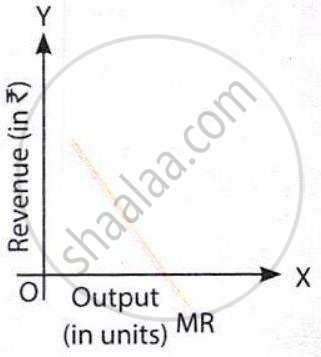
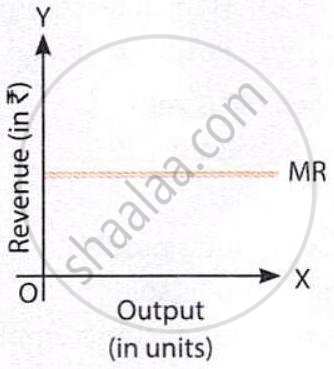
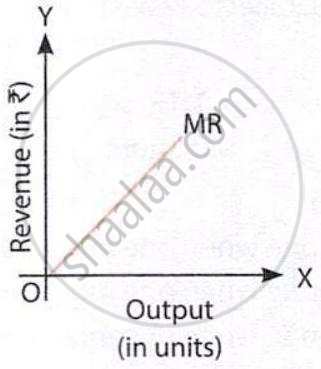
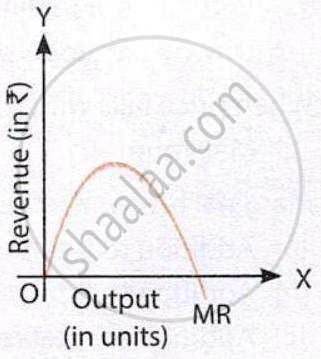
If TR = Total Revenue and Q = Quantity sold, then TR ÷ Q refers to ______.
Zero Revenue
Average Revenue
Marginal Revenue
None of these
If total revenue is ₹ 1,00,000 when 20,000 units are sold, then average revenue is equal to ______.
₹ 1,00,000
₹ 20,000
₹ 5
₹ 1,20,000
If a seller gets ₹ 10,000 by selling 100 units and ₹ 14,000 by selling 120 units, his Marginal Revenue is ______.
₹ 4,000
₹ 450
₹ 200
₹ 100
When price falls with rise in output, then as quantity sold increases ______.
MR falls quickly than AR
MR falls slowly than AR
Both MR and AR fall at the same rate
MR and AR do not change
When 5 units of a good is sold, total revenue is ₹ 100 . When 6 units are sold, marginal revenue is ₹ 8. At what price are 6 units sold? (Choose the correct alternative)
₹ 28 per unit
₹ 20 per unit
₹ 18 per unit
₹ 12 per unit
The product of ‘quantity’ and ‘AR’ at every unit sold is the firm’s ______.
TR
TVC
MR
None of these
Which of the following diagram correctly depicts the relation between AR and MR when price falls with rise in output?
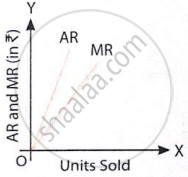
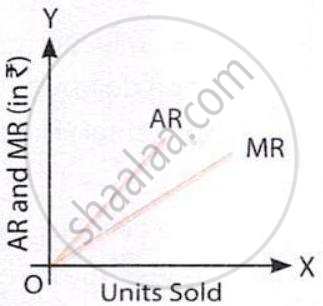
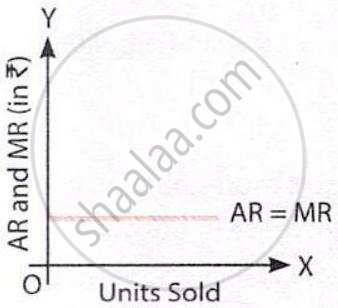
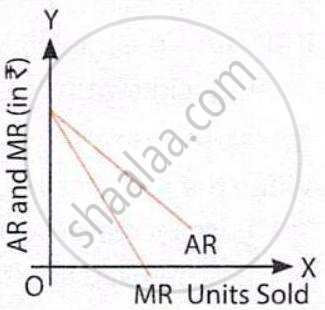
Suppose total revenue is rising at a constant rate as more and more units of a commodity are sold, marginal revenue would be ______.
Greater than Average Revenue
Equal to Average Revenue
Less than Average Revenue
Rising
A firm is able to sell any quantity of a good at a given price. The firm’s marginal revenue will be ______.
Greater than Average Revenue
Less than Average Revenue
Equal to Average Revenue
Zero
A firm is able to sell more quantity of a good only by lowering the price. The firm's marginal revenue, as he goes on selling, would be ______.
Greater than Average Revenue
Less than Average Revenue
Equal to Average Revenue
Zero
Average revenue equals ______.
Total revenue divided by quantity produced
Price
Both (1) and (2)
None of the above
Let TR be total revenue, Q be quantity of output, and ‘n’ the number of units, then marginal revenue equals:
TRn − TRn−1
`"Change in TR"/"Change in Q"`
Both (1) and (2)
None of the above
The Total Revenue earned by selling 20 units is ₹ 700. Marginal Revenue earned by selling the 21st unit is ₹ 70. The value of Total Revenue earned by selling total 21 units will be ______.
₹ 721
₹ 630
₹ 770
₹ 720
If the Marginal Revenue curve is parallel to the X-axis, the price of the commodity would be ______.
(Choose the correct alternative)
Equal to Marginal Revenue
More than Marginal Revenue
Zero
Less than Marginal Revenue
Which of the following is a true statement?
AR indicates Price
AR Curve and Demand Curve are the same
TR is maximum when MR = 0
All of the above
Assertion Reason Questions (ARQs)
In the following Question, read the statements: Assertion (A) and Reason (R). Choose the correct alternative among them:
Assertion (A): When price remains same at all levels of output, then Total Revenue (TR) curve is a positively sloped straight line.
Reason (R): In case of constant prices, MR is constant, i.e. TR increases at a constant rate.
Both Assertion (A) and Reason (R) are True and Reason (R) is the correct explanation of Assertion (A).
Both Assertion (A) and Reason (R) are True and Reason (R) is not the correct explanation of Assertion (A).
Assertion (A) is True but Reason (R) is False.
Assertion (A) is False but Reason (R) is True.
In the following Question, read the statements: Assertion (A) and Reason (R). Choose the correct alternative among them:
Assertion (A): Total revenue is at its maximum point when marginal revenue is zero.
Reason (R): When every additional unit is sold at the same price, Marginal Revenue = Average Revenue.
Both Assertion (A) and Reason (R) are True and Reason (R) is the correct explanation of Assertion (A).
Both Assertion (A) and Reason (R) are True and Reason (R) is not the correct explanation of Assertion (A).
Assertion (A) is True but Reason (R) is False.
Assertion (A) is False but Reason (R) is True.
In the following Question, read the statements: Assertion (A) and Reason (R). Choose the correct alternative among them:
Assertion (A): Total Revenue (TR) curve always starts from the origin.
Reason (R): TR is 0 at zero level of output.
Both Assertion (A) and Reason (R) are True and Reason (R) is the correct explanation of Assertion (A).
Both Assertion (A) and Reason (R) are True and Reason (R) is not the correct explanation of Assertion (A).
Assertion (A) is True but Reason (R) is False.
Assertion (A) is False but Reason (R) is True.
In the following Question, read the statements: Assertion (A) and Reason (R). Choose the correct alternative among them:
Assertion (A): When MR becomes negative, TR starts falling.
Reason (R): When price falls with rise in output, then MR is more than AR.
Both Assertion (A) and Reason (R) are True and Reason (R) is the correct explanation of Assertion (A).
Both Assertion (A) and Reason (R) are True and Reason (R) is not the correct explanation of Assertion (A).
Assertion (A) is True but Reason (R) is False.
Assertion (A) is False but Reason (R) is True.
Statement Based Questions (SBQs)
In the following Question, read the statements and choose the correct alternative among them:
Statement 1: Price and Average Revenue are one and the same thing.
Statement 2: Slope of Total Revenue Curve is represented by Marginal Revenue.
Both the Statements are true.
Both the Statements are false.
Statement 1 is true and Statement 2 is false.
Statement 2 is true and Statement 1 is false.
In the following Question, read the statements and choose the correct alternative among them:
Statement 1: When price remains same at all output levels, both AR and MR curves coincide in a horizontal straight line parallel to the X-axis.
Statement 2: When MR is constant, TR increases at an increasing rate.
Both the Statements are true.
Both the Statements are false.
Statement 1 is true and Statement 2 is false.
Statement 2 is true and Statement 1 is false.
In the following Question, read the statements and choose the correct alternative among them:
Statement 1: Both AR and MR can fall to zero and can even become negative.
Statement 2: Demand Curve or AR curve is perfectly elastic when price remains same at all output levels.
Both the Statements are true.
Both the Statements are false.
Statement 1 is true and Statement 2 is false.
Statement 2 is true and Statement 1 is false.
In the following Question, read the statements and choose the correct alternative among them:
Statement 1: When price falls with rise in output then both AR and MR curves slope upwards.
Statement 2: When firms can increase their volume of sales only by decreasing the price, then AR curve is steeper than the MR curve.
Both the Statements are true.
Both the Statements are false.
Statement 1 is true and Statement 2 is false.
Statement 2 is true and Statement 1 is false.
In the following Question, read the statements and choose the correct alternative among them:
Statement 1: MR can be zero when TR remains same with rise in output.
Statement 2: When MR is zero, TR is at its minimum point.
Both the Statements are true.
Both the Statements are false.
Statement 1 is true and Statement 2 is false.
Statement 2 is true and Statement 1 is false.
Very Short Answer Type Questions (VSAQs)
What is Revenue?
Define Total Revenue.
Define or explain the following concept:
Average Revenue
Define marginal revenue.
How is MR derived from TR?
If all the units are sold at the same rate, how will it affect AR and MR?
What is the relationship between price curve and MR curve, when price remains same at all output levels?
What are the shapes of the AR and MR curves when the firm sells its output at a constant price?
Can MR be zero or negative?
What will be the shape of MR curve when TR increases at constant rate?
Can the average revenue curve lie in the negative axis?
What is the behaviour of Average Revenue in a market in which a firm can sell any quantity of good at a given price?
If MR curve is parallel to the X-axis, what does it tell about price and the demand?
Out of the three concepts of revenue, which one is also known as price?
What is the shape of TR curve, when price remains same at all output levels?
How does TR change with output when MR is negative?
What happens to TR when MR is positive?
Under which situation, will MR fall when an additional quantity of a good is sold?
Comment on the shape of MR curve in case when TR curve is a horizontal straight line.
What is the behaviour of average revenue in a market in which a firm can sell more only by lowering the price?
What is the behaviour of Marginal Revenue in a market in which a firm can sell any quantity of the output it produces at a given price?
Sandeep Garg solutions for Introductory Microeconomics [English] Class 11 7 Revenue REVISION EXERCISE [Pages 7.25 - 7.28]
Short Answer Type Questions
Explain the relation between marginal revenue and average revenue when a firm is able to sell more quantity of output: (i) at the same price. (ii) only by lowering the price.
Explain the relationship between marginal revenue and total revenue with the help of a revenue schedule.
What change in total revenue will result in (i) a decrease in marginal revenue, and (ii) an increase in marginal revenue?
How do changes in marginal revenue affect total revenue?
What is Revenue?
What is an average revenue?
What is marginal revenue?
What happens to average revenue when marginal revenue is greater than average revenue?
What happens to average revenue when marginal revenue is equal to average revenue?
What happens to average revenue when marginal revenue is less than average revenue?
Draw average revenue and marginal revenue curves in a single diagram of a firm which can sell more units of a good only by lowering the price of that good. Explain.
Draw in a single diagram the average revenue and marginal revenue curves of a firm which can sell any quantity of the good at a given price. Explain.
State the relation between marginal revenue and average revenue.
Why is Average Revenue always equal to price?
“Demand curve is the Average Revenue (AR) curve of a firm.” Do you agree? Discuss briefly, with reason in support of your answer.
Long Answer Type Questions
Explain the relationship between marginal revenue and total revenue with the help of a revenue schedule.
Discuss the relationship between AR and MR when price remains constant.
Discuss the relationship between AR and MR when Price falls with rise in output.
Briefly discuss the shapes of TR, AR and MR curves with the help of an imaginary schedule and diagram (when price remains same).
State the relation between marginal revenue and average revenue.
Explain the relationship between marginal revenue and total revenue with the help of a revenue schedule.
What is meant by revenue in microeconomics?
State the relation between marginal revenue and average revenue under perfect competition using suitable diagram or schedule.
Unsolved Practicals
Calculate TR, AR and MR.
| Units sold | 1 | 2 | 3 | 4 |
| Price (₹) | 5 | 4 | 3 | 2 |
Determine the values of TR, AR and MR from the following data:
| Price (₹) | 100 | 95 | 90 | 85 | 80 |
| Sales (units) | 1 | 2 | 3 | 4 | 5 |
Compute TR, AR and MR.
| Unit sold | 3 | 4 | 5 |
| Price (₹) | 10 | 9 | 8 |
With the help of the given data, calculate the values of TR, AR and MR.
| Price (₹) | 10 | 20 | 30 | 40 | 50 | 60 | 70 |
| Units sold | 7 | 6 | 5 | 4 | 3 | 2 | 1 |
From the following data, determine TR, AR and MR.
| Units sold | 10 | 9 | 8 | 7 | 6 | 5 | 4 |
| Price (₹) | 10 | 20 | 30 | 40 | 50 | 60 | 70 |
Determine AR and MR.
| Units sold | 1 | 2 | 3 | 4 | 5 | 6 | 7 |
| TR (₹) | 20 | 36 | 48 | 56 | 60 | 60 | 56 |
Estimate the values of TR and MR.
| Units sold | 1 | 2 | 3 |
| AR (₹) | 10 | 9 | 9 |
Calculate TR and MR from the following data:
| Units sold | 1 | 2 | 3 | 4 | 5 | 6 |
| AR (₹) | 25 | 23 | 21 | 19 | 18 | 15 |
Complete the following table:
| Units sold | 1 | 2 | 3 | 4 | 5 | 6 | 7 | 8 |
| TR (₹) | 10 | - | 24 | - | 30 | 30 | 28 | - |
| MR(₹) | 10 | - | - | 4 | - | 0 | - | -4 |
| AR (₹) | - | 9 | - | 7 | 6 | - | 4 | 3 |
Complete the following table:
| Units sold | 4 | 5 | 6 | 7 |
| TR (₹) | 48 | - | - | 42 |
| AR (₹) | - | 10 | - | - |
| MR (₹) | - | - | −2 | - |
Complete the following table:
| Output (Units) | Total Revenue (₹) | Marginal Revenue (₹) | Price (₹) |
| 1 | 4 | - | - |
| 2 | 6 | - | - |
| 3 | 6 | - | - |
| 4 | 4 | - | - |
Calculate TR and AR.
| Units sold | 1 | 2 | 3 | 4 | 5 | 6 | 7 |
| MR (₹) | 10 | 8 | 6 | 4 | 2 | 0 | −2 |
Complete the following table:
| Output (units) | 1 | 2 | 3 | 4 | 5 |
| AR (₹) | 6 | - | 4 | - | 2 |
| MR (₹) | - | 4 | - | 0 | - |
| TR (₹) | 6 | - | - | - | 10 |
From the information given below, calculate the values of TR and MR.
| Price (₹) | 10 | 20 | 30 | 40 | 50 | 60 | 70 |
| Units sold | 7 | 6 | 5 | 4 | 3 | 2 | 1 |
Complete the following table:
| Price (₹) | Output (Units) | Total Revenue (₹) | Marginal Revenue (₹) |
| - | 1 | - | 5 |
| 4 | - | 8 | - |
| - | 3 | - | 1 |
| 2 | - | 8 | - |
The MR schedule of a monopoly firm is given below. Derive the TR and AR schedules.
| Output (units) | 0 | 1 | 2 | 3 | 4 | 5 | 6 | 7 |
| MR (₹) | - | 14 | 10 | 7 | 5 | 0 | −3 | −5 |
Complete the following table:
| Price (₹) | Output (Units) | Total Revenue (₹) | Marginal Revenue (₹) |
| 5 | 8 | - | - |
| 6 | 7 | - | - |
| 7 | 6 | - | - |
| 8 | 5 | - | - |
Complete the following table:
| Output (units) | 1 | 2 | 3 | 4 | 5 |
| AR (₹) | 10 | - | 8 | - | - |
| MR (₹) | 10 | 8 | - | 0 | - |
| TR (₹) | 10 | - | - | - | 20 |
Complete the following table:
| Price (₹) | Output (Units) | Total Revenue (₹) | Marginal Revenue (₹) |
| 7 | - | 7 | - |
| - | 2 | 10 | - |
| - | 3 | - | −1 |
| 1 | - | - | −5 |
A shopkeeper sold 25 calculators at the price of ₹ 125 each. His total receipts increased to ₹ 3,380 after selling 26 calculators. At what price did he sell the 26th calculator?
When sale of a unit increased from 20 unit to 35 units, the total revenue increased by ₹ 1,200. Calculate marginal revenue.
Sandeep Garg solutions for Introductory Microeconomics [English] Class 11 7 Revenue REVISION TEST PAPERS (RTPs) [Pages 7.31 - 7.34]
Revision Test Paper - 1
Which of the following statements correctly exhibit the relationship between Marginal Revenue and Total Revenue?
(i) When TR rises, MR is negative.
(ii) When TR is maximum, MR is Zero.
(iii) When TR falls, MR is negative.
(iv) When TR falls, MR is positive.
(v) When TR rises, MR is positive.
Alternatives:
(i), (ii) and (iv)
(iii) and (iv)
(i) and (iv)
(ii), (iii) and (v)
Three friends Raman, Ankit and Mayank are discussing the situation when a firm follows its own pricing policy. Identify who amongst them is correct.
Raman: Under this situation, price remains same at all levels of output.
Ankit: Under this situation, price falls with a rise in output.
Mayank: Under this situation, price rises with an increase in output.
Raman
Ankit
Mayank
None of them
In economics, it is customary to refer ______ curve as the demand curve of a firm.
Average Revenue
Marginal Revenue
Total Revenue
None of these
When the marginal revenue curve is a horizontal straight line parallel to the X-axis, then ______.
Price > MR
Price < MR
Price = MR
None of these
When price falls with a rise in output, then average revenue and marginal revenue curves are more elastic as compared to the situation of constant prices. (True / False)
When price remains same at all levels of output, then average revenue is ______ (More than / Equal to) Marginal Revenue.
Read the following statements carefully and choose the correct alternative from the following:
Statement 1: When price remains constant at all output levels, then area under MR curve is equal to TR.
Statement 2: MR can be negative when TR falls with a rise in output.
Both the Statements are True.
Both the Statements are False.
Statement 1 is True and Statement 2 is False.
Statement 2 is True and Statement 1 is False.
Marginal Revenue curve is steeper than the Average Revenue curve. Why?
Calculate Average Revenue (AR) and Marginal Revenue (MR):
| Units sold | 1 | 2 | 3 | 4 | 5 |
| TR (₹) | 50 | 90 | 126 | 152 | 175 |
‘When a firm is able to sell more output at the same price, then Average Revenue is more than Marginal Revenue at all levels of output’. Defend or refute.
Revision Test Paper - 2
In which situation, does the firm have to accept the same price as determined by the industry?
When price remains constant
When price falls with a rise in output
Either (1) or (2)
Neither (1) nor (2)
Three friends Aarav, Kartik and Pankaj are discussing the concept of revenue. Out of three, who is correct?
Aarav: Average Revenue is obtained by dividing total revenue by the number of units sold.
Kartik: When price remains constant at all levels of output, then Price Line is same as Marginal Revenue Curve.
Pankaj: Slope of Total Revenue curve is represented by Marginal Revenue (MR).
Only Kartik
Kartik and Pankaj
Aarav and Pankaj
All of them
Profit is equal to ______.
Revenue × Costs
Revenue + Costs
Revenue − Costs
Revenue ÷ Costs
If Total Revenue realised from the sale of 10 bags is ₹ 3,000 and from the sale of 11 bags is ₹ 3,400, then Marginal Revenue for the 11th bag will be ______.
₹ 3,000
₹ 400
₹ 3,400
₹ 640
When more output can be sold only by lowering the price, then revenue from every additional unit will rise. (True/False)
Marginal Revenue (MR) and Average Revenue (AR) fall with ______ (Decrease/Increase) in output. However, ______ (AR/MR) falls at a rate more than the rate of fall in ______ (AR/MR).
Read the following statements carefully and choose the correct alternative from the following:
Statement 1: If a firm sells 5 fans at a price of ₹ 1,800 per fan, then the average revenue is ₹ 1,800.
Statement 2: Average Revenue is the change in Total Revenue from the sale of one more unit of a commodity.
Both the Statements are True.
Both the Statements are False.
Statement 1 is True and Statement 2 is False.
Statement 2 is True and Statement 1 is False.
When does the AR curve coincide with the MR curve?
Calculate Total Revenue (TR), Average Revenue (AR) and Marginal Revenue (MR):
| Price (₹) | 40 | 35 | 30 | 25 | 20 | 15 | 10 | 5 |
| Demand (Units) | 1 | 2 | 3 | 4 | 5 | 6 | 7 | 8 |
Discuss the relationship between TR and MR when price falls with rise in output.
Solutions for 7: Revenue
Sandeep Garg solutions for Introductory Microeconomics [English] Class 11 chapter 7 - Revenue
Shaalaa.com has the CBSE Mathematics Introductory Microeconomics [English] Class 11 CBSE solutions in a manner that help students grasp basic concepts better and faster. The detailed, step-by-step solutions will help you understand the concepts better and clarify any confusion. Sandeep Garg solutions for Mathematics Introductory Microeconomics [English] Class 11 CBSE 7 (Revenue) include all questions with answers and detailed explanations. This will clear students' doubts about questions and improve their application skills while preparing for board exams.
Further, we at Shaalaa.com provide such solutions so students can prepare for written exams. Sandeep Garg textbook solutions can be a core help for self-study and provide excellent self-help guidance for students.
Concepts covered in Introductory Microeconomics [English] Class 11 chapter 7 Revenue are .
Using Sandeep Garg Introductory Microeconomics [English] Class 11 solutions Revenue exercise by students is an easy way to prepare for the exams, as they involve solutions arranged chapter-wise and also page-wise. The questions involved in Sandeep Garg Solutions are essential questions that can be asked in the final exam. Maximum CBSE Introductory Microeconomics [English] Class 11 students prefer Sandeep Garg Textbook Solutions to score more in exams.
Get the free view of Chapter 7, Revenue Introductory Microeconomics [English] Class 11 additional questions for Mathematics Introductory Microeconomics [English] Class 11 CBSE, and you can use Shaalaa.com to keep it handy for your exam preparation.
