Advertisements
Online Mock Tests
Chapters
1: Goods and Services Tax (G.S.T.)
2: Banking
3: Shares and Dividends
UNIT 2: ALGEBRA
4: Linear Inequations
5: Quadratic Equation
6: Problems on Quadratic Equations
7: Ratio and Proportion
8: Remainder Theorem and Factor Theorem
9: Matrices
10: Arithmetic Progression
11: Geometric Progression
12: Reflection
▶ 13: Section and Mid-point Formulae
14: Equation of a Straight Line
UNIT 3: GEOMETRY
Chapter 15: Similarity (As a Size Transformation)
Chapter 16: Similarity of Triangles
17: Loci
Chapter 18: Angle and Cyclic Properties of a Circle
Chapter 19: Tangent Properties of Circles
20: Constructions
UNIT 4: MENSURATION
Chapter 21: Volume and Surface Area of Solids (Cylinder, Cone and Sphere)
UNIT 5: TRIGONOMETRY
Chapter 22: Trigonometrical Identities
Chapter 23: Heights and Distances
UNIT 6: STATISTICS
Chapter 24: Graphical Representation of Statistical Data
Chapter 25: Measures of Central Tendency (Mean)
Chapter 26: Median, Quartiles and Mode
UNIT 7: PROBABILITY
Chapter 27: Probability
Advertisements
Solutions for Chapter 13: Section and Mid-point Formulae
Below listed, you can find solutions for Chapter 13 of CISCE R.S. Aggarwal for Mathematics [English] Class 10 ICSE.
R.S. Aggarwal solutions for Mathematics [English] Class 10 ICSE 13 Section and Mid-point Formulae EXERCISE 13 [Pages 209 - 211]
Find the co-ordinates of point P which divides the line segment joining A(–2, –7) and B(6, 1) in the ratio 5 : 3.
The line segment joining the points \(\mathrm{A}(4, -3)\) and \(\mathrm{B}(4, 2)\) is divided by the point P such that \(\mathrm{AP}: \mathrm{AB}=2:5\). Find the co-ordinates of P.
\[[\textbf{Hint: } \frac{AP}{AB} = \frac{2}{5} \Rightarrow \frac{AP}{AP + PB} = \frac{2}{5} \Rightarrow 3AP = 2PB \Rightarrow \frac{AP}{PB} = \frac{2}{3} \Rightarrow AP : PB = 2 : 3\text{.]}\]
P(1, -2) is a point on the line segment A(3, -6) and B(x, y) such that AP : PB is equal to 2 : 3. Find the coordinates of B.
Find a point P on the line segment joining \(\mathrm{A}(14, -5)\) and \(\mathrm{B}(-4, 4)\), which is twice as far from A as from B.
[Hint: \(AP = 2PB \Rightarrow AP : PB = 2 : 1\).]
Find the co-ordinates of the points of trisection of the line segment joining the points \(\mathrm{A}(5, -3)\) and \(\mathrm{B}(2, -9)\).
Find the co-ordinates of the mid-point of the line segment joining:
\(\mathrm{A}(5, 7)\) and \(\mathrm{B}(-3, -1)\)
Find the co-ordinates of the mid-point of the line segment joining:
\(\mathrm{P}(-5, -8)\) and \(\mathrm{Q}(3,4)\)
The line segment joining \(\mathrm{A}(-3, 1)\) and \(\mathrm{B}(7,-5)\) is a diameter of a circle whose centre is C. Find the co-ordinates of the point C.
\(\mathrm{A}(10, 5), \mathrm{B}(6, -3)\) and \(\mathrm{C}(2, 1)\) are the vertices of a \(\triangle \mathrm{ABC}\). \(\mathrm{L}\) is the mid-point of AB and M is the mid-point of AC. Write down the co-ordinates of L and M. Show that \(\mathrm{LM} = \frac{1}{2} \mathrm{BC}\).
The mid-point of the line segment joining \(\mathrm{A}(p, 5)\) and \(\mathrm{B}(3, q)\) is \(\mathrm{M}(-1, 4)\). Find the values of p and q.
The centre of a circle is C(–2, 3) and one end of a diameter PQ is P(2, –4). Find the co-ordinates of Q .
The point \(\mathrm{P}(-4, 1)\) divides the line segment joining the points \(\mathrm{A}(2, -2)\) and B in the ratio 3 : 5. Find the co-ordinates of point B.
In what ratio does the point P(2, –5) divide the join of A(–3, 5) and B(4, –9)?
In what ratio does the point \(\mathrm{P}(a, -1)\) divide the join of \(\mathrm{A}(1, -3)\) and \(\mathrm{B}(6, 2)\). Hence, find the value of a.
The line segment joining (\mathrm{A}(2, 3)) and (\mathrm{B}(6, -5)) is intercepted by the x-axis at the point k. Find the ratio in which k divides AB. Also, write the co-ordinates of the point k.
In what ratio is the segment joining the points \(\mathrm{A}(6,5)\) and \(\mathrm{B}(-3, 2)\) divided by the y-axis? Find the point at which the y-axis cuts AB.
- Write down the co-ordinates of the point P that divides the line joining A(−4, 1) and B(17, 10) in the ratio 1 : 2.
- Calculate the distance OP, where O is the origin.
- In what ratio does the y-axis divide the line AB?
The line joining P(–4, 5) and Q(3, 2) intersects the y-axis at point R. PM and QN are perpendicular from P and Q on the x-axis Find:
- the ratio PR : RQ
- the coordinates of R.
- the area of the quadrilateral PMNQ.
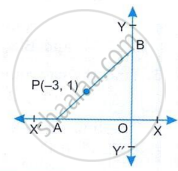
In the given figure, the line segment AB meets x-axis at A and y-axis at B. The point \(\mathrm{P}(-3, 1)\) on AB divides it in the ratio 2 : 3. Find the co-ordinates of A and B.
[Hint: (i) The co-ordinates of A and B are of the form A(x, 0), and B(0, y).]
Show that the line segment joining the points \(\mathrm{A}(-5, 8)\) and \(\mathrm{B}(10, -4)\) is trisected by the co-ordinate axes. Also, find the points of trisection of AB.
[Hint: Let x-axis divide AB in the ratio k : 1 at the point P(x, 0). Let y-axis divide AB in the ratio p : 1 at the point Q(0, y).]
The mid-points of the sides BC, CA and AB of \(\Delta \mathrm{ABC}\) are \(\mathrm{D}(2, 1), \mathrm{E}(-1, -3)\) and \(\mathrm{F}(4, 5)\) respectively. Find the co-ordinates of \(\mathrm{A}, \mathrm{B}\) and \(\mathrm{C}\).
Prove that the points \(\mathrm{A}(-2, -1), \mathrm{B}(1, 0), \mathrm{C}(4, 3)\) and \(\mathrm{D}(1, 2)\) are the vertices of a parallelogram ABCD.
If the points A(–2, –1), B(1, 0), C(a, 3) and D(1, b) form a parallelogram, find the values of a and b.
[Hint: Mid-point of AC = mid-point of BD.]
The three vertices of a parallelogram ABCD, taken in order are \(\mathrm{A}(-1, 0), \mathrm{B}(3, 1)\) and \(\mathrm{C}(2, 2)\). Find the co-ordinates of the fourth vertex of the parallelogram.
Find the lengths of the medians of a \(\triangle \mathrm{ABC}\) whose vertices are \(\mathrm{A}(-1, 3), \mathrm{B}(1, -1)\) and \(\mathrm{C}(5, 1)\). Also, find the co-ordinates of the centroid of \(\Delta \mathrm{ABC}\).
Find the co-ordinates of the centroid of \(\triangle \mathrm{PQR}\) whose vertices are \(\mathrm{P}(6, 3), \mathrm{Q}(-2, 5)\) and \(\mathrm{R}(-1, 7)\).
Find the co-ordinates of the point of intersection of the medians of the triangle whose vertices are A(–7, 5), B(–1, –3) and C(5, 7).
[Hint. Find the centroid of \(\triangle A B C\).]
If \(\mathrm{G}(-2, 1)\) is the centroid of \(\triangle \mathrm{ABC}\), two of whose vertices are \(\mathrm{A}(1, -6)\) and \(\mathrm{B}(-5, 2)\), find the third vertex of the triangle.
A(6, y), B(–4, 4) and C(x, –1) are the vertices of \(\triangle \mathrm{ABC}\) whose centroid is the origin. Calculate the values of x and y.
ABC is a triangle and \(\mathrm{G}(4, 3)\) is its centroid. If \(\mathrm{A}(1, 3), \mathrm{B}(4, b)\) and \(\mathrm{C}(a, 1)\) be the vertices, find the values of a and b and hence find the length of side BC.
Calculate the ratio in which the line segment joining \(\mathrm{A}(-4, 2)\) and \(\mathrm{B}(3, 6)\) is divided by the point \(\mathrm{P}(x, 3)\). Also, find (i) x (ii) length of AP.
In what ratio is the line joining \(\mathrm{P}(5, 3)\) and \(\mathrm{Q}(-5, 3)\) divided by the x-axis? Also find the coordinates of the point of intersection.
Find a point P which divides internally the line segment joining the points A(–3, 9) and B(1, –3) in the ratio 1 : 3.
R.S. Aggarwal solutions for Mathematics [English] Class 10 ICSE 13 Section and Mid-point Formulae COMPETENCY-FOCUSED QUESTIONS [Pages 211 - 214]
I. Multiple Choice Questions Choose the correct alternative:
The coordinates of the point P which divides the join of A(5, –2) and B(9, 6) in the ratio 3 : 1 are ______.
\((4, -7)\)
\(\left(\frac{7}{2}, 4\right)\)
\((8, 4)\)
\((12, 8)\)
The coordinates of the point on x-axis which divides the line segment joining the points (2, 3) and (5, – 6) in the ratio 1 : 2 are ______.
(2, 0)
(–2, 0)
(3, 0)
(–3,0)
The point which divides the line segment joining the points A(3, –2) and B(6, 7) internally in the ratio 3 : 2 lies in which of the following quadrants?
I
II
III
IV
If the point \(\mathrm{R}(k, 4)\) divides the line segment joining the points \(\mathrm{P}(2,6)\) and \(\mathrm{Q}(5, 1)\) in the ratio 2 : 3, then the value of (k) is ______.
–5
\(-\frac{16}{5}\)
5
\(\frac{16}{5}\)
Points \(\mathrm{A}(x, y), \mathrm{B}(3, -2)\) and \(\mathrm{C}(4, -5)\) are collinear. The value of y in terms of x is ______.
\(3x - 11\)
\(11 - 3x\)
\(3x - 7\)
\(7 - 3x\)
If the point \(\mathrm{P}(6, 2)\) divides the line segment joining \(\mathrm{A}(6, 5)\) and \(\mathrm{B}(4, y)\) in the ratio 3 : 1, then the value of y is ______.
1
2
3
4
The ratio in which the point \(\mathrm{P}(1, 2)\) divides the join of the points \(\mathrm{A}(-2, 1)\) and \(\mathrm{B}(7, 4)\) is ______.
1 : 2
2 : 1
3 : 2
2 : 3
The line segment joining \(\mathrm{A}(-7, 2)\) and \(\mathrm{B}(3, -8)\) is divided by the x-axis in the ratio:
1 : 4
3 : 7
4 : 1
7 : 3
In what ratio is the line segment joining the points \(\mathrm{P}(-4, 2)\) and \(\mathrm{Q}(8, 3)\) divided by y-axis?
1 : 3
3 : 1
1 : 2
2 : 1
Point P divides the line segment joining R(-1, 3) and S(9,8) in ratio k:1. If P lies on the line x - y + 2 = 0, then value of k is ______.
`2/3`
`1/2`
`1/3`
`1/4`
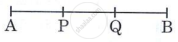
In the adjoining figure, \(\mathrm{P}(5, -3)\) and \(\mathrm{Q}(3, y)\) are the points of trisection of the line segment joining \(\mathrm{A}(7, -2)\) and \(\mathrm{B}(1, -5)\). Then, y equals:
– 4
\(-\frac{5}{2}\)
2
4
If the point \(\mathrm{P}(6, -3)\) lies on the line segment joining points \(\mathrm{A}(4, 2)\) and \(\mathrm{B}(8, 4)\) then:
\(\mathrm{AP}=\frac{1}{3} \mathrm{AB}\)
\(\mathrm{AP}=\frac{1}{4} \mathrm{AB}\)
\(\mathrm{PB}=\frac{1}{3} \mathrm{AB}\)
\(\mathrm{AP}=\frac{1}{2} \mathrm{AB}\)
The mid-point of the line segment joining the points (–3, 2) and (7, 6) is ______.
(–2, –4)
(–2, 4)
(2, 4)
(4, 2)
If A(4, 2), B(6, 5) and C(1, 4) be the vertices of \(\triangle \mathrm{ABC}\) and AD is a median, then the coordinates of D are ______.
\(\left(\frac{5}{2}, 3\right)\)
\(\left(5, \frac{7}{2}\right)\)
\(\left(\frac{7}{2}, \frac{9}{2}\right)\)
none of these
If (3, – 6) is the mid-point of the line segment joining (0, 0) and (x, y), then the point (x, y) is ______.
(–3, 6)
(6, –6)
(6, –12)
\(\left(\frac{3}{2},-3\right)\)
If the line segment joining the points P and Q(3, –4) is bisected at the origin, then the coordinate of P are ______.
(3, –2)
(3, –4)
(–3, –4)
(–3, 4)
\(\mathrm{A}(-3, b)\) and \(\mathrm{B}(1, b + 4)\) are two points. If the coordinates of the mid-point of AB are \((-1, 1)\), then the value of b is ______.
–1
0
1
2
If the point \(\mathrm{R}(5,7)\) is the mid-point of the line segment joining the points \(\mathrm{P}(3, y)\) and \(\mathrm{Q}(x, 9)\), then \((x + y)\) equals:
7
9
12
14
The mid-point of the line segment joining (4p, 5) and (2, 3q) is (5, 5p – 1). The values of p and q are respectively are ______.
\(2, \frac{8}{3}\)
\(-2, \frac{8}{3}\)
\(2, \frac{13}{3}\)
\(-2, \frac{13}{3}\)
A line intersects the y-axis and x-axis at the points P and Q respectively. If (2, –5) is the mid-point of PQ, then the coordinates of P and Q are respectively:
(0, 10) and (–4, 0)
(0, –5) and (2, 0)
(0, 4) and (–10, 0)
(0, –10) and (4, 0)
If a point \(\mathrm{R}\left(\frac{23}{5}, \frac{33}{5}\right)\) divides the line segment PQ joining the points \(\mathrm{P}(3, 5)\) and \(\mathrm{Q}(x, y)\) in the ratio 2 : 3 internally, then the values of x and y respectively are ______.
4, 7
5, 9
7, 8
7, 9
The coordinates of the vertices of ΔABC are respectively (–4, –2), (6, 2), and (4, 6). The centroid G of ΔABC is ______.
(2, 2)
(2, 3)
(3, 3)
(0, –1)
Two vertices of a \(\triangle \mathrm{ABC}\) are \(\mathrm{A}(-1,4)\) and \(\mathrm{B}(5, 2)\) and its centroid is (0, –3). The coordinates of C are ______.
(4, 3)
(4, 15)
(–4, –15)
(–15, –4)
In the adjoining diagram, G is the centroid of ΔABC. A(3, –3), В(2, –6), C(x, y) and G(5, –5). The coordinates of point D are:

(2, –6)
(3, –6)
(6, –6)
(10, –6)
The points \(\mathrm{A}, \mathrm{B}\) and \(\mathrm{C}\) divide the line segment joining the points \(\mathrm{P}(-3, 8)\) and \(\mathrm{Q}(9, -4)\) into four equal parts. If A is nearest to P, then the coordinates of A are ______.
(–3, 5)
(0, 5)
(3, 5)
(6, –1)
The line 2x + y – 4 = 0 divides the line segment joining \(\mathrm{A}(2, -2)\) and \(\mathrm{B}(3, 7)\) in the ratio
2 : 3
2 : 5
2 : 7
2 : 9
The centre of the circle having end points of its one diameter as (–4, 2) and (4, –3), is ______.
\((0, -1)\)
\((2, -1)\)
\(\left(0, -\frac{1}{2}\right)\)
\(\left(4, -\frac{5}{2}\right)\)
A circle has its centre at (4, 4). If one end of a diameter is (4, 0), then the coordinates of the other end are ______.
(0, 4)
(4, 8)
(4, –8)
(–4, –8)
The vertices of a parallelogram in order are A(1, 2), B(4, y), C(x, 6) and D(3, 5). Then (x, y) is ______.
(6, 3)
(3, 6)
(5, 6)
(1, 4)
The fourth vertex D of a parallelogram ABCD, whose three vertices are A(–2, 3), B(6, 7) and C(8, 3), is ______.
(0, 1)
(0, –1)
(–1, 0)
(1, 0)
\(\mathrm{A}(1,4), \mathrm{B}(4,1)\) and \(\mathrm{C}(x, 4)\) are the vertices of \(\triangle \mathrm{ABC}\). If the centroid of the triangle is \(\mathrm{G}(4, 3)\), then x is equal to ______.
2
1
7
4
II. Assertion-Reason Type Questions Directions: In each question below, there are two statements labelled as Assertion (A) and Reason (R). Choose the correct answer as per the options given below:
Assertion (A): The coordinates of a point which divides a line segment joining the points (–3, 4) and (7, –6) in the ratio 1 : 2 internally are \(\left(\frac{1}{3}, \frac{2}{3}\right)\).
Reason (R): The coordinates of the point which divides the line segment. joining the points \(\left(x_{1}, y_{1}\right)\) and \(\left(x_{2}, y_{2}\right)\) internally in the ratio \(m : n\) are given by \(\left(\frac{mx_{2} + nx_{1}}{m + n}, \frac{my_{2} + ny_{1}}{m + n}\right)\)
Both A and R are true, and R is the correct explanation of A.
Both A and R are true, but R is not the correct explanation of A.
A is true, but R is false.
A is false, but R is true.
Assertion (A): The coordinates of one end of a diameter of a circle are (1, 4). If its centre is at (2, –3), then the coordinates of the other end of the diameter are (–3, –10).
Reason (R): Centre of a circle is equidistant from each end of a diameter.
Both A and R are true, and R is the correct explanation of A.
Both A and R are true, but R is not the correct explanation of A.
A is true, but R is false.
A is false, but R is true.
Assertion (A): If the points \(\mathrm{A}(x, 1), \mathrm{B}(8, 2), \mathrm{C}(9, 4)\) and \(\mathrm{D}(7, 3)\) are the vertices of a parallelogram, taken in order, then the value of x is 6.
Reason (R): Adjacent angles of a parallelogram are supplementary.
Both A and R are true, and R is the correct explanation of A.
Both A and R are true, but R is not the correct explanation of A.
A is true, but R is false.
A is false, but R is true.
Assertion (A): The coordinates of the centroid of a triangle whose vertices are (–1, –4), (4, 3) and (6 – 2) are (3, –1).
Reason (R): If the vertices of a triangle are \(\left(x_{1}, y_{1}\right),\left(x_{2}, y_{2}\right)\) and \(\left(x_{3}, y_{3}\right)\), then the coordinates of its centroid are \(\left(\frac{x_{1} + x_{2} + x_{3}}{2}, \frac{x_{1} + x_{2} + x_{3}}{2}\right)\)
Both A and R are true, and R is the correct explanation of A.
Both A and R are true, but R is not the correct explanation of A.
A is true, but R is false.
A is false, but R is true.
III. Analytical and Application Based Questions
Determine the ratio in which the line y = 2 + 3x divides the line segment AB joining the points A(–3, 9) and B(4, 2).
In the given figure, if the line segment AB is intercepted by the y-axis and x-axis at C and D, respectively, such that AC : AD = 1 : 4 and D is the midpoint of CB. Find the coordinates of D, C and В.

Solutions for 13: Section and Mid-point Formulae
R.S. Aggarwal solutions for Mathematics [English] Class 10 ICSE chapter 13 - Section and Mid-point Formulae
Shaalaa.com has the CISCE Mathematics Mathematics [English] Class 10 ICSE CISCE solutions in a manner that help students grasp basic concepts better and faster. The detailed, step-by-step solutions will help you understand the concepts better and clarify any confusion. R.S. Aggarwal solutions for Mathematics Mathematics [English] Class 10 ICSE CISCE 13 (Section and Mid-point Formulae) include all questions with answers and detailed explanations. This will clear students' doubts about questions and improve their application skills while preparing for board exams.
Further, we at Shaalaa.com provide such solutions so students can prepare for written exams. R.S. Aggarwal textbook solutions can be a core help for self-study and provide excellent self-help guidance for students.
Concepts covered in Mathematics [English] Class 10 ICSE chapter 13 Section and Mid-point Formulae are .
Using R.S. Aggarwal Mathematics [English] Class 10 ICSE solutions Section and Mid-point Formulae exercise by students is an easy way to prepare for the exams, as they involve solutions arranged chapter-wise and also page-wise. The questions involved in R.S. Aggarwal Solutions are essential questions that can be asked in the final exam. Maximum CISCE Mathematics [English] Class 10 ICSE students prefer R.S. Aggarwal Textbook Solutions to score more in exams.
Get the free view of Chapter 13, Section and Mid-point Formulae Mathematics [English] Class 10 ICSE additional questions for Mathematics Mathematics [English] Class 10 ICSE CISCE, and you can use Shaalaa.com to keep it handy for your exam preparation.
