English

In the adjoining figure, (\mathrm{P}(5, –3)) and (\mathrm{Q}(3, y)) are the points of trisection of the line segment joining (\mathrm{A}(7, –2)) and (\mathrm{B}(1, –5)). Then, y equals:

Advertisements
Advertisements

Question

In the adjoining figure, \(\mathrm{P}(5, -3)\) and \(\mathrm{Q}(3, y)\) are the points of trisection of the line segment joining \(\mathrm{A}(7, -2)\) and \(\mathrm{B}(1, -5)\). Then, y equals:  
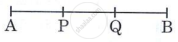
A horizontal line segment bounded by the endpoints A and B.

Options

  • – 4

  • \(-\frac{5}{2}\)

  • 2

  • 4

MCQ
Advertisements

Solution

– 4

Explanation:

Q is the second point of trisection, so it divides AB in the ratio 2 : 1:

$$x = \frac{2 \times 1 + 1 \times 7}{3} = 3$$

$$y = \frac{2 \times (-5) + 1 \times (-2)}{3} = -4$$

Hence y = – 4.

shaalaa.com
  Is there an error in this question or solution?
Chapter 13: Section and Mid-point Formulae - COMPETENCY-FOCUSED QUESTIONS [Page 212]

APPEARS IN

R.S. Aggarwal Mathematics [English] Class 10 ICSE
Chapter 13 Section and Mid-point Formulae
COMPETENCY-FOCUSED QUESTIONS | Q 11. | Page 212
Share
Notifications

Englishहिंदीमराठी


      Forgot password?
Use app×