Advertisements
Chapters
1: What 's Your Dream
2: A Devoted Son
3: The Hum of Insects
4: The Judgment of Paris
5: On Education
6: I Can Play Schools
▶ 7: The Last Letter
Poetry - An Introduction to Poetry
1 a): The Darkling Thrush
1 b): Hope is the Thing
2: Survivors
3: At a Potato Digging
4: Ode: To Autumn
5: Hamlet's Dilemma
6: Curtain
Chapter 7: A Walk by Moonlight
Drama - An Introduction to Drama
Chapter 1: Remember Ceasar
Chapter 2: The Monkey's Paw
Advertisements
Solutions for Chapter 7: The Last Letter
Below listed, you can find solutions for Chapter 7 of CBSE CBSE for English Literature Reader Class 12.
CBSE solutions for English Literature Reader Class 12 7 The Last Letter Intex Questions [Page 53]
Identify other sources of history and share your ideas.
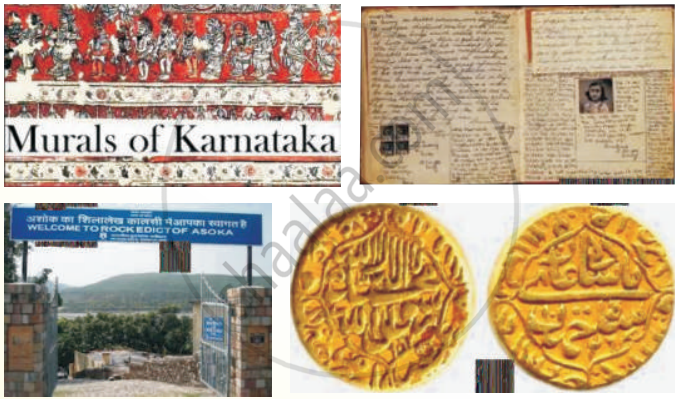
Warm up:
Given below are pictures of a few artefacts. Study them carefully. How are they to be classified? What insights do they give? Discuss with your partner.
CBSE solutions for English Literature Reader Class 12 7 The Last Letter Exercise [Pages 56 - 57]
Understanding the text: Answer the following questions briefly:
What prompts the author to write the last letter?
How does Nehru reflect on Benjamin Disraeli’s thoughts?
What sources did Nehru depend on while writing from prison?
How should one view the past?
What is common about people both past and present?
Mention a few striking pictures from the gallery of history.
Assess the relative importance of the past and the future.
How does Karl Marx define history?
What is the most important lesson that history teaches us?
Explain Romain Rolland’s view on ‘thought’ and ‘action’.
Read the following extract and answer the questions:
| ‘Other men condemned to exile and captivity, if they survive, despair: the man of letters may reckon those days as the sweetest of his life.’ |
Bring out the contrast in the reactions of the two types of individuals in captivity.
Read the following extract and answer the questions:
| ‘It is absurd for us to judge past people as if they lived now and thought as we do’. |
Why is it absurd to do so?
Read the following extract and answer the questions:
| ‘The past brings us many gifts.’ |
What are the gifts received from our past?
Read the following extract and answer the questions:
| ‘Danger seems terrible from a distance; it is not so bad if you have a close look at it.’ |
Explain, with an example, how ‘danger’ adds zest to life.
Read the following extract and answer the questions:
| ‘People avoid action often because they are afraid of the consequences, for action means risk and damages.’ |
Explain this attitude to action? Is this appropriate in day to day life? Give reasons.
Vocabulary:
Match the words and phrases with their meaning.
| Words/Phrases | Meaning |
| 1. unravel | sad |
| 2. a man of letters | disentangle |
| 3. exhilaration | overcame |
| 4. dismal | thrill |
| 5. surmounted | scholar |
Using Suffixes:
Form nouns by adding ‘- tion’ or ‘-ity’ to each of the following words.
ambiguous, celebrate, compatible, ethnic, frugal, assume, declare, depreciate, fumigate, exaggerate
Replace each of the words in italics with the appropriate word.
| treachery | unquestioning | disillusion | reverently | glimpse |
- The members welcomed the chairman respectfully.
- In olden days, students in the Gurukula system had implicit faith in what their teachers said.
- On witnessing the dance drama, the foreigner got a peek at Indian culture.
- Kohli’s trip to the U.S. turned out to be a disenchanted one.
- The award winning short story was on betrayal and revenge.
Writing Skills:
Answer in about 100-120 words.
How, according to Nehru, is the present different from the past?
Answer in about 100-120 words.
While it is important to understand the past, it is more important to value the future. Why?
Answer in about 100-120 words.
“Actions justify thoughts.” Elaborate.
Answer in about 100-120 words.
History is not a magic show, but there is plenty of magic in it for those who have eyes to see. Explain.
Answer in about 100-120 words.
History, it is said, has many lessons to teach us; and there is another saying that history never repeats itself. Explain the message conveyed by the two sayings?
Answer in about 100-120 words.
As a historian, write a paragraph based on Nehru’s views, on the path breaking events of the 21st century that have significantly contributed to the growth and progress of humanity.
Conversation Skills:
‘Thought, in order to justify itself, must lead to action’. In groups of four think of a significant event in history that substantiates these words of Nehru.
Read this famous letter: Abraham Lincoln’s Letter to His Son’s Teacher.
|
Respected Teacher, My son will have to learn I know that all men are not just, all men are not true. But teach him also that for every scoundrel there is a hero; that for every selfish politician, there is a dedicated leader. Teach him that for every enemy there is a friend. It will take time, I know; but teach him, if you can, that a dollar earned is far more valuable than five found. Teach him to learn to lose and also to enjoy winning. Steer him away from envy, if you can. Teach him the secret of quiet laughter. Let him learn early that the bullies are the easiest to lick. Teach him, if you can, the wonder of books… but also give him quiet time to ponder over the eternal mystery of birds in the sky, bees in the sun, and flowers on a green hill -side. In school teach him it is far more honourable to fail than to cheat. Teach him to have faith in his own ideas, even if every one tells him they are wrong. Teach him to be gentle with gentle people and tough with the tough. Try to give my son the strength not to follow the crowd when every one is getting on the bandwagon. Teach him to listen to all men but teach him also to filter all he hears on a screen of truth and take only the good that comes through. Teach him, if you can, how to laugh when he is sad. Teach him there is no shame in tears. Teach him to scoff at cynics and to beware of too much sweetness. Teach him to sell his brawn and brain to the highest bidders; but never to put a price tag on his heart and soul. Teach him to close his ears to a howling mob… and to stand and fight if he thinks he’s right. Treat him gently; but do not cuddle him because only the test of fire makes fine steel. Let him have the courage to be impatient, let him have the patience to be brave. Teach him always to have sublime faith in himself because then he will always have sublime faith in mankind. This is a big order; but see what you can do. He is such a fine little fellow, my son. Abraham Lincoln. |
Think and discuss:
- What message does Lincoln’s letter give the reader? Discuss with your partner
- Compare the purpose of Lincoln’s letter with “The Last Letter” by Pt. Nehru.
Solutions for 7: The Last Letter
CBSE solutions for English Literature Reader Class 12 chapter 7 - The Last Letter
Shaalaa.com has the CBSE Mathematics English Literature Reader Class 12 CBSE solutions in a manner that help students grasp basic concepts better and faster. The detailed, step-by-step solutions will help you understand the concepts better and clarify any confusion. CBSE solutions for Mathematics English Literature Reader Class 12 CBSE 7 (The Last Letter) include all questions with answers and detailed explanations. This will clear students' doubts about questions and improve their application skills while preparing for board exams.
Further, we at Shaalaa.com provide such solutions so students can prepare for written exams. CBSE textbook solutions can be a core help for self-study and provide excellent self-help guidance for students.
Concepts covered in English Literature Reader Class 12 chapter 7 The Last Letter are .
Using CBSE English Literature Reader Class 12 solutions The Last Letter exercise by students is an easy way to prepare for the exams, as they involve solutions arranged chapter-wise and also page-wise. The questions involved in CBSE Solutions are essential questions that can be asked in the final exam. Maximum CBSE English Literature Reader Class 12 students prefer CBSE Textbook Solutions to score more in exams.
Get the free view of Chapter 7, The Last Letter English Literature Reader Class 12 additional questions for Mathematics English Literature Reader Class 12 CBSE, and you can use Shaalaa.com to keep it handy for your exam preparation.
