Advertisements
Chapters
1: Natural Resources – Air, Water and Land
2: The Living World
3: Diversity in Living Things and their Classification
4: Disaster Management
Part 2
5: Substances in the Surroundings—Their States and Properties
6: Substances in Daily Use
7: Nutrition and Diet
8: Our Skeletal System and the Skin
Part 3
9: Motion and Types of Motion
10: Force and Types of Force
11: Work and Energy
12: Simple Machines
Part 4
13: Sound
▶ 14: Light and the Formation of Shadows
15: Fun with Magnets
16: The Universe
![Balbharati solutions for General Science Integrated [English] Standard 6 Maharashtra State Board chapter 14 - Light and the Formation of Shadows - Shaalaa.com](/images/general-science-integrated-english-standard-6-maharashtra-state-board_6:16ccdac16bb449e39ef419deb5dc6b8d.jpg "Balbharati solutions for General Science Integrated [English] Standard 6 Maharashtra State Board chapter 14 - Light and the Formation of Shadows")
Advertisements
Solutions for Chapter 14: Light and the Formation of Shadows
Below listed, you can find solutions for Chapter 14 of Maharashtra State Board Balbharati for General Science Integrated [English] Standard 6 Maharashtra State Board.
Balbharati solutions for General Science Integrated [English] Standard 6 Maharashtra State Board 14 Light and the Formation of Shadows Intext Questions [Pages 70 - 73]
Can you tell?
Can we see anything in total darkness?
What helps us to see the objects around us?
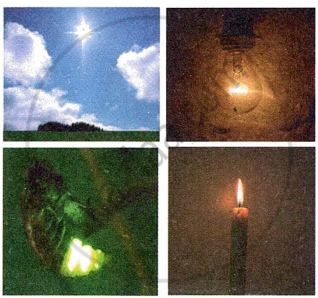
What does the light in each one of the pictures originate from?
Use your brain power!
Make a list of some luminous objects and substances and classify them into natural and artificial sources of light.
Let's try this.
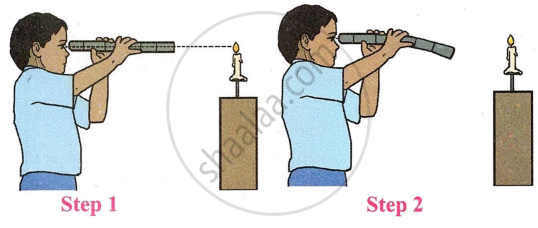
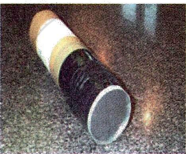
Take a straight tube that can be bent easily. As shown in the figure, place a burning candle on a stand, and look at it through the tube. Then bend the tube and look at the candle again. What do you see?
Use your brain power!
In which step is the flame of the candle seen clearly? Why?
Con you tell?
In which objects do we see a reflection?
What is the difference between an object and its reflection? What causes the difference?
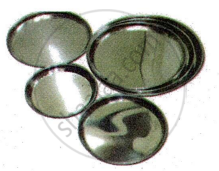
You may have seen your image formed on surfaces such as a new steel dish, the glossy granite cladding of a wall and the still water in a lake. Make a list of other similar surfaces. Compare the images seen in them. Make a guess about the property of a surface due to which an image is formed. Discuss this with your teachers and parents.
Let's try this.
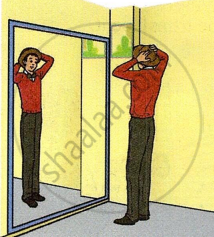
Stand in front of a plane mirror and look at your image in it.
- Raise your right hand. Which hand of the mirror image is raised?
- What change do you see in the image if you decrease or increase your distance from the mirror?
- Is there any difference between your height and the height of the mirror image?
Use your brain power!
How will you light up a dark room using reflected light?
Try to start the TV by operating the remote control from behind it.
Why is the image on the diaphragm of the pinhole camera inverted?
Can you tell?
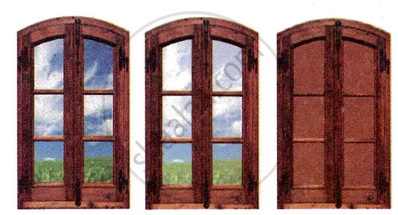
What difference do you notice on looking through the windows in the picture? What causes the difference?
The picture shows transparent, opaque, and translucent window panes. Spot them. Depending on the nature of the window pane, we may or may not see the objects on the other side through it.
Balbharati solutions for General Science Integrated [English] Standard 6 Maharashtra State Board 14 Light and the Formation of Shadows Exercise [Page 77]
Choose an appropriate word and fill in the blanks.
A ______ is a natural source of light.
seven
star
through
transparent
opaque
colors
shape
erect
inverted
luminous
candle
A ______ is an artificial source of light.
seven
star
through
transparent
opaque
colors
shape
erect
inverted
luminous
candle
When light passes through a prism, it gets separated into ______ colours.
seven
star
through
transparent
opaque
colors
shape
erect
inverted
luminous
candle
The image obtained in the pinhole camera is ______.
seven
star
through
transparent
opaque
colors
shape
erect
inverted
luminous
candle
A shadow is formed when an ______ object comes in the way of light.
seven
star
through
transparent
opaque
colors
shape
erect
inverted
luminous
candle
When a ______ object comes in the way of light, light passes ______ it.
seven
star
through
transparent
opaque
colors
shape
erect
inverted
luminous
candle
Write whether of the following objects are luminous or non-luminous.
| Object | Luminous/Non-luminous |
| A book | |
| A burning candle | |
| A wax cloth | |
| A pencil | |
| A pen | |
| A light bulb | |
| A tyre | |
| A torch |
Match the following.
| Group A | Group B |
| (a) Mirror | (1) Non-luminous |
| (b) Firefly | (2) Inverted image |
| (c) Pinhole camera | (3) Reflection |
| (d) Moon | (4) Luminous |
Write the answers to the following.
What things are necessary for the formation of a shadow?
When can an object be seen?
What is a shadow?
Solutions for 14: Light and the Formation of Shadows
Balbharati solutions for General Science Integrated [English] Standard 6 Maharashtra State Board chapter 14 - Light and the Formation of Shadows
Shaalaa.com has the Maharashtra State Board Mathematics General Science Integrated [English] Standard 6 Maharashtra State Board Maharashtra State Board solutions in a manner that help students grasp basic concepts better and faster. The detailed, step-by-step solutions will help you understand the concepts better and clarify any confusion. Balbharati solutions for Mathematics General Science Integrated [English] Standard 6 Maharashtra State Board Maharashtra State Board 14 (Light and the Formation of Shadows) include all questions with answers and detailed explanations. This will clear students' doubts about questions and improve their application skills while preparing for board exams.
Further, we at Shaalaa.com provide such solutions so students can prepare for written exams. Balbharati textbook solutions can be a core help for self-study and provide excellent self-help guidance for students.
Concepts covered in General Science Integrated [English] Standard 6 Maharashtra State Board chapter 14 Light and the Formation of Shadows are Climatic Factors > Light, The propagation of light, Luminous and Non-luminous Bodies, Sources of Light, Reflection of Light, Plane Mirror, A Pinhole Camera, Important Terms Related to Light, Formation of Shadow, Dispersion of Light.
Using Balbharati General Science Integrated [English] Standard 6 Maharashtra State Board solutions Light and the Formation of Shadows exercise by students is an easy way to prepare for the exams, as they involve solutions arranged chapter-wise and also page-wise. The questions involved in Balbharati Solutions are essential questions that can be asked in the final exam. Maximum Maharashtra State Board General Science Integrated [English] Standard 6 Maharashtra State Board students prefer Balbharati Textbook Solutions to score more in exams.
Get the free view of Chapter 14, Light and the Formation of Shadows General Science Integrated [English] Standard 6 Maharashtra State Board additional questions for Mathematics General Science Integrated [English] Standard 6 Maharashtra State Board Maharashtra State Board, and you can use Shaalaa.com to keep it handy for your exam preparation.
