Please select a subject first
Advertisements
Advertisements
Derive the expression for resultant capacitance, when the capacitor is connected in series.
Concept: undefined >> undefined
Derive the expression for resultant capacitance, when the capacitor is connected in parallel.
Concept: undefined >> undefined
Advertisements
Calculate the resultant capacitances for each of the following combinations of capacitors.
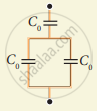
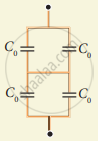
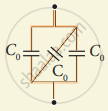
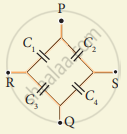
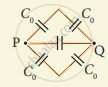
Concept: undefined >> undefined
During a thunder storm, the movement of water molecules within the clouds creates friction, partially causing the bottom part of the clouds to become negatively charged. This implies that the bottom of the cloud and the ground act as a parallel plate capacitor. If the electric field between the cloud and ground exceeds the dielectric breakdown of the air (3 × 10⁶ Vm–1), lightning will occur.
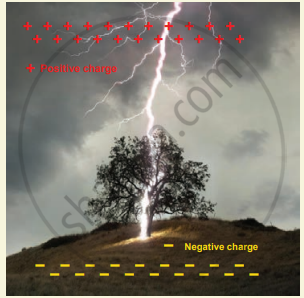
- If the bottom part of the cloud is 1000 m above the ground, determine the electric potential difference that exists between the cloud and ground.
- In a typical lightning phenomenon, around 25 C of electrons are transferred from cloud to ground. How much electrostatic potential energy is transferred to the ground?
Concept: undefined >> undefined
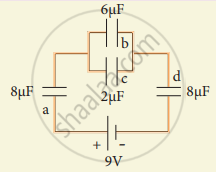
For the given capacitor configuration
- Find the charges on each capacitor
- potential difference across them
- energy stored in each capacitor.
Concept: undefined >> undefined
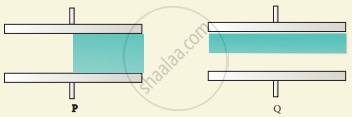
Capacitors P and Q have identical cross-sectional areas A and separation d. The space between the capacitors is filled with a dielectric of dielectric constant Er as shown in the figure. Calculate the capacitance of capacitors P and Q.
Concept: undefined >> undefined
What is magnetic permeability?
Concept: undefined >> undefined
State Ampere’s circuital law.
Concept: undefined >> undefined
Define ampere.
Concept: undefined >> undefined
Find the magnetic field due to a long straight conductor using Ampere’s circuital law.
Concept: undefined >> undefined
Calculate the magnetic field inside and outside of the long solenoid using Ampere’s circuital law
Concept: undefined >> undefined
What are LC oscillations?
Concept: undefined >> undefined
Explain the generation of LC oscillations in a circuit containing an inductor of inductance L and a capacitor of capacitance C.
Concept: undefined >> undefined
Show that the total energy is conserved during LC oscillations.
Concept: undefined >> undefined
Prove that energy is conserved during electromagnetic induction.
Concept: undefined >> undefined
In a series LC circuit, the voltages across L and C are 180° out of phase. Is it correct? Explain.
Concept: undefined >> undefined
Two point white dots are 1 mm apart on a black paper. They are viewed by eye of pupil diameter 3 mm approximately. The maximum distance at which these dots can be resolved by the eye is, [take wavelength of light, λ = 500 nm]
Concept: undefined >> undefined
Prove laws of reflection using Huygens’ principle.
Concept: undefined >> undefined
