Please select a subject first
Advertisements
Advertisements
A table regarding the ownership of various sectors in both the countries is given. Like Brazil, fill the details regarding India and complete the table.
| Sr. No. | India | Sector | Brazil |
| 1. | -- | Banking | Private and public both |
| 2. | -- | Railways | Private and public both |
| 3. | -- | Airways | Private and public both |
| 4. | -- | Electricity production | Largely public |
| 5. | -- | Iron and Steel Industry | Largely public |
| 6. | -- | Health | Private and public both |
| 7. | -- | Education | Largely public, little private |
| 8. | -- | Telecommunications | Private and public both |
On the basis of the information about the ownership of various sectors in both the countries given in the table, can you infer about the type of these economies?
Concept: undefined >> undefined
In figure given below, the pie-charts show the contribution of each sector in the respective country’s GDP and the percentage of population engaged in various activities. Read both the pie-charts carefully and answer the following questions.
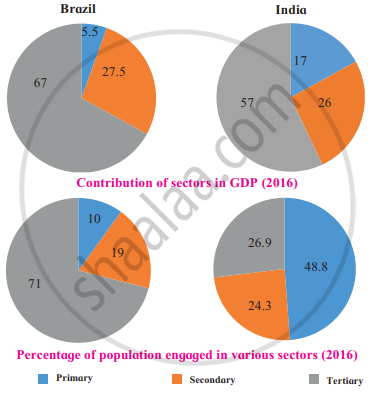
- Which country has a higher percentage of population engaged in primary activities?
- In which country is the contribution of tertiary sector greater in the GDP?
- In which country is the share of secondary activities more in the GDP?
- Can we say that Brazil is an agrarian economy like India? Give reasons.
Concept: undefined >> undefined
Advertisements
Answer the questions on the basis of figure.
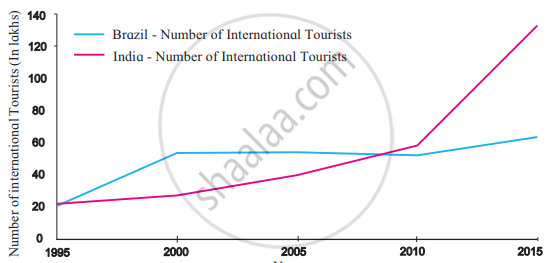
Number of International Tourists
- Which country attracted more international tourists in the year 1995?
- In which country did more international tourists arrive in the year 2000?
- In which year can an increase be seen in the number of international tourists in India?
- What was the number of international tourists in the year 2015 in both the countries? What was the difference between them?
- What could be the reason of increase in tourists in India after the year 2010?
Concept: undefined >> undefined
Observe figures and answer the questions.
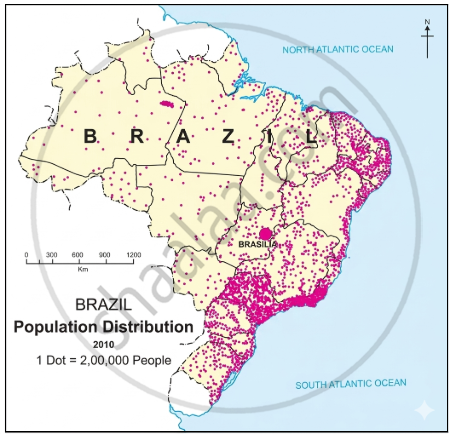
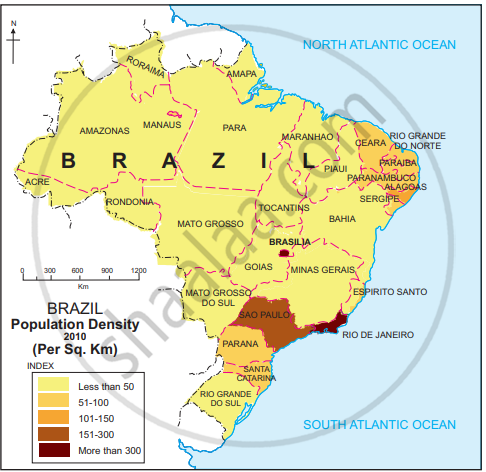
- In which area is population greatly concentrated?
- In which area is the distribution of population sparse?
- Prepare a note on factors responsible for the uneven distribution of population based on study of Brazil you have made so far.
- Identify the type of map showing distribution.
Concept: undefined >> undefined
Brazil is the ______ populated country in the south American continent.
Concept: undefined >> undefined
Identify the odd man out
With reference to flora of India-
Concept: undefined >> undefined
Identify the odd man out.
With reference to the flora of India-
Concept: undefined >> undefined
Read the following graph and answer the questions:
India and Brazil Contribution of sectors in national income and percentage of population engaged in the sector.

- Name the sectors mentioned in the graph.
- Which sector contributes the highest in National income in India?
- How much percent of population is engaged in primary sector in Brasil?
Concept: undefined >> undefined
Read the following graph and answer the questions:
India and Brazil
Contribution of sectors in national income and percentage of population engaged in the sector.
Questions:
- Name the sectors mentioned in the graph.
- Which sector contributes the highest in National income in India?
- How much percent of population is engaged in primary sector in Brazil?
- Out of given two countries, the share of primary sector to the national income is less.
- Which country's contribution of tertiary sector to the national income is less?
- In which sector 19% population of Brazil is engaged?
Concept: undefined >> undefined
Identify the odd man out.
With reference to the flora of India-
Concept: undefined >> undefined
Match the columns :
| Column A | Column B | ||
| (a) | Evergreen Forests | (i) | Sundar trees |
| (b) | Deciduous Forests | (ii) | Pine |
| (c) | Coastal Forests | (iii) | Pau Brasil |
| (d) | Himalayan Forests | (iv) | Khejadi |
| (e) | Thorny and bush-type vegetation | (v) | Teak |
| (vi) | Orchid | ||
| (vii) | Sal |
Concept: undefined >> undefined
Match the columns:
| (a) | Evergreen Forests | (i) | Sundar trees |
| (b) | Deciduous Forests | (ii) | Pine |
| (c) | Coastal Forests | (iii) | Pau Brasil |
| (d) | Himalayan Forests | (iv) | Khejadi |
| (e) | Thorny and bush-type vegetation | (v) | Teak |
| (vi) | Orchid | ||
| (vii) | Sal |
Concept: undefined >> undefined
Identify the odd man out
With reference to flora of India-
Concept: undefined >> undefined
Match the columns:
| (a) | Evergreen Forests | (i) | Sundar trees |
| (b) | Deciduous Frests | (ii) | Pine |
| (c) | Coastal Forests | (iii) | Pau Brasil |
| (d) | Himalayan forests | (iv) | Khejadi |
| (e) | Thorny and bush-type vegetation | (v) | Teak |
| (vi) | Orchid | ||
| (vii) | Sal |
Concept: undefined >> undefined
Give the geographical reasons for the following:
Most of the Himalayan rivers are perennial in nature.
Concept: undefined >> undefined
The Western Himalayas
Concept: undefined >> undefined
Give geographical reasons for the following statement.
Himalayas determine climatic conditions of India.
Concept: undefined >> undefined
Devbhoomi (Uttarakhand)
Concept: undefined >> undefined
An economic problem mainly arises due to _____________ of resources.
(plenty, scarcity, availability)
Concept: undefined >> undefined
State whether the following statement is true or false and correct the
false statement:
Brazil was under Portuguese rule for one and half century.
Concept: undefined >> undefined
