Please select a subject first
Advertisements
Advertisements
A car accelerates to a velocity of 30 m/s in 10 s and then decelerates for 20 s so that it stops. Draw a velocity-time graph to represent the motion and find:
Distance travelled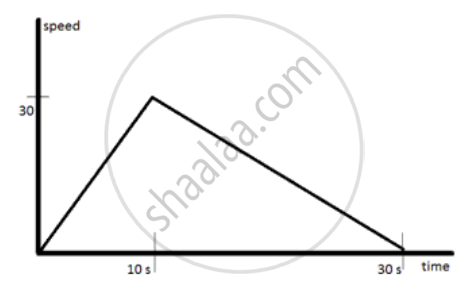
Concept: undefined >> undefined
Figure represents graphically the velocity of a car moving along a straight road over a period of 100 hours.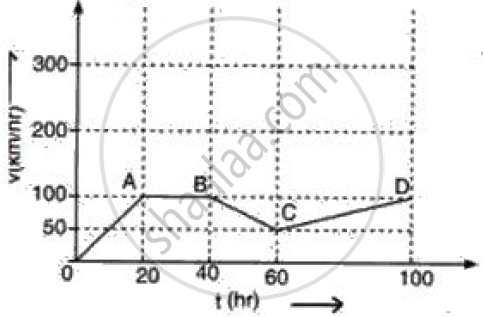
Calculate the acceleration along AB and the retardation along BC.
Concept: undefined >> undefined
Advertisements
Concept: undefined >> undefined
Concept: undefined >> undefined
A piece of wax floats in brine. What fraction of its volume will be immersed?
R.D. of wax = 0.95, R.D. of brine = 1.1.
Concept: undefined >> undefined
Concept: undefined >> undefined
Concept: undefined >> undefined
Concept: undefined >> undefined
Calculate the mass of a body whose volume is 2m3 and relative density is 0.52.
Concept: undefined >> undefined
A piece of metal weighs 44.5 gf in air, 39.5 gf in water. What is the R.D. of the metal?
Concept: undefined >> undefined
A body of volume 100 cm3 weighs 1 kgf in air. Calculate its weight in water. What is its relative density?
Concept: undefined >> undefined
An aeroplane is moving uniformly at a constant height under the action of two forces (i) Upward force (lift) and (ii) Downward force (weight). What is the net force on the aeroplane?
Concept: undefined >> undefined
A tennis ball and a cricket ball , both are stationary. To start motion in them .
Concept: undefined >> undefined
Define linear momentum and state its S.I. unit.
Concept: undefined >> undefined
A body of mass m moving with a velocity v is acted upon by a force. Write an expression for change in momentum in each of the following cases: (i) When v << c, (ii) When v → c and (iii) When v << c but m does not remain constant. Here, c is the speed of light.
Concept: undefined >> undefined
Show that the rate of change of momentum = mass × acceleration. Under what condition does this relation hold?
Concept: undefined >> undefined
Two bodies A and B of same mass are moving with velocities v and 2v, respectively. Compare their (i) inertia and (ii) momentum.
Concept: undefined >> undefined
Two balls A and B of masses m and 2 m are in motion with velocities 2v and v, respectively. Compare:
(i) Their inertia.
(ii) Their momentum.
(iii) The force needed to stop them in the same time.
Concept: undefined >> undefined
State the Newton's second law of motion. What information do you get from it?
Concept: undefined >> undefined
Write the mathematical form of Newton's second law of motion. State the conditions if any.
Concept: undefined >> undefined
