Please select a subject first
Advertisements
Advertisements
Make z the subject of the formula y = `(2z + 1)/(2z - 1)`. If x = `(y + 1)/(y - 1)`, express z in terms of x, and find its value when x = 34.
Concept: undefined >> undefined
Make c the subject of the formula a = b(1 + ct). Find c, when a = 1100, b = 100 and t = 4.
Concept: undefined >> undefined
Advertisements
"The volume of a cylinder V is equal to the product of π and square of radius r and the height h". Express this statement as a formula. Make r the subject formula. Find r, when V = 44cm3, π = `(22)/(7)`, h = 14cm.
Concept: undefined >> undefined
"The volume of a cone V is equal to the product of one third of π and square of radius r of the base and the height h". Express this statement as a formula. Make r the subject formula. Find r, when V = 1232cm3, π = `(22)/(7)`, h = 24cm.
Concept: undefined >> undefined
The pressure P and volume V of a gas are connected by the formula PV = C; where C is a constant. If P = 4 when V = `2(1)/(2)`; find the value of P when V = 4?
Concept: undefined >> undefined
The total energy E possess by a body of Mass 'm', moving with a velocity 'v' at a height 'h' is given by: E = `(1)/(2) "m" "u"^2 + "mgh"`. Make 'm' the subject of formula.
Concept: undefined >> undefined
The total energy E possess by a body of Mass 'm', moving with a velocity 'v' at a height 'h' is given by: E = `(1)/(2) "m" "u"^2 + "mgh"`. Find m, if v = 2, g = 10, h = 5 and E = 104.
Concept: undefined >> undefined
If s = `"n"/(2)[2"a" + ("n" - 1)"d"]`, the n express d in terms of s, a and n. find d if n = 3, a = n + 1 and s = 18.
Concept: undefined >> undefined
"Area A oof a circular ring formed by 2 concentric circles is equal to the product of pie and the difference of the square of the bigger radius R and the square of the bigger radius R and the square of the smaller radius r. Express the above statement as a formula. Make r the subject of the formula and find r, when A = 88 sq cm and R = 8cm.
Concept: undefined >> undefined
Find the length of the hypotenuse of a triangle whose other two sides are 24cm and 7cm.
Concept: undefined >> undefined
Calculate the area of a right-angled triangle whose hypotenuse is 65cm and one side is 16cm.
Concept: undefined >> undefined
A man goes 10 m due east and then 24 m due north. Find the distance from the straight point.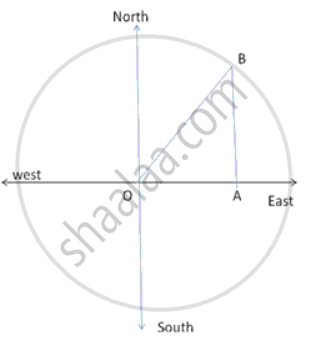
Concept: undefined >> undefined
A ladder 25m long reaches a window of a building 20m above the ground. Determine the distance of the foot of the ladder from the building.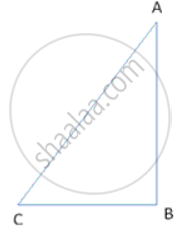
Concept: undefined >> undefined
A right triangle has hypotenuse p cm and one side q cm. If p - q = 1, find the length of third side of the triangle.
Concept: undefined >> undefined
A ladder 15m long reaches a window which is 9m above the ground on one side of a street. Keeping its foot at the same point, the ladder is turned to other side of the street to reach a window 12m high. Find the width of the street.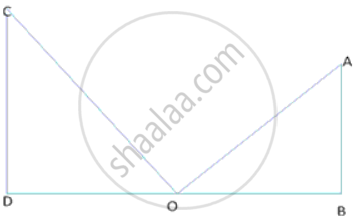
Concept: undefined >> undefined
The foot of a ladder is 6m away from a wall and its top reaches a window 8m above the ground. If the ladder is shifted in such a way that its foot is 8m away from the wall to what height does its tip reach?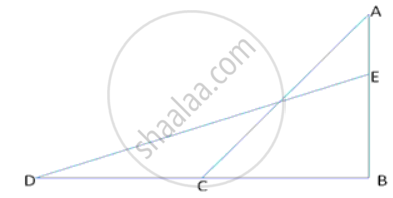
Concept: undefined >> undefined
Two poles of height 9m and 14m stand on a plane ground. If the distance between their 12m, find the distance between their tops.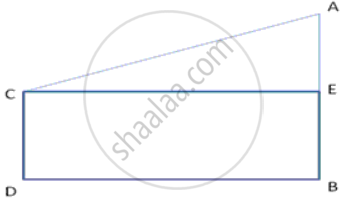
Concept: undefined >> undefined
The length of the diagonals of rhombus are 24cm and 10cm. Find each side of the rhombus.
Concept: undefined >> undefined
Each side of rhombus is 10cm. If one of its diagonals is 16cm, find the length of the other diagonals.
Concept: undefined >> undefined
In ΔABC, AD is perpendicular to BC. Prove that: AB2 + CD2 = AC2 + BD2
Concept: undefined >> undefined
