Please select a subject first
Advertisements
Advertisements
Show that :
`( a^m/a^-n)^( m - n ) xx (a^n/a^-l)^( n - l) xx (a^l/a^-m)^( l - m ) = 1`
Concept: undefined >> undefined
Simplify:
`( x^a/x^b)^( a^2 + ab + b^2 ) xx (x^b/x^c)^(b^2 + bc + c^2) xx (x^c/x^a)^( c^2 + ca + a^2 )`
Concept: undefined >> undefined
Advertisements
Simplify:
`( x^a/x^-b )^( a^2 - ab + b^2 ) xx ( x^b/x^-c )^( b^2 - bc + c^2 ) xx ( x^c/x^-a )^( c^2 - ca + a^2 )`
Concept: undefined >> undefined
If a = xm + n. yl ; b = xn + l. ym and c = xl + m. yn,
Prove that : am - n. bn - l. cl - m = 1
Concept: undefined >> undefined
From the following figure, prove that: AB > CD.

Concept: undefined >> undefined
In a triangle PQR; QR = PR and ∠P = 36o. Which is the largest side of the triangle?
Concept: undefined >> undefined
If two sides of a triangle are 8 cm and 13 cm, then the length of the third side is between a cm and b cm. Find the values of a and b such that a is less than b.
Concept: undefined >> undefined
In the following figure, write BC, AC, and CD in ascending order of their lengths.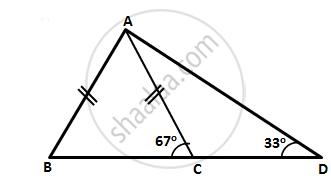
Concept: undefined >> undefined
Arrange the sides of ∆BOC in descending order of their lengths. BO and CO are bisectors of angles ABC and ACB respectively.
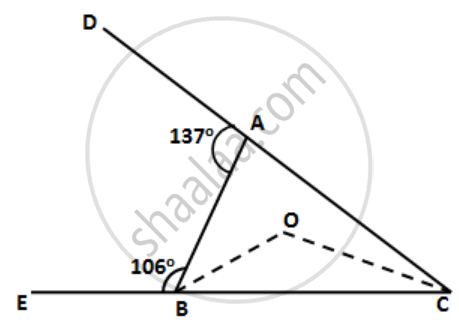
Concept: undefined >> undefined
D is a point in side BC of triangle ABC. If AD > AC, show that AB > AC.
Concept: undefined >> undefined
In the following figure, ∠BAC = 60o and ∠ABC = 65o.
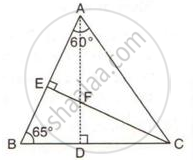
Prove that:
(i) CF > AF
(ii) DC > DF
Concept: undefined >> undefined
In the following figure ; AC = CD; ∠BAD = 110o and ∠ACB = 74o.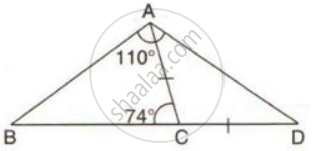
Prove that: BC > CD.
Concept: undefined >> undefined
In triangle ABC, M is mid-point of AB and a straight line through M and parallel to BC cuts AC in N. Find the lengths of AN and MN if Bc = 7 cm and Ac = 5 cm.
Concept: undefined >> undefined
Prove that the figure obtained by joining the mid-points of the adjacent sides of a rectangle is a rhombus.
Concept: undefined >> undefined
In the given figure, M is mid-point of AB and DE, whereas N is mid-point of BC and DF.
Show that: EF = AC.
Concept: undefined >> undefined
D, E, and F are the mid-points of the sides AB, BC and CA of an isosceles ΔABC in which AB = BC.
Prove that ΔDEF is also isosceles.
Concept: undefined >> undefined
The following figure shows a trapezium ABCD in which AB // DC. P is the mid-point of AD and PR // AB. Prove that:
PR = `[1]/[2]` ( AB + CD)

Concept: undefined >> undefined
The figure, given below, shows a trapezium ABCD. M and N are the mid-point of the non-parallel sides AD and BC respectively. Find:
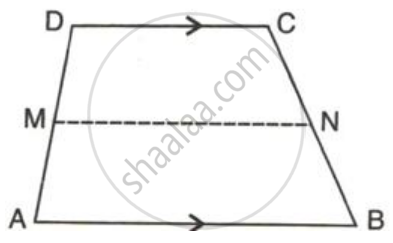
- MN, if AB = 11 cm and DC = 8 cm.
- AB, if DC = 20 cm and MN = 27 cm.
- DC, if MN = 15 cm and AB = 23 cm.
Concept: undefined >> undefined
In ∆ABC, E is the mid-point of the median AD, and BE produced meets side AC at point Q.
Show that BE: EQ = 3: 1.
Concept: undefined >> undefined
The diagonals of a quadrilateral intersect at right angles. Prove that the figure obtained by joining the mid-points of the adjacent sides of the quadrilateral is rectangle.
Concept: undefined >> undefined
