Advertisements
Advertisements
Name the greatest and the smallest sides in the following triangles:
ΔABC, ∠ = 56°, ∠B = 64° and ∠C = 60°.
Concept: undefined >> undefined
Name the greatest and the smallest sides in the following triangles:
ΔDEF, ∠D = 32°, ∠E = 56° and ∠F = 92°.
Concept: undefined >> undefined
Advertisements
Name the greatest and the smallest sides in the following triangles:
ΔXYZ, ∠X = 76°, ∠Y = 84°.
Concept: undefined >> undefined
Arrange the sides of the following triangles in an ascending order:
ΔABC, ∠A = 45°, ∠B = 65°.
Concept: undefined >> undefined
Arrange the sides of the following triangles in an ascending order:
ΔDEF, ∠D = 38°, ∠E = 58°.
Concept: undefined >> undefined
Name the smallest angle in each of these triangles:
In ΔABC, AB = 6.2cm, BC = 5.6cm and AC = 4.2cm
Concept: undefined >> undefined
Name the smallest angle in each of these triangles:
In ΔPQR, PQ = 8.3cm, QR = 5.4cm and PR = 7.2cm
Concept: undefined >> undefined
Name the smallest angle in each of these triangles:
In ΔXYZ, XY = 6.2cm, XY = 6.8cm and YZ = 5cm
Concept: undefined >> undefined
In a triangle ABC, BC = AC and ∠ A = 35°. Which is the smallest side of the triangle?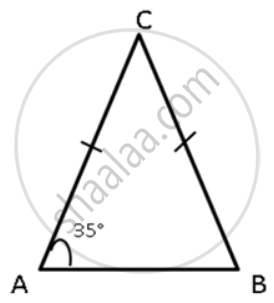
Concept: undefined >> undefined
In ΔABC, the exterior ∠PBC > exterior ∠QCB. Prove that AB > AC.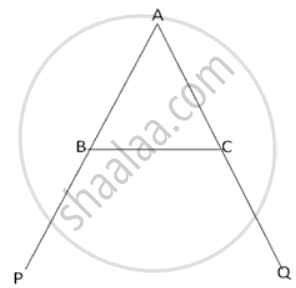
Concept: undefined >> undefined
ΔABC is isosceles with AB = AC. If BC is extended to D, then prove that AD > AB.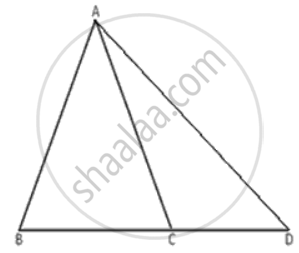
Concept: undefined >> undefined
Prove that the perimeter of a triangle is greater than the sum of its three medians.
Concept: undefined >> undefined
Prove that the hypotenuse is the longest side in a right-angled triangle.
Concept: undefined >> undefined
D is a point on the side of the BC of ΔABC. Prove that the perimeter of ΔABC is greater than twice of AD.
Concept: undefined >> undefined
For any quadrilateral, prove that its perimeter is greater than the sum of its diagonals.
Concept: undefined >> undefined
ABCD is a quadrilateral in which the diagonals AC and BD intersect at O. Prove that AB + BC + CD + AD < 2(AC + BC).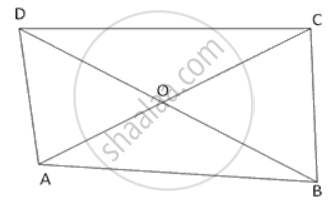
Concept: undefined >> undefined
In ABC, P, Q and R are points on AB, BC and AC respectively. Prove that AB + BC + AC > PQ + QR + PR.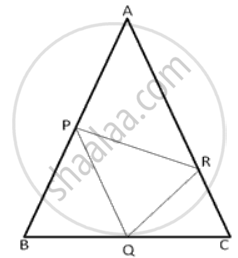
Concept: undefined >> undefined
In ΔPQR, PR > PQ and T is a point on PR such that PT = PQ. Prove that QR > TR.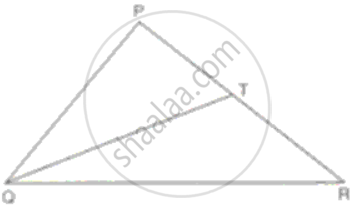
Concept: undefined >> undefined
ABCD is a trapezium. Prove that: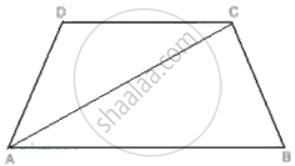
CD + DA + AB + BC > 2AC.
Concept: undefined >> undefined
ABCD is a trapezium. Prove that: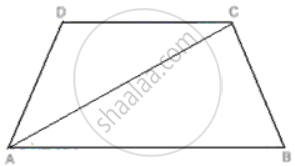
CD + DA + AB > BC.
Concept: undefined >> undefined
