Advertisements
Advertisements
Show with the help of a diagram how a total reflecting prism can be used to turn a ray of light through 90°. Name one instrument in which such a prism is used.
Concept: undefined >> undefined
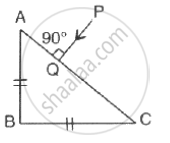
In the following figure, a ray of light PQ is incident normally on the hypotenuse of an isosceles right angle prism ABC.
- Complete the path of the ray PQ till it emerges from the prism. Mark in the diagram the angle wherever necessary.
- What is the angle of deviation of the ray PQ?
- Name a device in which this action is used.
Concept: undefined >> undefined
Advertisements
What device other than a plane mirror can be used to turn a ray of light through 180°? Draw a diagram in support of your answer. Name an instrument in which this device is used.
Concept: undefined >> undefined
Mention one difference between reflection of light from a plane mirror and total internal reflection of light from a prism.
Concept: undefined >> undefined
In the given figure, a ray of light PQ is incident normally on the face AB of an equilateral glass prism. Complete the ray diagram showing its emergence into air after passing through the prism. Take critical angle for glass = 42°.
- Write the angles of incidence at the faces AB and AC of the prism.
- Name the phenomenon which the ray of light suffers at the face AB, AC and BC of the prism.

Concept: undefined >> undefined
Draw a neat labelled ray diagram to show the total internal reflection of a ray of light normally incident on one face of a 30°, 90°, 60° prism.
Concept: undefined >> undefined
A total reflecting equilateral prism can be used to deviate a ray of light through ______.
Concept: undefined >> undefined
State the condition under which the mechanical energy is conserved.
Concept: undefined >> undefined
A body falls freely under gravity from rest. Name the kind of energy it will possess while falling.
Concept: undefined >> undefined
Show that the sum of kinetic energy and potential energy (i.e., total mechanical energy) is always conserved in the case of a freely falling body under gravity (with air resistance neglected) from a height h by finding it when
- The body is at the top.
- the body has fallen a distance x.
- the body has reached the ground.
Concept: undefined >> undefined
A ball of mass 0.20 kg is thrown vertically upwards with an initial velocity of 20 m s-1. Calculate the maximum potential energy it gains as it goes up.
Concept: undefined >> undefined
A pendulum is oscillating on either side of its rest position. The correct statement is:
Concept: undefined >> undefined
A stone of mass 500 g is thrown vertically upwards with a velocity of 15 m/s. Calculate:
- the potential energy at the greatest height,
- the kinetic energy on reaching the ground, and
- the total energy at its half-way point.
Concept: undefined >> undefined
A metal ball of mass 2 kg is allowed to fall freely from rest from a height of 5 m above the ground. Taking g = 10 m s−2, calculate:
- the potential energy possessed by the ball when it is initially at rest.
- the kinetic energy of the ball just before it hits the ground?
Concept: undefined >> undefined
What is the difference between potential energy and kinetic energy?
Concept: undefined >> undefined
Concept: undefined >> undefined
Compare the magnitudes of centripetal and centrifugal force.
Concept: undefined >> undefined
State two differences between the centripetal and centrifugal force.
Concept: undefined >> undefined
A boy experiences a centrifugal force on his hand when he rotates a piece of stone tied at one end of a string, holding the other end in the hand.
Concept: undefined >> undefined
