Advertisements
Advertisements
Question
What device other than a plane mirror can be used to turn a ray of light through 180°? Draw a diagram in support of your answer. Name an instrument in which this device is used.
Advertisements
Solution
A total reflecting prism can be used to turn a ray of light by 180°. The following diagram can make it further clear.
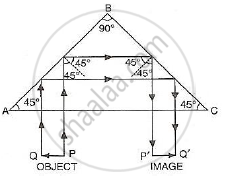
This action of prism is used in binocular.
APPEARS IN
RELATED QUESTIONS
Copy the diagram given below and complete the path of the light ray till it emerges out of the prism. The critical angle of glass is 42°. In your diagram mark the angles wherever necessary.

What is a total reflecting prism?
Show with the help of a diagram how a total reflecting prism can be used to turn a ray of light through 90°. Name one instrument in which such a prism is used.
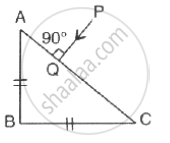
In the following figure, a ray of light PQ is incident normally on the hypotenuse of an isosceles right angle prism ABC.
- Complete the path of the ray PQ till it emerges from the prism. Mark in the diagram the angle wherever necessary.
- What is the angle of deviation of the ray PQ?
- Name a device in which this action is used.
In the given figure, a ray of light PQ is incident normally on the face AB of an equilateral glass prism. Complete the ray diagram showing its emergence into air after passing through the prism. Take critical angle for glass = 42°.
- Write the angles of incidence at the faces AB and AC of the prism.
- Name the phenomenon which the ray of light suffers at the face AB, AC and BC of the prism.

A total reflecting equilateral prism can be used to deviate a ray of light through ______.
A total reflecting right angled isosceles prism can be used to deviate a ray of light through ______.
State three actions that a total reflecting prism can produce.
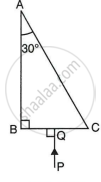
Complete the path of ray PQ through the glass prism ABC shown in Fig. till it emerges out of the prism. Given the critical angle of the glass is 42°.
Draw a diagram to show one such action of the total reflecting prism.
