Advertisements
Advertisements
Questions
Mention one difference between reflection of light from a plane mirror and total internal reflection of light from a prism.
Mention the differences between the total internal reflection of light from a prism and the reflection of light from a plane mirror.
Advertisements
Solution
| Sr. No. | Reflection of light from a plane mirror | Total internal reflection of light from a prism |
| 1. | A part of the incident ray of light is reflected, and the remaining is refracted and absorbed. | The incident ray of light is totally reflected back into the denser medium. |
| 2. | Reflection occurs when the ray of light falls on a plane mirror at any angle of incidence from any medium. | Total internal reflection occurs only when the ray of light travels from a denser to rarer medium at an angle of incidence greater than the critical angle. |
| 3. | The energy of the reflected ray of light is less than that of the incident ray due to loss of energy. | It occurs without any loss of energy. The energy of incident and reflected rays of light remains the same. |
| 4. | The brightness of the image formed is less, which gradually reduces as the silvering of the mirror wears out. | A brighter image is formed. |
Notes
Students should refer to the answer according to the question.
APPEARS IN
RELATED QUESTIONS
Copy the diagram given below and complete the path of the light ray till it emerges out of the prism. The critical angle of glass is 42°. In your diagram mark the angles wherever necessary.

A ray of light XY passes through a right-angled isosceles prism as shown below
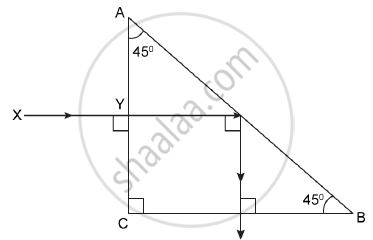
- What is the angle through which the incident ray deviates and emerges out of the prism?
- Name the instrument where this action of the prism is put into use.
- Which prism surface will behave as a mirror?
What is a total reflecting prism?
Show with the help of a diagram how a total reflecting prism can be used to turn a ray of light through 90°. Name one instrument in which such a prism is used.
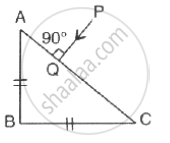
In the following figure, a ray of light PQ is incident normally on the hypotenuse of an isosceles right angle prism ABC.
- Complete the path of the ray PQ till it emerges from the prism. Mark in the diagram the angle wherever necessary.
- What is the angle of deviation of the ray PQ?
- Name a device in which this action is used.
What device other than a plane mirror can be used to turn a ray of light through 180°? Draw a diagram in support of your answer. Name an instrument in which this device is used.
A total reflecting equilateral prism can be used to deviate a ray of light through ______.
State three actions that a total reflecting prism can produce.
Complete the path of ray PQ through the glass prism ABC shown in Fig. till it emerges out of the prism. Given the critical angle of the glass is 42°.
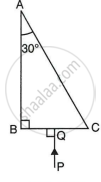
Draw a diagram to show one such action of the total reflecting prism.
