Advertisements
Advertisements
Can a transformer work when it is connected to a D.C. source? Give a reason.
Concept: undefined >> undefined
Draw a simple labeled diagram of a step-down transformer.
Concept: undefined >> undefined
Advertisements
Draw a simple labeled diagram of a step-up transformer.
Concept: undefined >> undefined
The diagram 10 shows two coils X and Y. The coil X is connected to a battery S and a key K. The coil Y is connected to a galvanometer G.
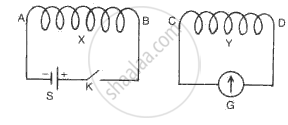
When the key K is closed. State the polarity
(i)At the end of the coil X,
(ii)At the end C of the coil Y,
(iii)At the end C of the coil Y if the coil Y is (a) Moved towards the coil X, (b) Moved away from the coil X.
Concept: undefined >> undefined
The following diagram shows a fixed coil of several turns connected to a center zero galvanometer G and a magnet NS which can move in the direction shown in the diagram.
- Describe the observation in the galvanometer if
- The magnet is moved rapidly,
- The magnet is kept still after it has moved into the coil
- The magnet is then rapidly pulled out the coil.
- How would the observation in (i) of part (a) change if a more powerful magnet is used?

Concept: undefined >> undefined
Draw and label the diagram of a simple D.C. motor.
(a) Explain the rotation of the coil, giving a reason for your answer.
(b) How can you reverse the direction of rotation of the armature?
(c) How can you increase the speed of rotation of the motor?
Concept: undefined >> undefined
Fig. shows a simple form of an A.C. generator.
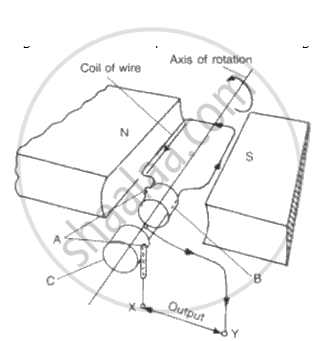
(a) Name the parts labeled A and B.
(b) What would be the effect of doubling the number of turns on the coil if the speed of rotation remains unchanged?
(c) Which of the output terminals is positive if the coil is rotating in the
direction shown in the diagram (anticlockwise)?
( d ) What is the position of the rotating coil when p.d. across its ends is zero? Explain why p.d. is zero when the coil is at this position .
(e) Sketch a graph showing how the p.d. across the ends of the rotating coil varies with time for an A.C. dynamo.
( f) On th e same sheet of paper and vertically below the first graph using the same time scale, sketch graphs to show the effect of
(i) Doubling the speed of rotation and at the same time keeping
the field and the number of turns constant,
(ii ) Doubling the number of turns on the coil and at the same time
doubling the speed of rotation of the coil, keeping th e speed
constant.
Concept: undefined >> undefined
Fill in the blanks by writing (i) Only soft iron, (ii) Only steel, (iii) Both soft-iron and steel for the material of core and/or magnet.
D.C. motor ______.
Concept: undefined >> undefined
Fill in the blanks by writing (i) Only soft iron, (ii) Only steel, (iii) Both soft-iron and steel for the material of core and/or magnet.
A. C. generator______.
Concept: undefined >> undefined
Fill in the blanks by writing (i) Only soft iron, (ii) Only steel, (iii) Both soft-iron and steel for the material of core and/or magnet.
Transformer______.
Concept: undefined >> undefined
A transformer has 400 turns in the primary winding and 10 turns in the secondary winding. The primary e.m.f. is 250 V and the primary current is 2.0 A. calculate:
(a) The secondary voltage,
(b) The secondary current, assuming 100% efficiency.
Concept: undefined >> undefined
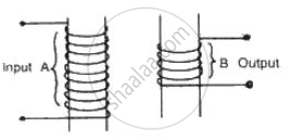
Complete the following diagram of a transformer and name the parts labeled A and B. Name the part you have drawn to complete the diagram . What is the material of this part? In this transformer a step-up or step-down? Why?
Concept: undefined >> undefined
A cell of e.m.f. 2 V and internal resistance 1.2 Ω is connected to an ammeter of resistance 0.8 Ω and two resistors of 4.5 Ω and 9 Ω as shown in following figure.
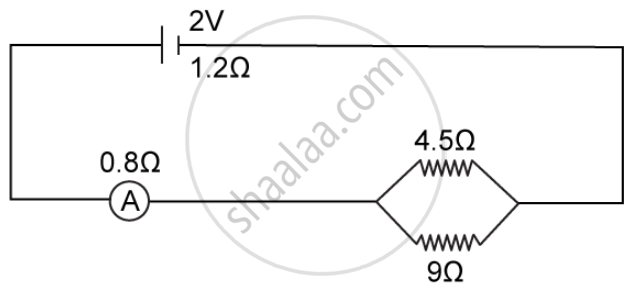
Find:
- The reading of the ammeter,
- The potential difference across the terminals of the cells, and
- The potential difference across the 4.5 Ω resistor.
Concept: undefined >> undefined
A certain radioactive nucleus emits a particle that leaves its mass unchanged, but increased its atomic number by one. Identify the particle and write its symbol.
Concept: undefined >> undefined
What changes occurs in the nucleus of radioactive elements when it emits (a) an alpha particle (b) beta particle and (c) gamma radiations? Give one example in each case in support of your answer.
Concept: undefined >> undefined
A nucleus is \[\ce {^24_11 Na}\] is β-radioactive.
What are the numbers 24 and 11 called?
Concept: undefined >> undefined
A nucleus of stable phosphorus has 15 protons and 16 neutrons.
- What is its atomic number and mass number?
- The nucleus of radio phosphorous has one neutron more than the stable nucleus. What will be its atomic number and mass number?
- What will be the atomic number and mass number of new nucleus formed by decay of a β-particle by the radio phosphorus in part (b)?
Concept: undefined >> undefined
A nucleus \[\ce {^A_Z X}\] emits 2 α particles and 1 β particles to form a nucleus \[\ce {^222_85 R}\]. Find the atomic nucleus and mass number of X.
Concept: undefined >> undefined
Complete the following nuclear change:
\[\ce {^a_x P -> Q + ^0_-1β}\]
Concept: undefined >> undefined
Complete the following nuclear change:
\[\ce{^238_92U -> ^234_90Th}\] + ______ + energy
Concept: undefined >> undefined
